Fourteen Frames, One Set, Three Faces
Seven reference files, three faces and one walnut set gave us 14 frames from 14 separate chats. Reference count told us nothing about speed, and the 2K files were not 2K.
Key takeaways
- The kit was seven files: a face crop and a character sheet per cast member, plus one set master plate. A person's files only went into frames that person appears in.
- References per frame followed who was on screen: 1 for the props still life, 3 for one person, 5 for two, 7 for the full cast.
- Every image was labelled by role in the prompt, with the set master last, and the set and film-look paragraphs were identical text in all 14 prompts.
- 9:16 was stated in the prompt at Medium effort. Frames came back at 941x1672; the 1152x2048 versions are a local Lanczos resize, not native 2K.
- Generation time did not track reference count (7-reference runs took 40 s and 221 s). The one retake, the cast group, changed the words, not the references.
Three faces and one room
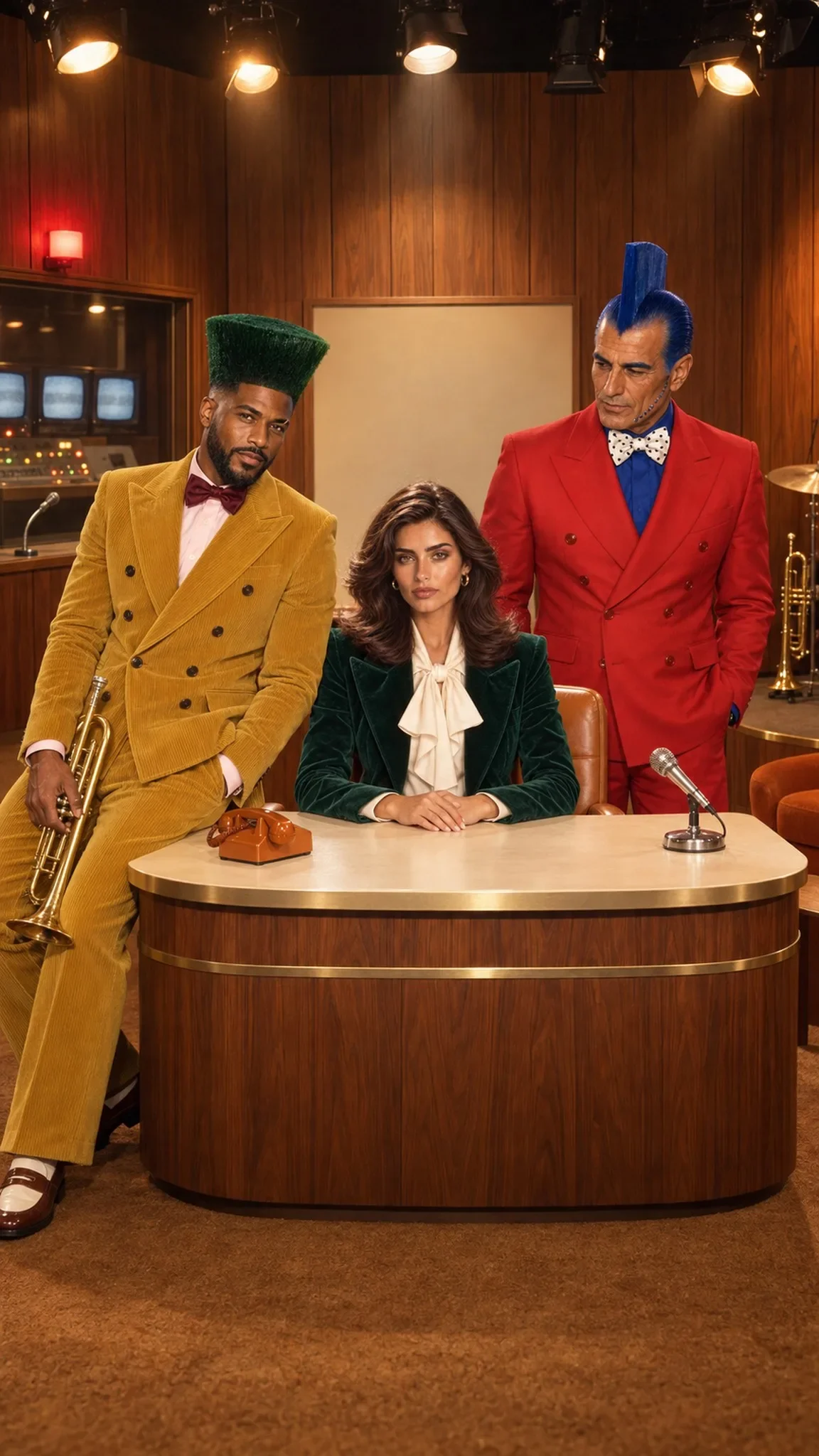
A talk show lives or dies on recurring faces in a recurring room. For the lookbook of our 1970s-set late-night show we needed 14 vertical frames of an ensemble: Livia Serrano, the deadpan host (32); Augustin Ferreira, the director (58, cobalt hair fin, tomato-red suit); and Desmond Reid, the silent bandleader (37, emerald hi-top, mustard corduroy suit, trumpet). All of them on one set, Studio B: walnut panelling, a curved walnut desk with a cream top, an orange rotary phone, a booth behind talkback glass on the left, a rust-orange armchair and the edge of a bandstand on the right.
Image generators are good at one face or one room. Holding three faces and the same room across 14 separate generations is the hard version, and it is the one a producer actually needs. This is the reference recipe we used, with numbers from the run log. It is one run, not a controlled comparison.
The frames were written on 2026-10-26, between 00:11 for the cover and 01:22 for the last one. The lookbook is not published yet.
The kit: seven files, built once
Before any frame was generated we built a reference kit of seven files:
- a face crop for each of the three cast members (900x1200 for Livia, 901x1200 for Augustin and Desmond);
- a character sheet for each (1600x740), carrying body, wardrobe and hair;
- one set master plate of Studio B (2000x1116).
The split matters: the face crop carries identity, the character sheet carries body, suit and hair, and the set master carries the room. Each file has one job, so the prompt can name it.
Every prompt also restates each person's wardrobe and hair, and the set, in words. The images and the words say the same thing twice on purpose.
Each frame got only the references it needed
We did not attach all seven files to every frame. The log shows exactly what went in:
- One person on screen: 3 references. That person's face crop, their character sheet and the set master. This covers Livia's cover, portraits and phone insert, Augustin's booth and full-length frames, and Desmond's two.
- Two people: 5 references. Two faces, two sheets, the set master. Livia with Augustin through the booth glass; Livia with Desmond for the band cue.
- Three people: 7 references. Everything. The wide studio frame and the cast group at the desk.
- No people: 1 reference. The props still life got the set master only.
The rule is simple: a person's files go in when that person is in the frame, and the set master goes in whenever there is a room to match. Nobody's face is attached to a frame they are not in.
| References | Frames | Logged generation time |
|---|---|---|
| 1 (set master only) | tl13 props | 40 s |
| 3 (one person + set) | tl01 cover | 181 s |
| 3 (one person + set) | tl03, tl04, tl05, tl06, tl08, tl09, tl10 | 40 to 80 s |
| 5 (two people + set) | tl11 through the glass, tl12 cue the band | 221 s, 101 s |
| 7 (three people + set) | tl02 studio wide, tl14 cast desk | 181 s; 40 s and 221 s (two runs of tl14) |
Writing the prompt around the references
Attaching images is half the job. The other half is telling the model what each image is, in order. Every prompt labels the files by role: for each person, "Image N is NAME's FACE reference and Image N+1 is NAME's character sheet (body, wardrobe, hair)", followed by an instruction to keep face, marks, proportions, hair and wardrobe identical and to never invent a different person. The set master always comes last and is introduced as the set reference to match.
After the labels, each prompt is assembled from the same parts, in the same order:
- a head line naming the lookbook and the shot;
- the reference labels;
- the wardrobe and hair text for each person present;
- the shared set paragraph;
- the body of that shot, written per frame;
- a shared film-look paragraph: a 1977 network publicity still on 35mm tungsten-balanced colour negative, with banned items spelled out (skyline window, pink neon, pink sofa, butter-yellow suit).
Because the set and look paragraphs are identical text in every frame, only the cast and the shot change. Prompt length followed the cast: 2335 characters for the props still life, between 2796 and 3064 for single-person frames, and 4373 for the final cast group.
Settings: Medium, prompt-driven 9:16, and what 2K really was
Every frame ran in its own fresh chat, one runner launch per frame, in our Studio project on ChatGPT Chat, at the Medium setting. The log shows the power slider being set to Medium (value 1 on a 0 to 2 scale) before any reference was uploaded. A fresh chat per frame means no frame builds on the previous one.
Aspect ratio is in the prompt, not in a control. The runner prints on every launch that the 9:16 chip no longer exists and that the prompt must state the ratio. Ours says "VERTICAL 9:16 portrait orientation, tall and narrow, in 2K high-quality resolution."
The ratio came through. The resolution did not. Every generated frame measured 941x1672 (one was 940x1672), a clean 9:16 vertical but not 2K. The "_2k" files in the folder are 1152x2048 and are made locally with a Lanczos resize after the fact. They are a convenient delivery size, not extra detail, and we would not describe them as native 2K.
Pacing followed our throttle rule: 60 seconds between frames, and a 5-minute drain after every fourth frame. The skill's rule is a 40 to 60 second gap and batches of about four or five frames.
Time, failures and the one retake
Computed from the 14 completion ticks in the log, the mean generation time was 100 seconds and the median 60 seconds. The seven plain single-person frames averaged 60 seconds.
More references did not mean a reliably slower frame. The two 7-reference runs of the cast group took 40 and 221 seconds. The 5-reference through-the-glass frame also took 221. Reference count told us nothing about speed.
Three first attempts never got as far as an image. Two (Livia's portrait and the through-the-glass frame) timed out at 15000 ms waiting for the composer; one (Augustin in the booth) hit a closed-page error after the message was accepted. Each was simply re-run and finished.
The retake is the cast group, tl14_cast_desk. The log shows two runs, with prompt lengths 4146 and 4373 characters, and both images sit in the folder: tl14_cast_desk_v1.png from 01:10 and tl14_cast_desk.png from 01:22. The final prompt is tagged "CAST GROUP v2" and states that there are exactly three people, hides Livia's legs behind a solid desk front, and says that if any two faces look alike or any of her legs is visible, the image is wrong. We have no file that records why v1 was retaken, so we do not claim a cause. The contact sheet, made before the retake, shows v1 with Livia's cream boots visible below the desk front, which is the thing the v2 wording forbids. What the record shows is that the retake changed the words, not the seven references.
What it bought, and what we cannot say
What we can say is what the contact sheet shows: frames from separate chats, one shared kit, one shared set paragraph and one film-look paragraph. The walnut desk, the cream panel on the back wall, the booth window with its monitors and red lamp, the orange phone and the orange armchair recur from the cover to the props still life, and the green-suited host, the red-suited director and the mustard-suited bandleader read as the same three people in singles, pairs and the group frame. That is a visual read, not a measurement.
What we cannot say is how much of that is the kit. We did not run the same frames with fewer references, with no set master, or without the role labels, so we have no measured gain to quote. This is a record of a recipe that worked on one run, not an A/B test.
If you are building a similar ensemble set, the transferable parts are small:
- Build one kit per person and one per room, once.
- Attach by presence. A person's files only go in frames they appear in.
- Label every image by role, in order, and put the set last.
- Keep the set and look paragraphs word-for-word identical across the whole set.
- Treat 9:16 as a prompt sentence, and treat 2K as an upscale you do yourself.
- Budget for retakes on the group shot, and change the words before you change the references.
Related
Inside the Paper Wife Lookbook: Grade, Halation, Catchlights
Magnific Classic 2k hardened the eye catchlights on our upscales, so we wrote a fix. Here is the whole pipeline behind OMNI Lookbook Vol. 03, from 14 chat-generated frames to a 4:4:4 web edition.
Two Characters, One Clip: Keeping AI Dialogue on the Right Mouth
In our 7-second two-face probe, both lines landed word-perfect with zero crosstalk. The time slice schema, word budgets, and blocking rules that isolate speakers.
How to Prompt Seedance 2.5 for Dialogue Scenes
Two synthetic characters, two voices, two lines — and the right mouth moved for each on the first try. The structure that made it work, and the failures that taught us each rule.