Two Characters, One Clip: Keeping AI Dialogue on the Right Mouth
In our 7-second two-face probe, both lines landed word-perfect with zero crosstalk. The time slice schema, word budgets, and blocking rules that isolate speakers.
OMNI LabsUpdated
Key takeaways
Multi-speaker Seedance 2.5 prompts require isolated temporal slices with explicit @Audio 1 timbre conditioning per line.
Dialogue budgets for a 45-second episode cap speech at 21 words for the opener, 14 words per 10-second clip, and 50 words overall.
A 7-second two-face 480p probe passed at $1.44 with perfect line isolation (0.56 to 3.64 s and 4.96 to 5.60 s).
Audio reference clips should range between 5 to 10 seconds of clean speech, staying under the 30 seconds combined request limit.
The non-speaking character must be blocked facing away, out of focus, or with mouth closed to prevent duplicate lip movement.
The official time-slice prompt schema
The Seedance 2.5 dialogue form we use is the official one: each line gets its own time slice, the speaker's name in capitals, the reference in brackets, the spoken words in plain double quotes, 'The timbre references @Audio 1.' and 'Lip movements must match the timing of the speech.' Every line gets its own slice.
When multiple characters share a single video generation, generative diffusion models naturally struggle with voice attribution. If dialogue is written in casual script prose, the network frequently animates both faces simultaneously or maps the vocal performance onto the wrong actor. Binding each utterance to a strict timestamped segment establishes an unequivocal temporal schedule for the audio synthesis and lip generation modules.
Prompts must enforce explicit speaker identity within each slice. By tagging each line directly with its corresponding audio asset, the model is instructed to activate mouth motion only for the designated talent during that precise window, keeping the listening character's lips firmly shut.
In standard screenwriting practice, dialogue blocks overlap with scene action. In synthetic multi-speaker prompting, that looseness leads directly to vocal desynchronization. Explicitly declaring time windows ensures that the generative audio module and the visual deformation network operate with synchronized mathematical precision.
Word limits and dramatic pauses
Our word budgets for a 45-second episode, set on 22 October 2026: the 15-second opener has at most 3 lines and 21 words, each 10-second clip at most 2 lines and 14 words, and the whole episode at most 8 lines and 50 words, with at least 1.5 seconds of silence after the key line.
Dramatic delivery runs about 2.0 to 2.5 words per second in our scripts, and speech fills no more than about 60% of a clip. That is why the word limits are per clip, not per second.
Attempting to pack uninterrupted continuous dialogue into a 10-second shot is a primary cause of unnatural synthetic performances. If a character speaks continuously from the first frame to the cut, the visual model exhibits frantic jaw movement and phoneme drift. Leaving dedicated pauses of silence allows for natural inhalation, thoughtful eye darts, and realistic character reactions.
When writing for virtual actors, silence is as vital as spoken copy. Giving characters at least 1.5 seconds of clean room ambience after delivering a major story turn allows the camera to hold on subtle facial shifts, preserving natural dramatic pacing.
The $1.44 two-face probe results
Script word limits and timing allocation for 45-second micro-dramas · measured 22 Oct 2026
Segment
Max Lines
Max Word Count
Speech Allocation
15 s Opener
3
21 words
≤ 60% of duration
10 s Clip B
2
14 words
≤ 60% of duration
10 s Clip C
2
14 words
≤ 60% of duration
10 s Clip D
2
14 words
≤ 60% of duration
Full 45 s Episode
8
50 words
Minimum 1.5 s silence after key line
Derived from 2.0 to 2.5 spoken words per second delivery. Turkish is unsupported.
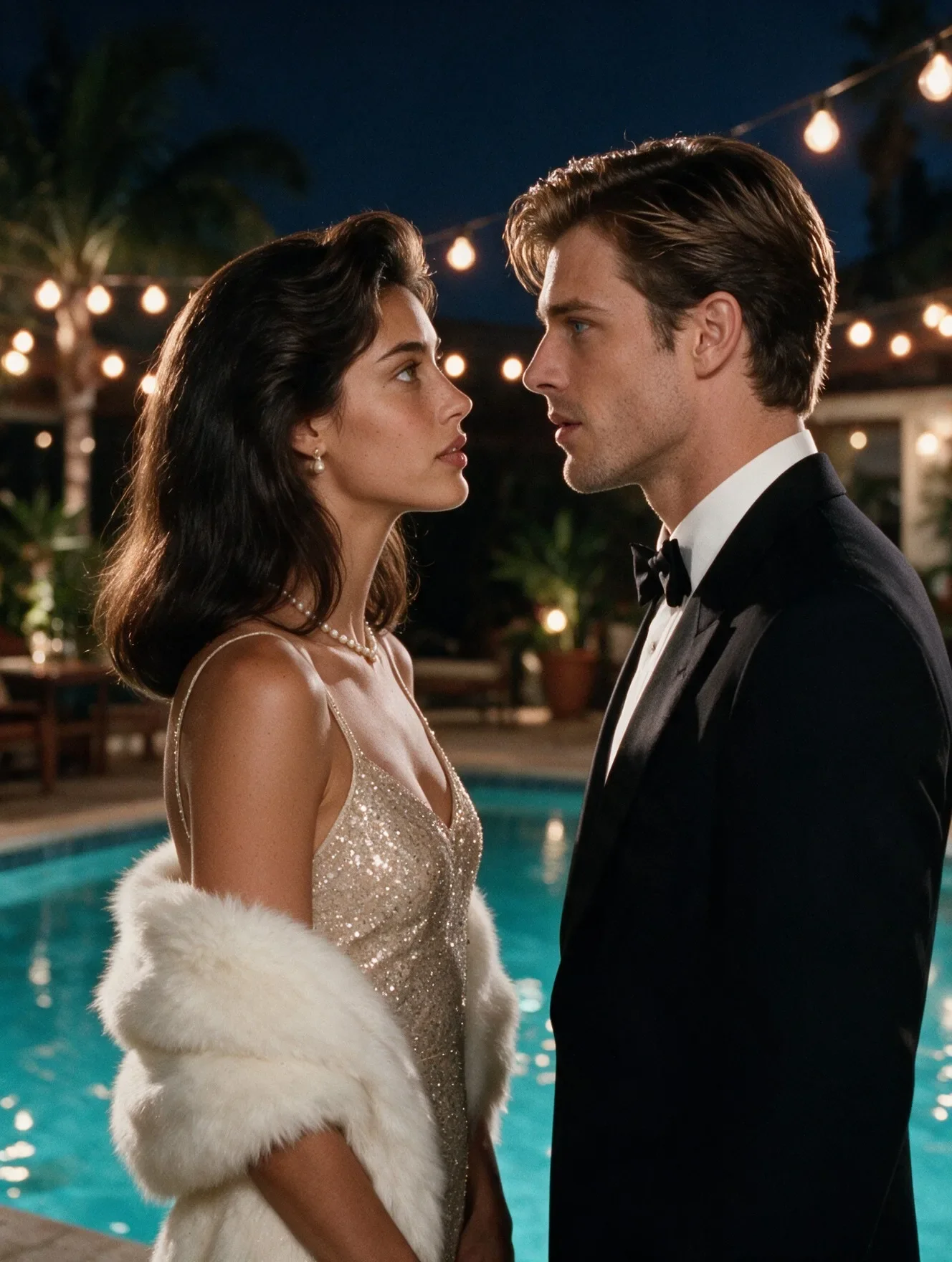
A two-face Seedance 2.5 probe on Higgsfield passed on 23 October 2026: 7 seconds at 480p, $1.44, two character sheets, two voice references, no first frame. Both lines came out word-perfect on their own slices (0.56 to 3.64 s and 4.96 to 5.60 s).
In that probe the right mouth spoke each line, the other mouth stayed closed, the sides never swapped, and there was no third person, subtitle or music. Validating these exact mechanics in a low-cost $1.44 probe proved that dual-speaker dialogue is fully achievable in a single generation pass without relying on complex compositing tricks.
Curating voice references for acting register
Voice references: one clean, noise-free clip per speaker, 5 to 10 seconds is best and 30 seconds combined is the limit per request. Record it in the register the character speaks in, because the model takes rhythm and emotion from it, not only timbre.
Many production teams treat voice reference files as purely acoustic timbre samples, uploading flat studio greetings or isolated vowel sounds. Seedance 2.5 extracts cadence, breathing patterns, and emotional pitch directly from the provided reference clip. If a scene demands tense, hushed confrontation, feeding a brightly cheerful voice clip will corrupt the emotional weight of the performance.
Ensuring absolute silence between spoken words in the reference audio prevents room hum and background noise from bleeding into synthetic speech. Clean references yield clean, articulate dialogue tracks.
If a character reference audio file includes background air conditioning hum or street noise, the generation model attempts to synthesize that ambient noise directly into the actor's vocal track. Cleaning reference audio with high-pass filters and noise gates before submission guarantees pristine vocal clarity.
Physical staging to suppress accidental lip movement
The open risk is the 15-second single take, where both mouths can be in frame at once. We stage the non-speaker turned away, out of focus, or with a closed mouth, and draft the take at 480p before any 720p render.
Camera blocking is your strongest defense against generative crosstalk. When two synthetic actors face the camera in equal two-shot proximity, minor stochastic noise can cause the non-speaking actor to mimic vowel shapes. Positioning the listening character in three-quarter profile, shifting focus to the primary speaker, or placing the listener over the shoulder eliminates visual confusion.
One miss in the same probe: a lean toward nose contact despite 'lips stop an inch apart'. We cut before that moment or end the clip earlier. When the model drifts into unintended physical intimacy, trimming the timeline before contact preserves dramatic tension.
Controlling camera distance also mitigates physical interaction glitches. When two synthetic figures lean too close together, diffusion latents frequently struggle with boundary resolution. Maintaining arm's-length staging preserves clean silhouette separation.
Moderation gates and silent signature takes
A close two-person framing with a bare shoulder and an arm's-length approach was blocked by content safety at 720p twice. Softening the wording and stepping closer in two steps passed on the first try. Turkish is not a supported language for Seedance 2.5 in our tests, so every line is written in English.
A silent signature shot is a separate request with generate_audio off and no audio references. That keeps a second speaker out of the mouth problem entirely.
When a commercial script calls for a high-impact reaction shot, generating the plate as a purely visual take without an audio conditioning stream bypasses mouth synchronization altogether. This provides total camera freedom and allows post-production sound designers to layer dialogue or score independently.