



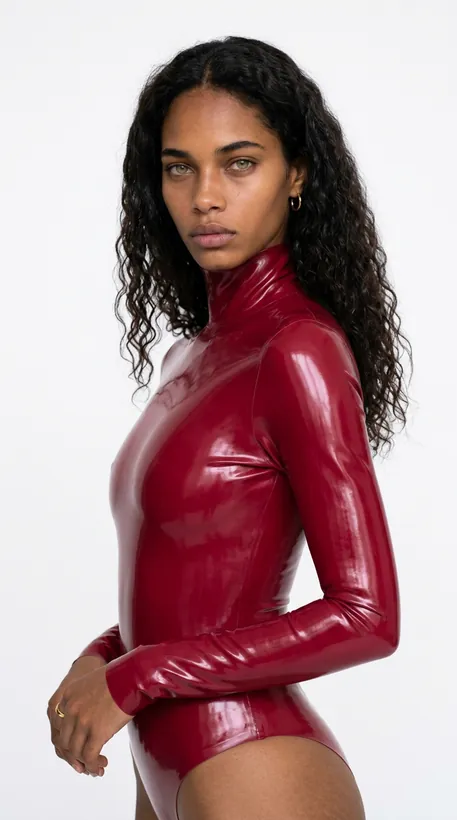
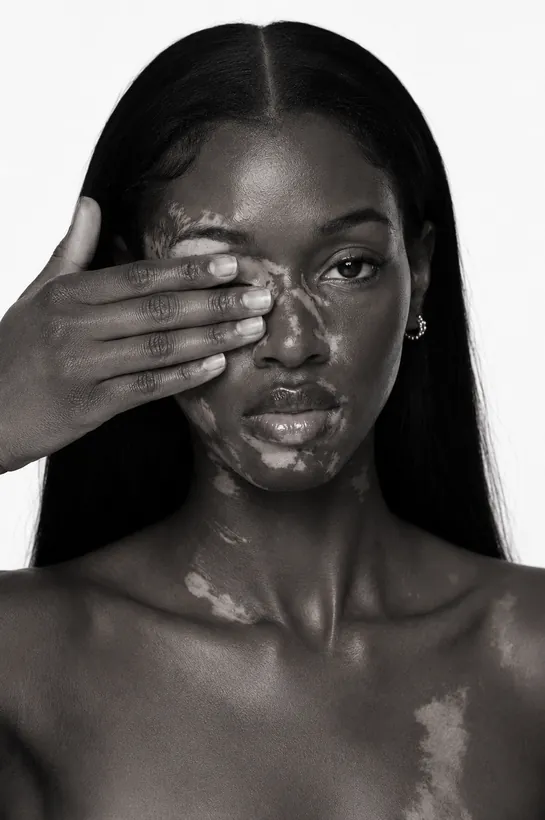
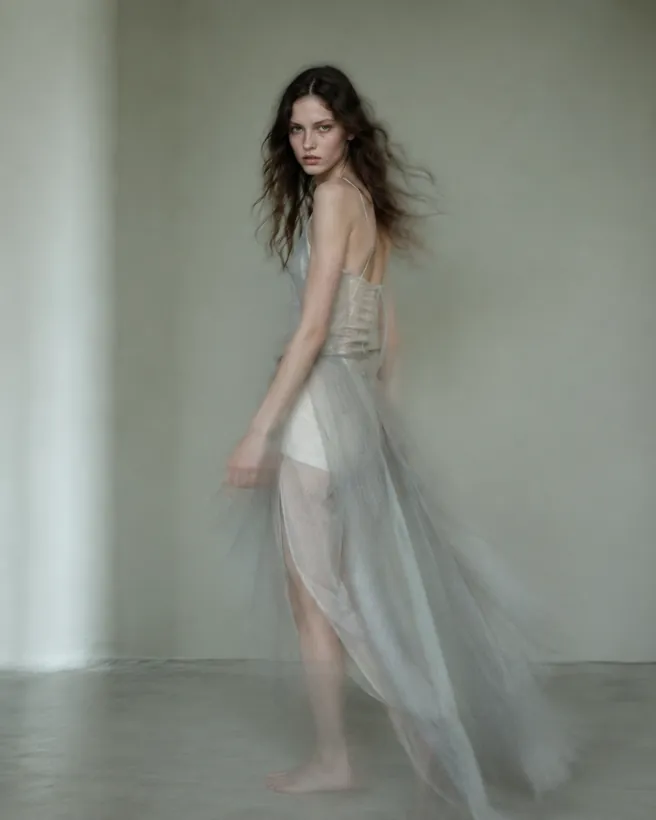

Synthetic Media / Fashion / Image System
Synthetic Editorial System
A controlled visual system for creating consistent editorial imagery, model identities, wardrobe directions, and campaign-ready image sets.
View structure →

OMNI Labs builds high-end visual assets, campaign systems, and custom AI workflows for brands, founders, and creative teams.
Portfolio studies in synthetic media, visual systems, digital talent, and AI-powered production workflows.
A controlled visual system for creating consistent editorial imagery, model identities, wardrobe directions, and campaign-ready image sets.
View structure →One of seven original digital identities — built and owned in-house, held consistent across 120+ shots, studio digitals, and motion. A glimpse of the full roster.
Explore talent roster →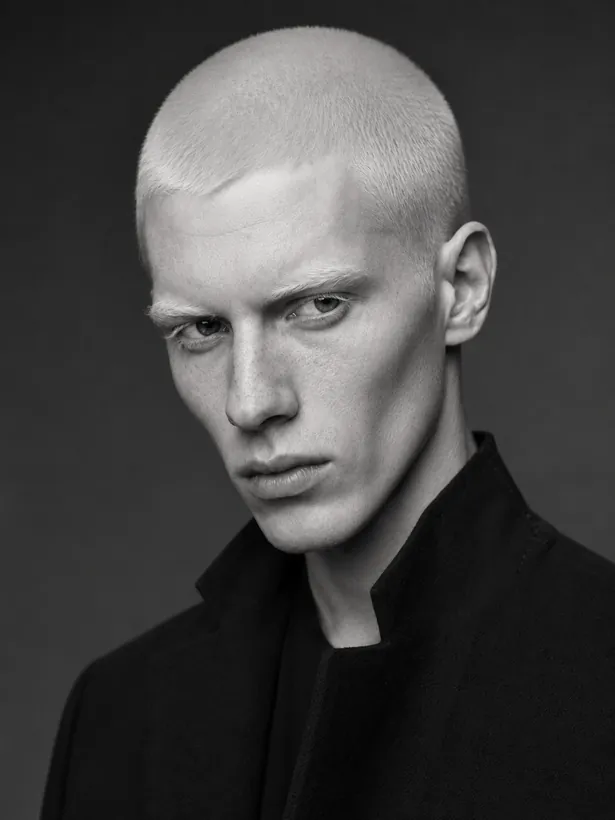
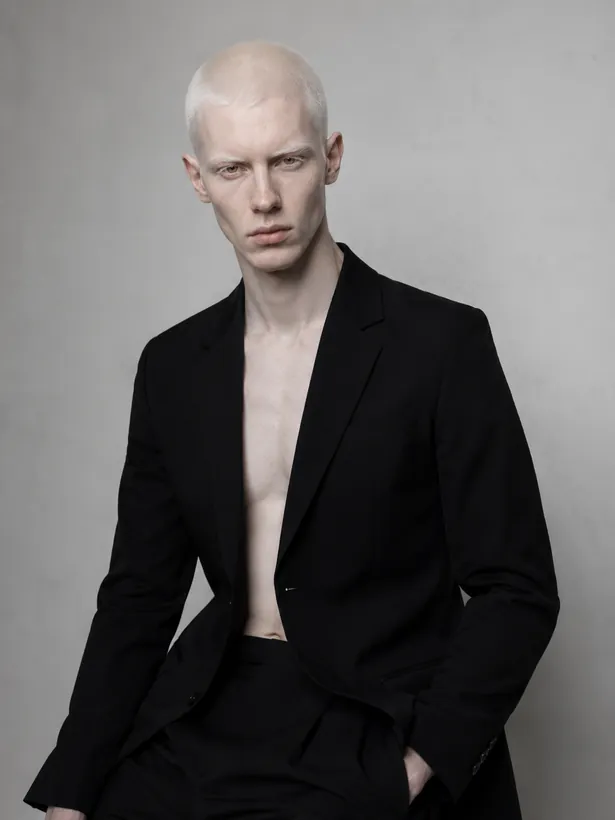
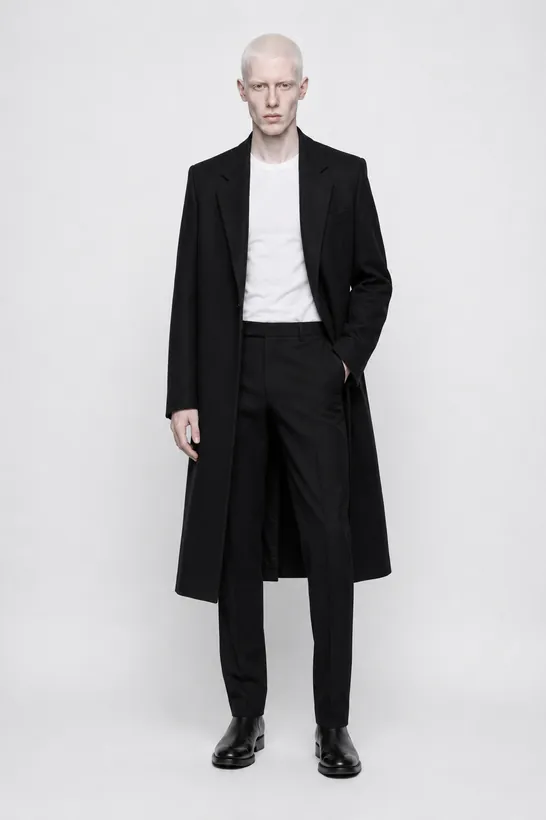
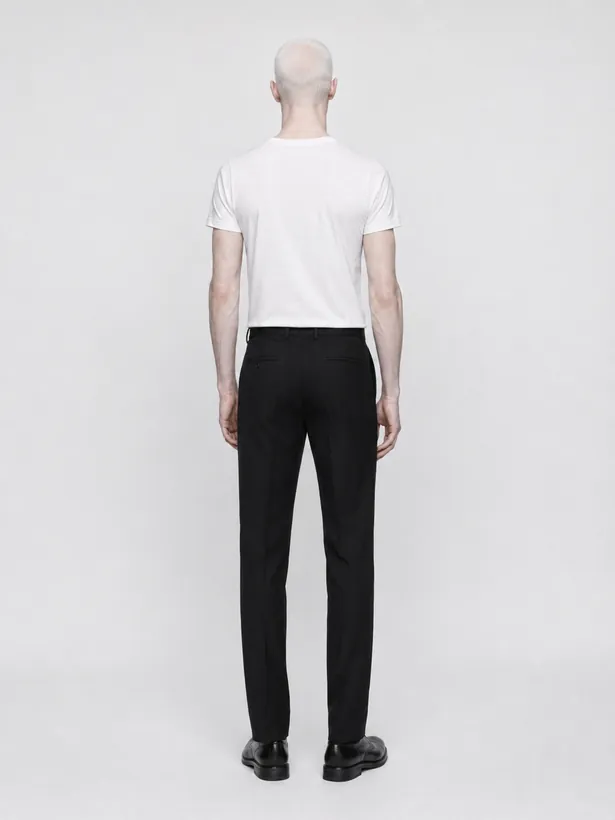

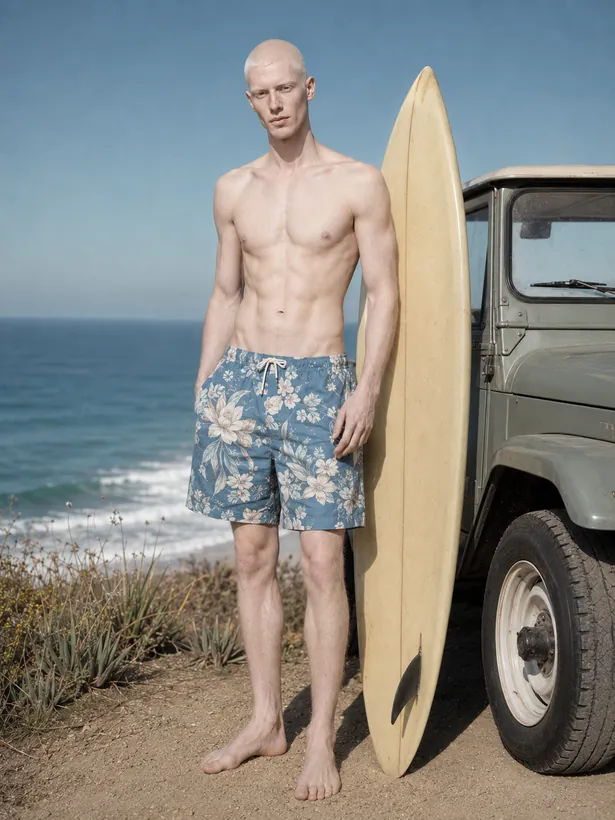

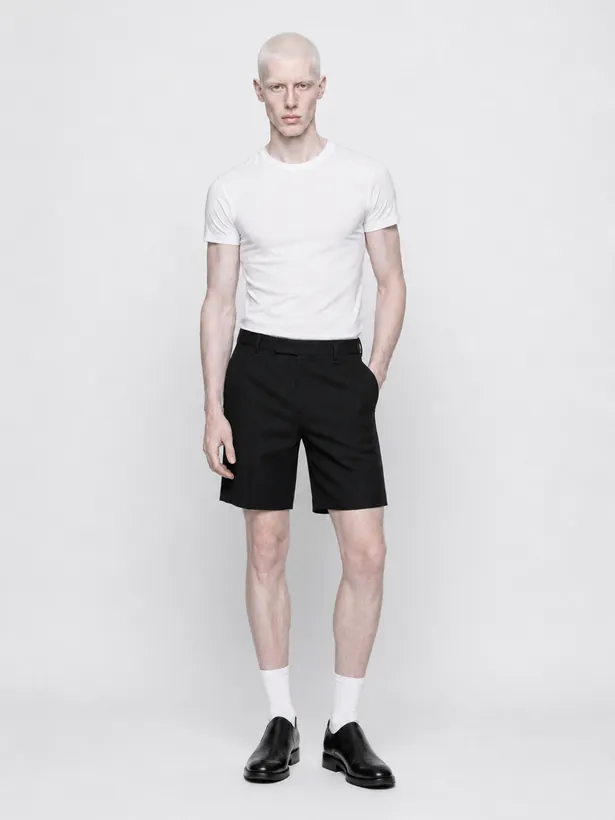
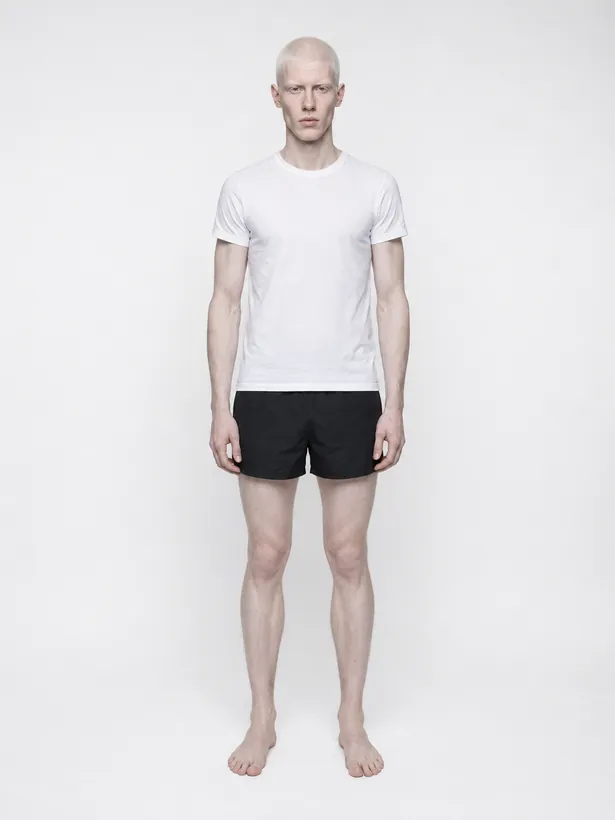
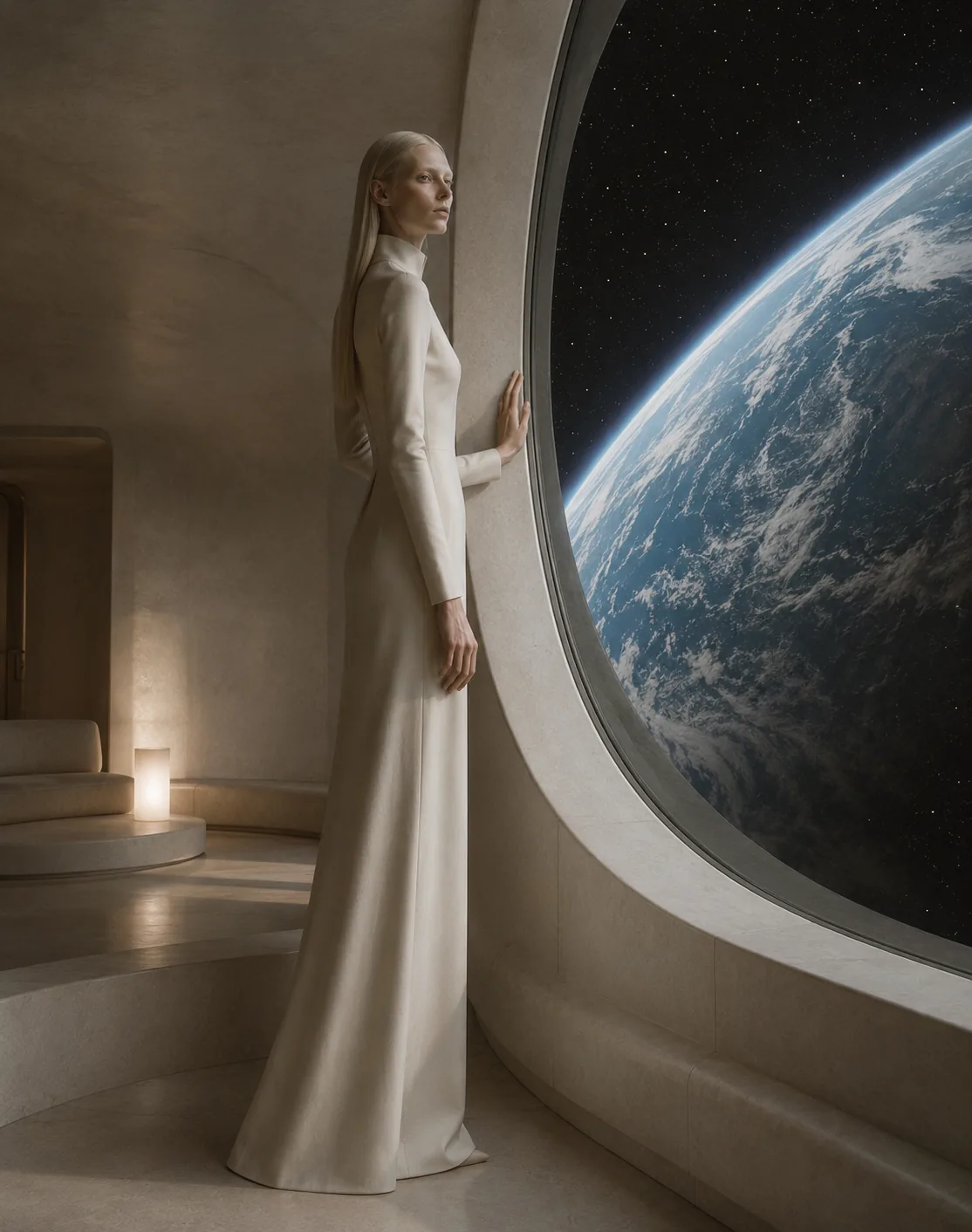
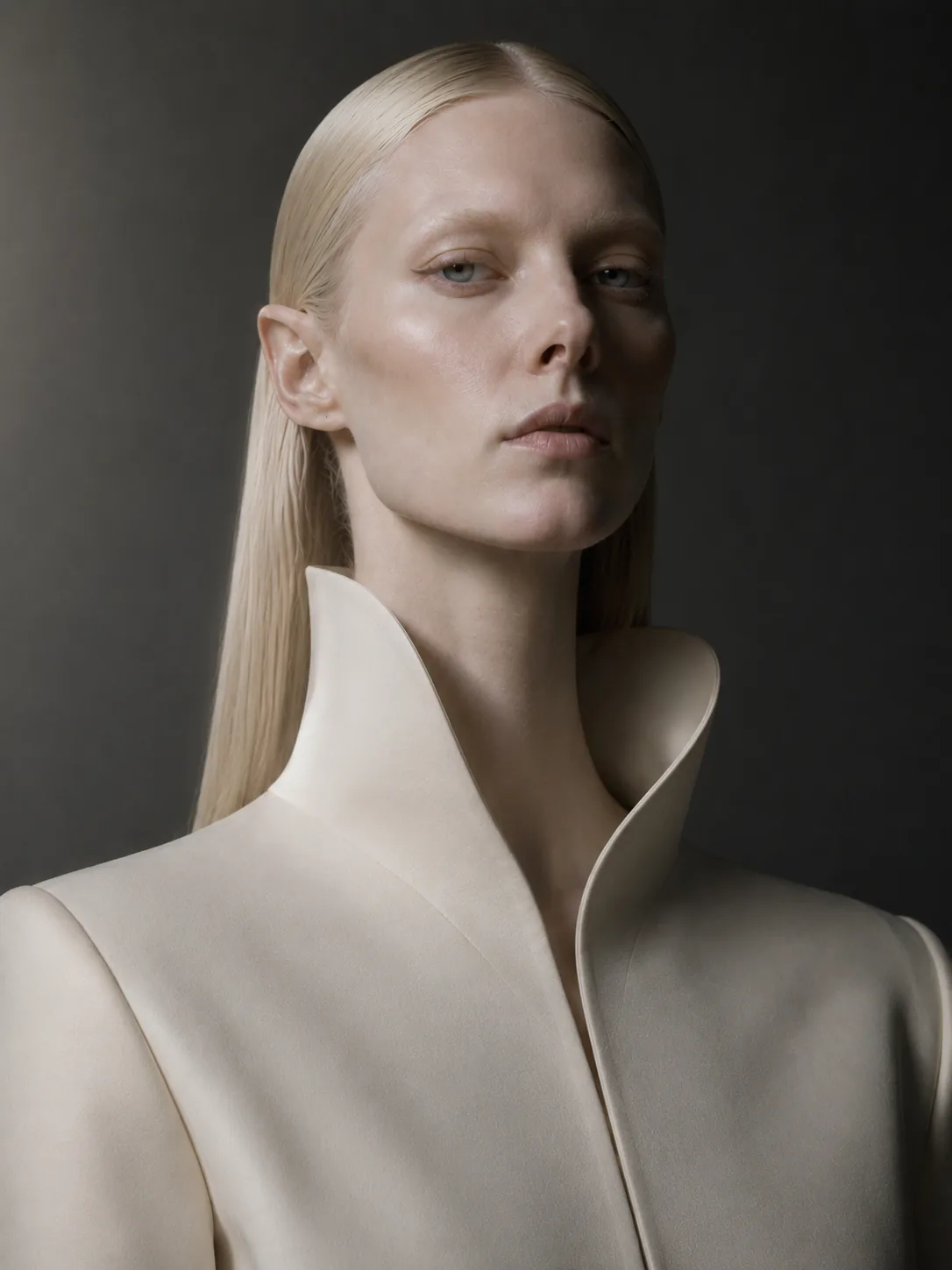
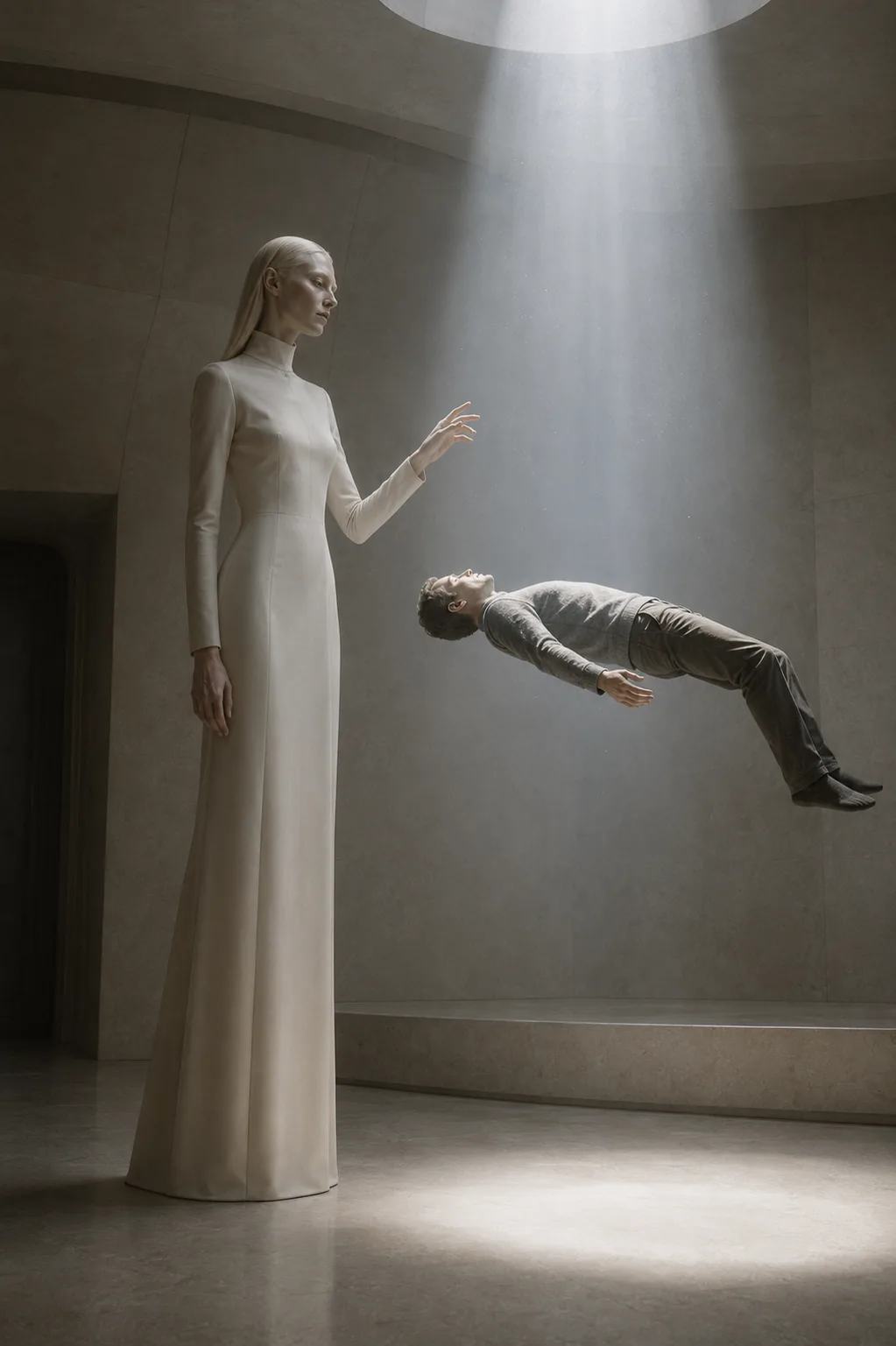
A Nordic-type extraterrestrial editorial presence — pale ash-blonde, silver-blue gaze, elongated 7-foot silhouette. Identity held across stills and motion, including off-world narrative frames.
Explore talent roster →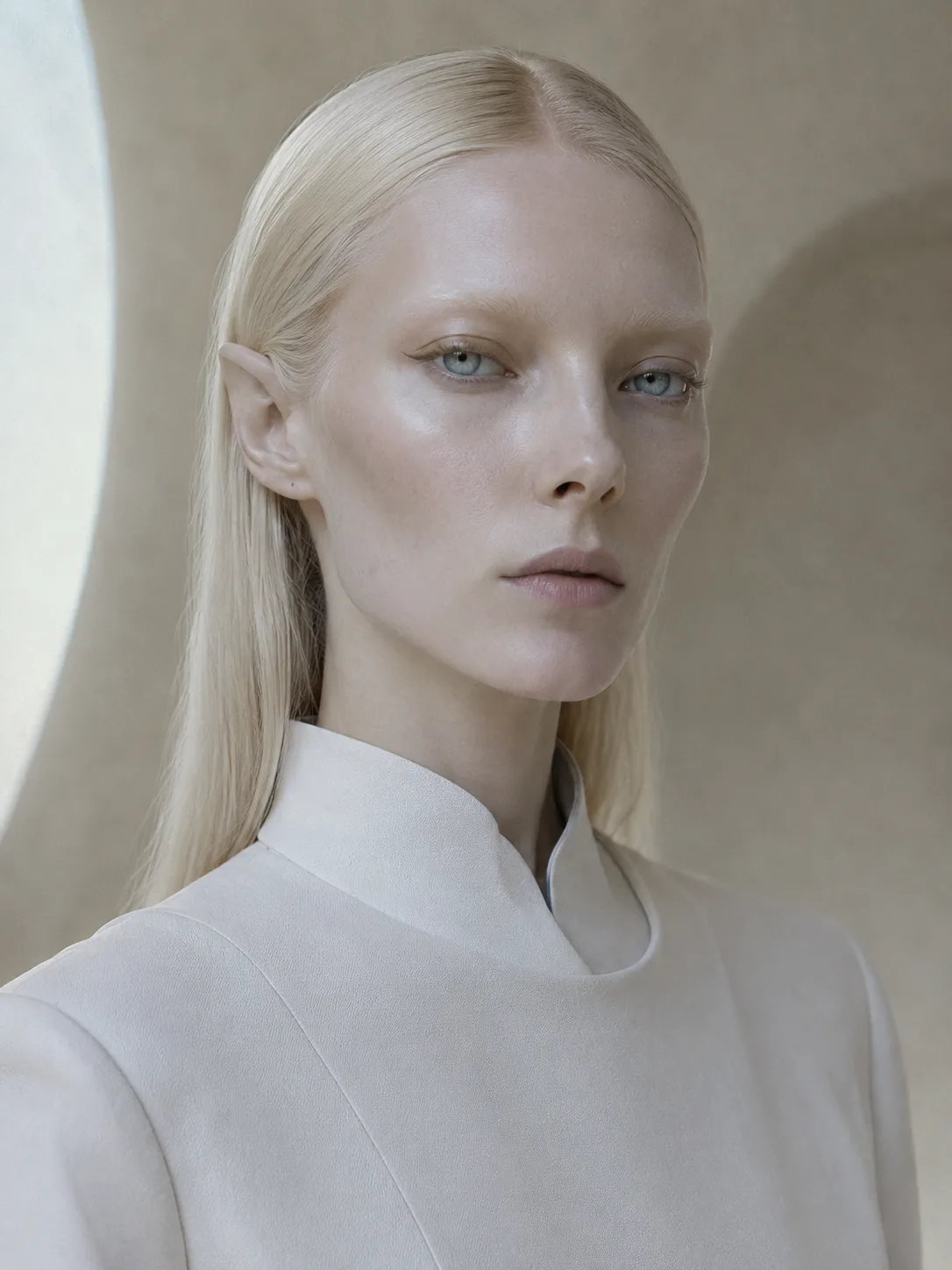


An equestrian concept campaign with an original silk carré designed by İdil Kıbaroğlu — motifs, composition, and styling carried end-to-end into editorial, motion, and product through the studio pipeline.
View case study →"Craft is Craft" — a product ritual campaign with photoreal stills and a cinematic hand-wash film, directed, generated, and finished as a complete concept piece.
View case study →A bold, bilingual website for a functional sparkling-soda brand — a five-mood product system, an interactive flavour range, a B2B portal, and a custom image CMS so the brand can run it all without touching code.
View case study →A design-led cultural-uniform house built end-to-end: a brand doctrine, one cut in three colorways, a synthetic flagship face, a thirteen-slide carousel, an 83-second designed film — and a complete e-commerce site we coded and shipped. We didn't mock the storefront; it's live.
View case study →A self-initiated dark-metal water brand built end-to-end — positioning, three SKUs, two original synthetic faces, and a full campaign, all from a single idea.
View case study →A real-time 3D brand experience in vanilla TypeScript + Three.js — gravitational-lensing shaders, a live ocean, drag-to-rotate product, and scroll-cinematic motion across four pages.
View case study →An endless 3D tunnel-faller inside the OMNI DEATH site — you are the can, weaving plastic walls down a procedurally-engraved void. Object-pooled hazards, synthesized WebAudio, a real combo system, depth-zone moods — built so people return to the site just to play.
View case study → Play it live ↗A landing page for an on-chain AI-agent marketplace, anchored by a live Spline robot — not a render, not a video loop. The robot owns the hero, then dissolves out of frame on scroll as the marketplace rises to take its place: real-time 3D wired to a parallax narrative.
View case study → Visit the live site ↗A 60-second vertical brand film, end-to-end AI-crafted: an ancient synthetic archivist passing a keep-or-discard verdict on every object humanity ever made. Inexpensive image-to-video, identity-locked across every frame, then cut into an actual ad film — kinetic typography, a verdict mechanic built for the feed, and an original first-person score. Cheap generation, expensive direction.
View case study →One DJI drone, a single continuous helix orbit of an abandoned factory in Chico, California — and from that one video, a fully walkable Gaussian-splat reconstruction of the real building. COLMAP solved all 407 of 407 cameras; Brush trained the splats locally. No LiDAR, no rig — just photogrammetry and a real flight, rendered in a browser you can fly through.
View case study →A fictional performance concept, built as a single-page showcase you drive with the scroll. A scarlet GT sweeps through a glass-tower junction, its V8 unbolts itself into a full teardown, and the finale hands you real-time control of a 3D night cruise. Scroll-scrub frame sequences, an AI-authored engine disassemble, and a live Three.js scene — one in-house automotive spec piece, no build step.
View case study →A 70-second vertical wildlife film, end-to-end AI-crafted: a hummingbird hawk-moth held in hover at broadcast-grade macro detail, cut with lower-third species cards and permanent Leica + BBC Earth bugs. AI-generated macro flight, 2× upscaled, scored with a cinematic narrator reading off a "Leica 35mm APO-Summicron" credit line, under a layered mix of score and garden ambience. See what speed hides.
View case study →AI-generated campaign visuals, editorial portraits, product scenes, and branded image systems.
Short-form video treatments, image-to-video direction, motion prompts, cinematic sequences, and campaign-ready visual narratives.
Synthetic models, avatar concepts, character systems, casting boards, and visual identity consistency.
Production pipelines, prompt systems, review workflows, asset generation systems, and repeatable creative operations.
Drag to explore →
Selected studies and production systems across synthetic imagery, AI video, digital talent, visual design, and workflow infrastructure.
A controlled visual system for consistent editorial imagery and campaign assets.
An original digital face system with studio digitals and face-consistency rules.
Product scenes and art direction built into a coherent brand world.
Storyboard frames and camera logic for image-to-video sequences.
A 60-second vertical brand film, end-to-end AI-crafted: one synthetic archivist passing a keep-or-discard verdict on every object humanity ever made. Cheap generation, expensive direction.
A bold, bilingual website for a functional sparkling-soda brand: a five-mood product system, an interactive flavour range, a B2B portal — and a custom image CMS to run it all.
An end-to-end fictional fashion house: doctrine, one cut in three colorways, a synthetic face, a designed film, and a live e-commerce site we coded and shipped.
An end-to-end fictional water brand: positioning, three SKUs, two synthetic faces, and a campaign — built from a single idea.
A real-time 3D brand experience: gravitational shaders, a live ocean, drag-to-rotate product, scroll-cinematic motion.
An endless 3D tunnel-faller built into the brand site: weave the plastic, kiss the edge, drown. Object-pooled, synth-audio, 60fps.
A landing page where a live Spline robot anchors the hero, then dissolves on scroll as the marketplace comes alive — real-time 3D wired to a parallax narrative, not a video loop.
DJI helix drone orbit → COLMAP SfM (407/407 cameras) → Brush training → a walkable 3D world reconstructed from a single real video.
Scroll-scrub frame sequences → an AI-authored V8 teardown (keyframe interpolation) → a real-time Three.js night cruise. A concept car you drive with the scroll.
A 70-second vertical hawk-moth documentary reel — broadcast lower-thirds, permanent Leica + BBC Earth bugs, a cinematic narrator, and a full layered sound mix. Cheap generation, broadcast-grade direction.
One synthetic identity, held consistent across portraits, studio digitals, and editorial campaigns. Platinum bob · East Asian · editorial / quiet luxury.
 P·01
P·01 P·02
P·02 P·03
P·03 P·04
P·04 P·05
P·05 P·06
P·06 S·01
S·01 S·02
S·02 S·03
S·03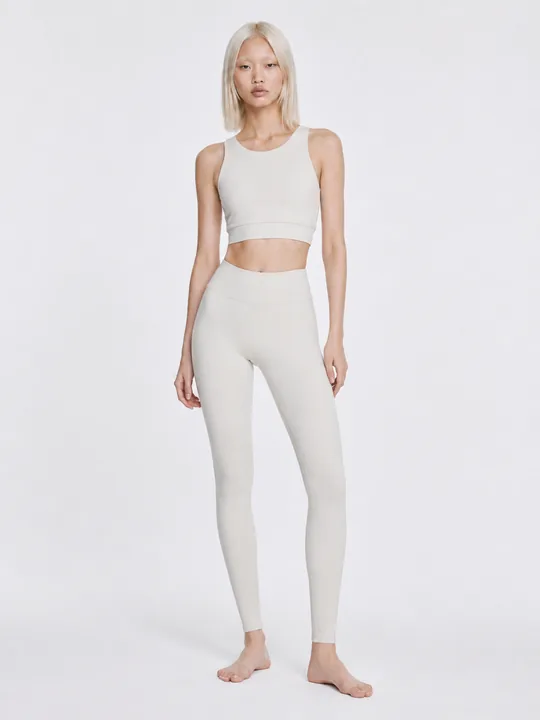 S·04
S·04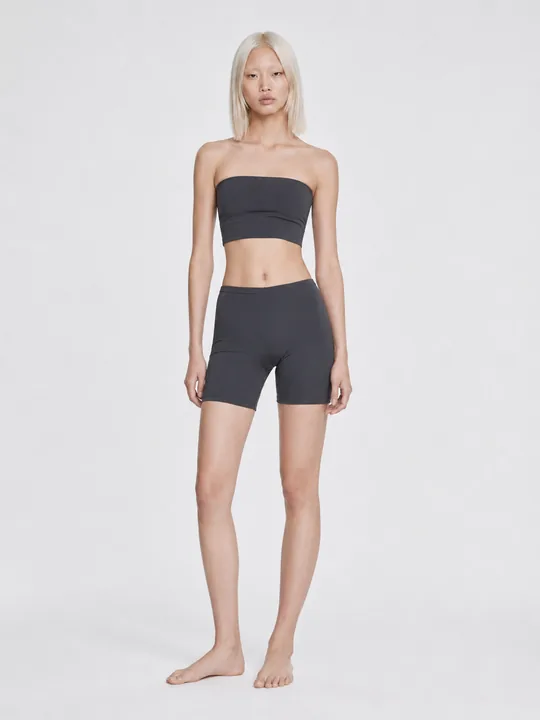 S·05
S·05 S·06
S·06 E·01
E·01 E·02
E·02 E·03
E·03 E·04
E·04 E·05
E·05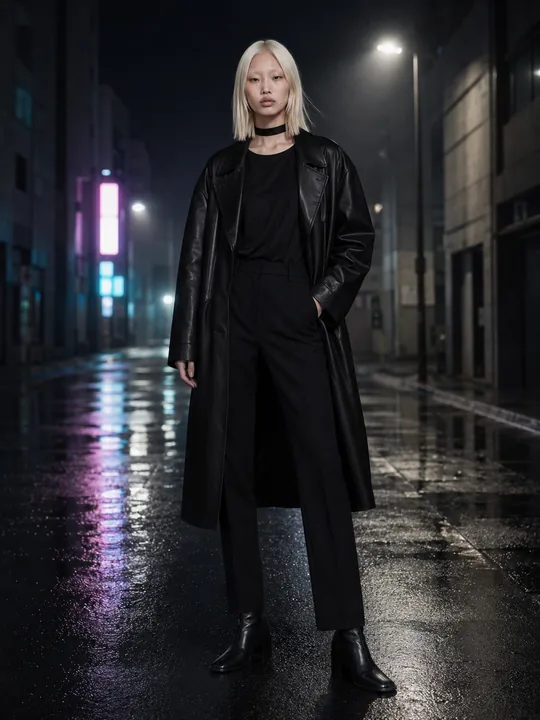 E·06
E·06Each project will document the problem, visual direction, production workflow, selected outputs, refinement process, and final delivery structure.
Original synthetic identities — each held consistent across portraits, studio digitals, and editorial campaigns. Built and owned in-house, ready to cast.
An equestrian concept campaign — an original silk carré by İdil Kıbaroğlu, carried into synthetic talent, styling, and motion end-to-end.
A collaboration between ID Atelier and OMNI Labs: a concept campaign reimagining a Hermès-grade equestrian editorial — "Le Défilé des Chevaux Persans". The original scarf design — the horse motifs and the full carré composition — is the work of İdil Kıbaroğlu; OMNI Labs carried that artwork into an in-house synthetic model, scarf styling, product, and a cinematic hero.
Every frame was generated, directed, retouched, and finished through the studio pipeline: identity locked across shots, wardrobe and props art-directed, and a moving-image hero produced from the same design language. No external shoot, no licensing — a complete brand-grade campaign from artwork to film.
Eight hand-illustrated horses in an Ottoman-miniature register — each saddle, mane, and gait drawn as an individual character before composition. Original motifs by İdil Kıbaroğlu.
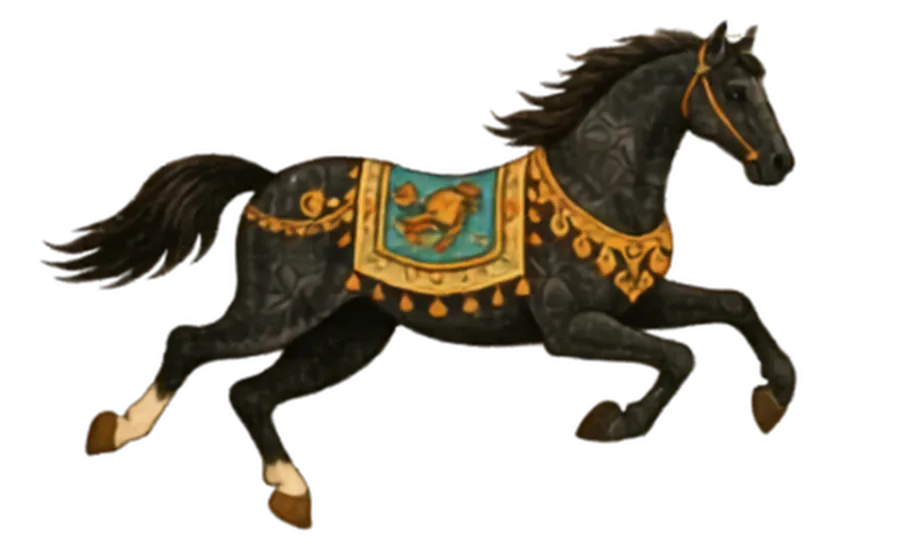
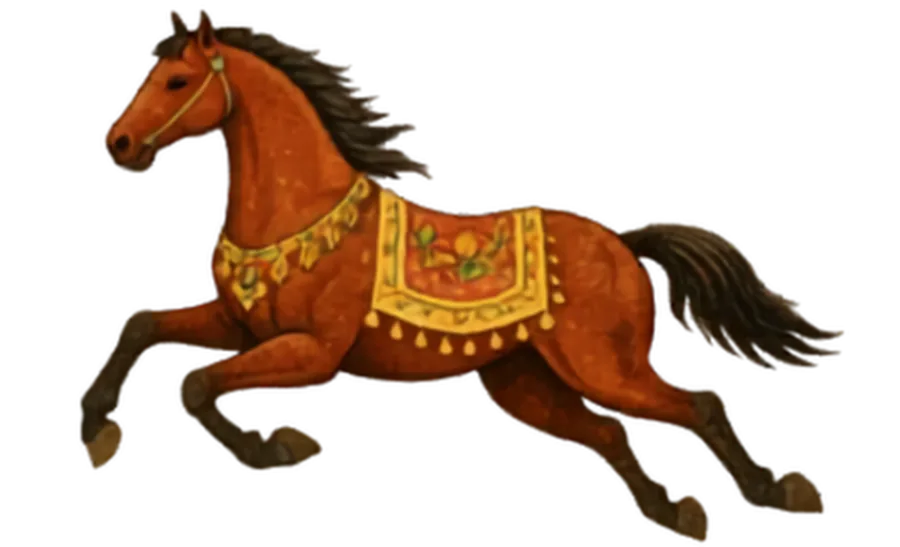
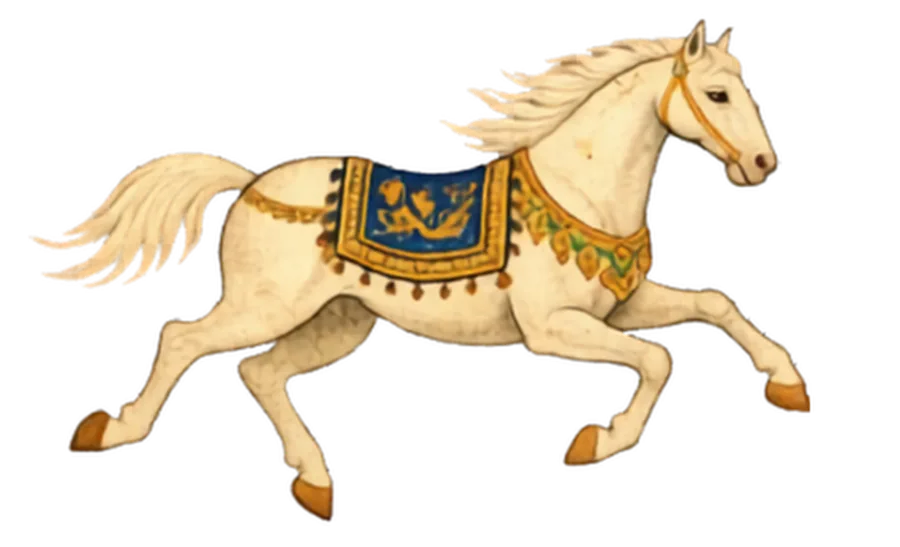
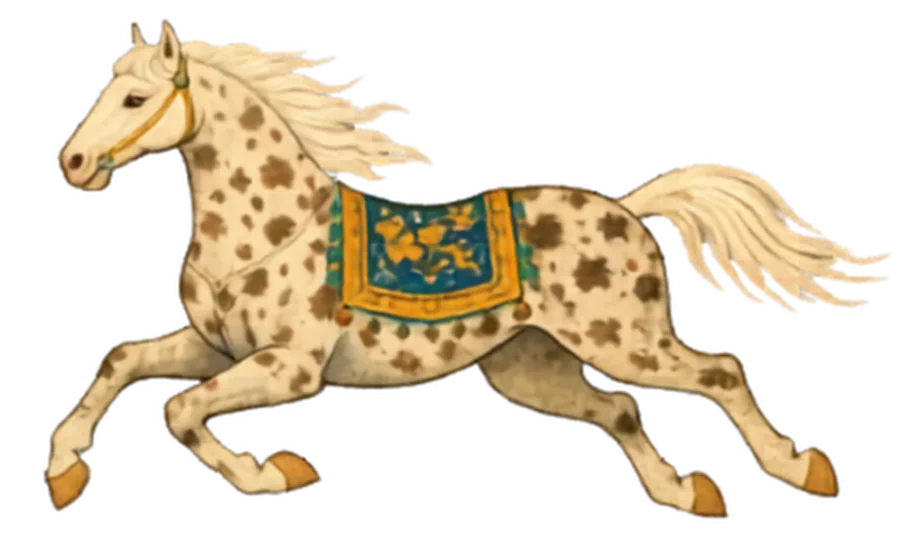
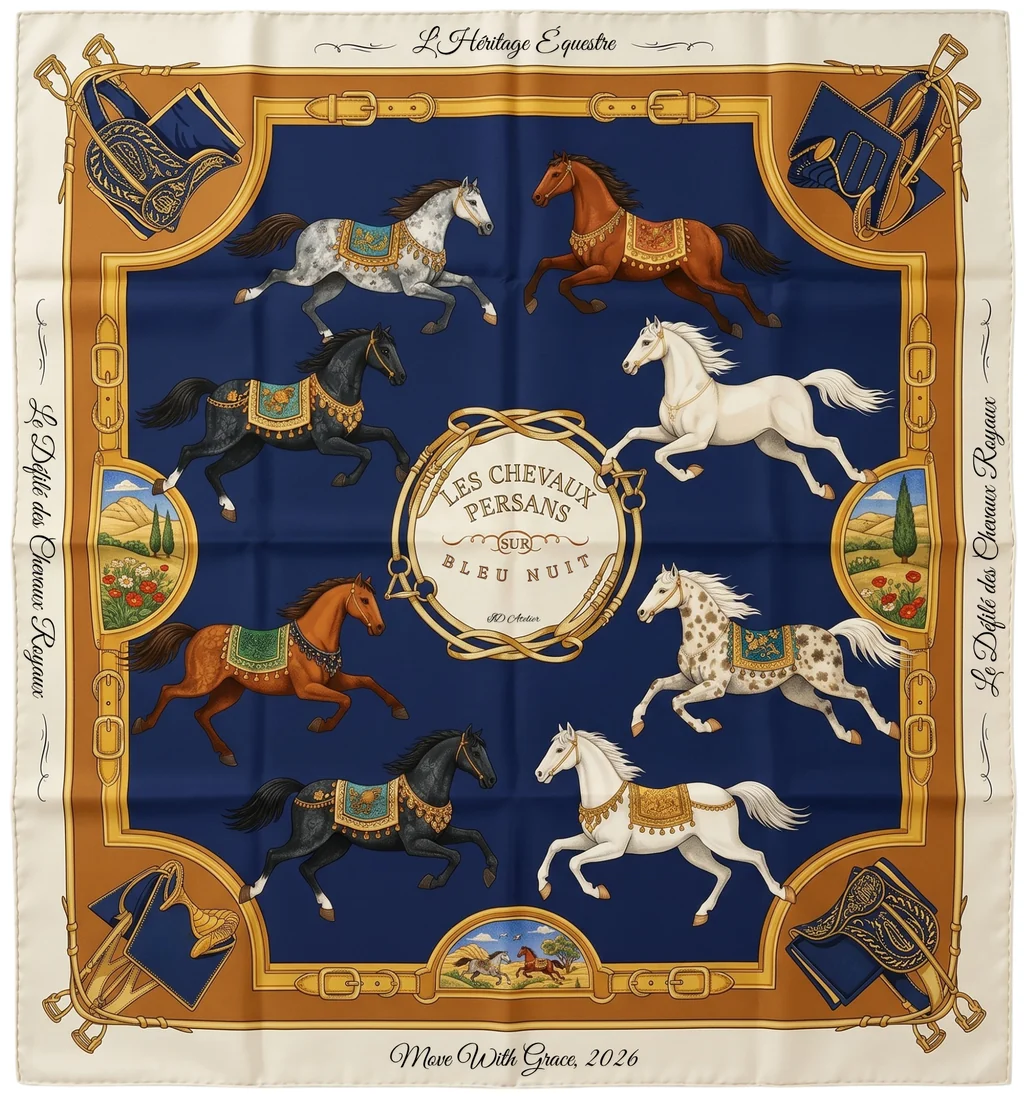
Motifs composed into the finished silk carré — "Les Chevaux Persans sur Bleu Nuit". Composition by İdil Kıbaroğlu.
"Move With Grace, 2026" — the carré that anchors the campaign.
The individual motifs resolve into one balanced composition on a bleu nuit ground: eight Persian horses framed by an equestrian border of saddles, bridles, and Anatolian landscapes — a wearable illustration that then carries into styling, film, and product.
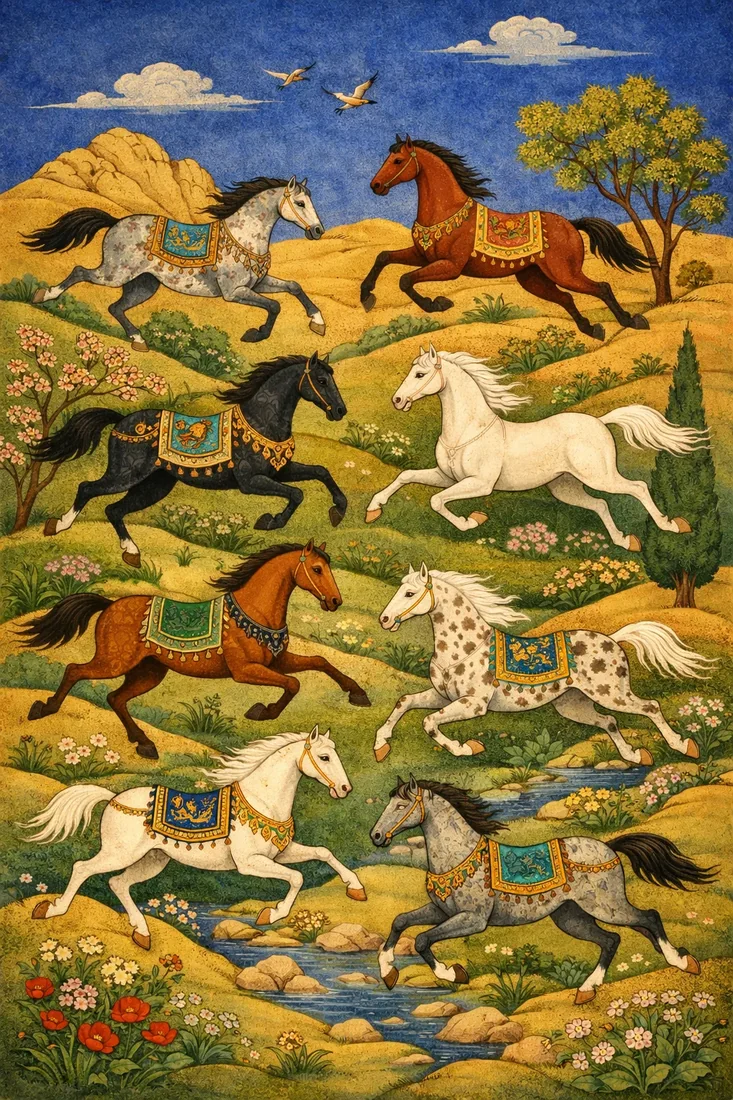
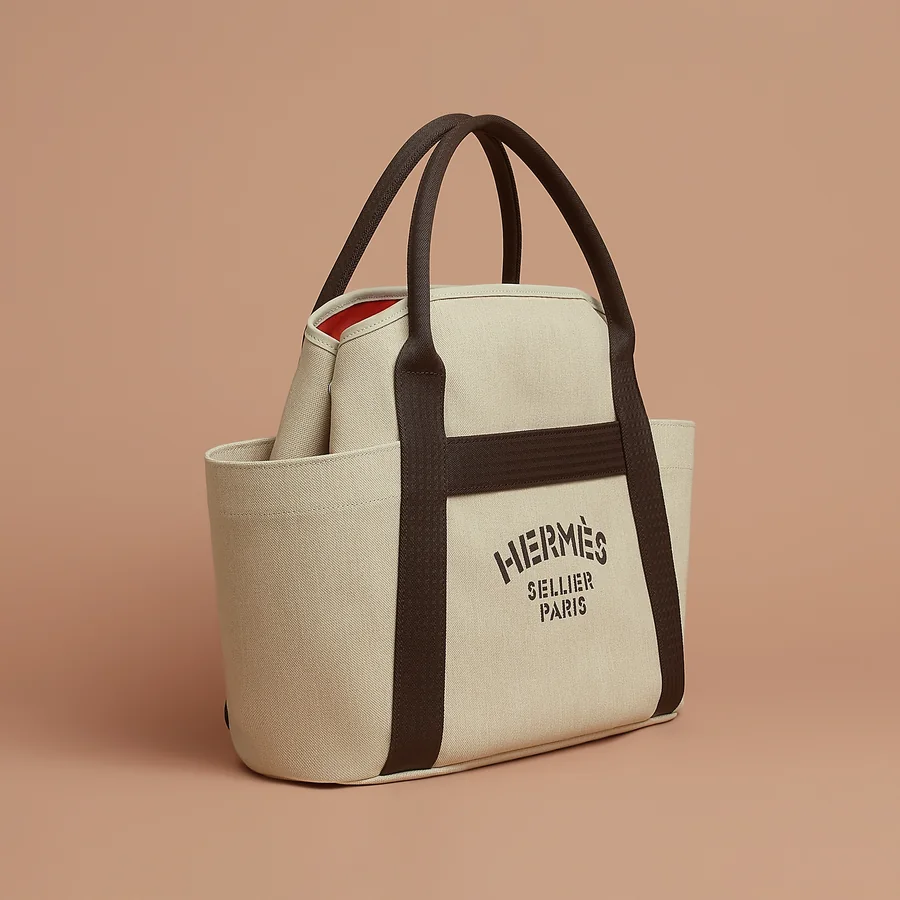
The concept extended onto a sellier canvas tote — rendered as clean product photography in-pipeline.


"Craft is Craft" — a product ritual campaign in photoreal stills and a cinematic hand-wash film.
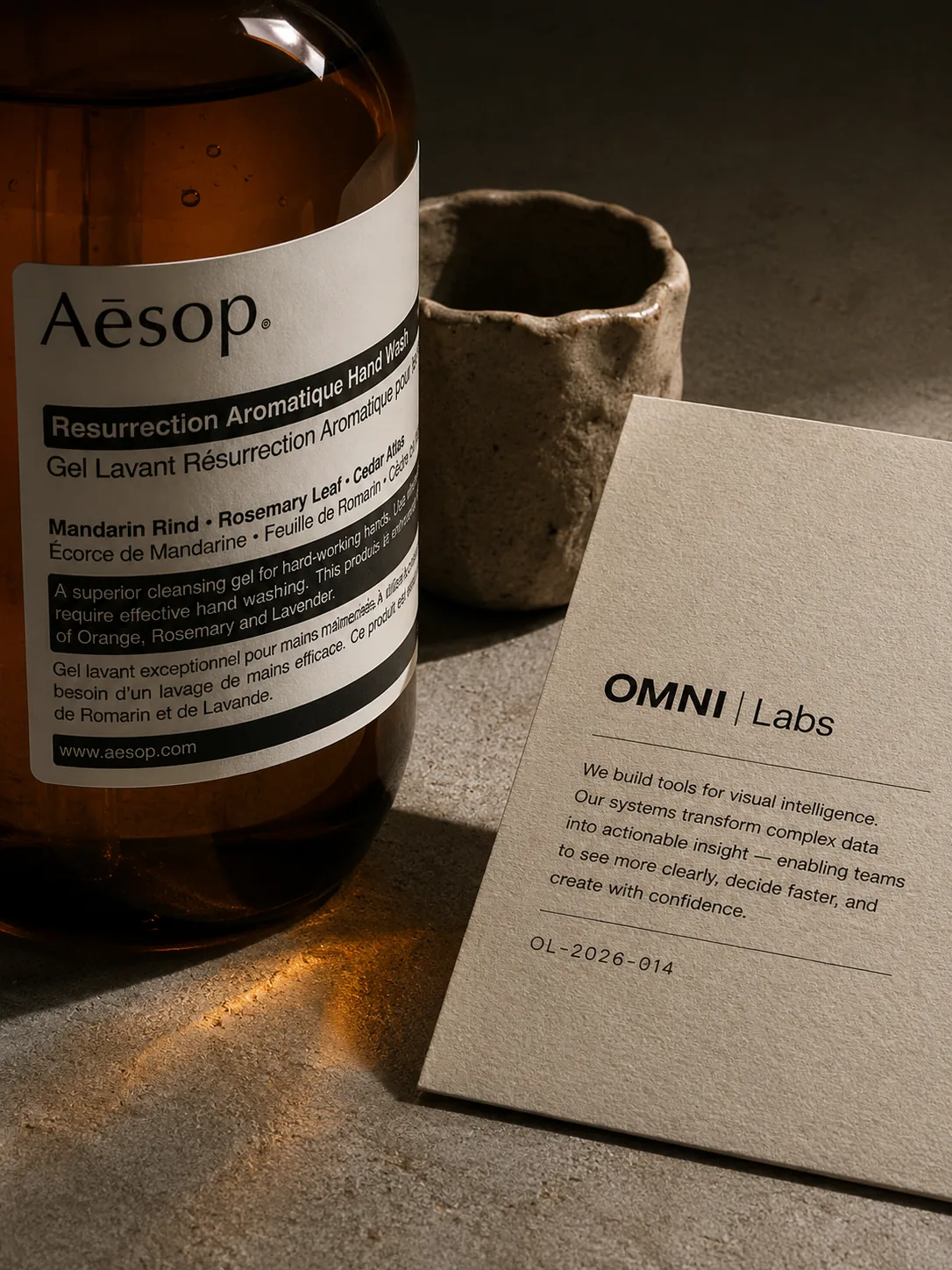
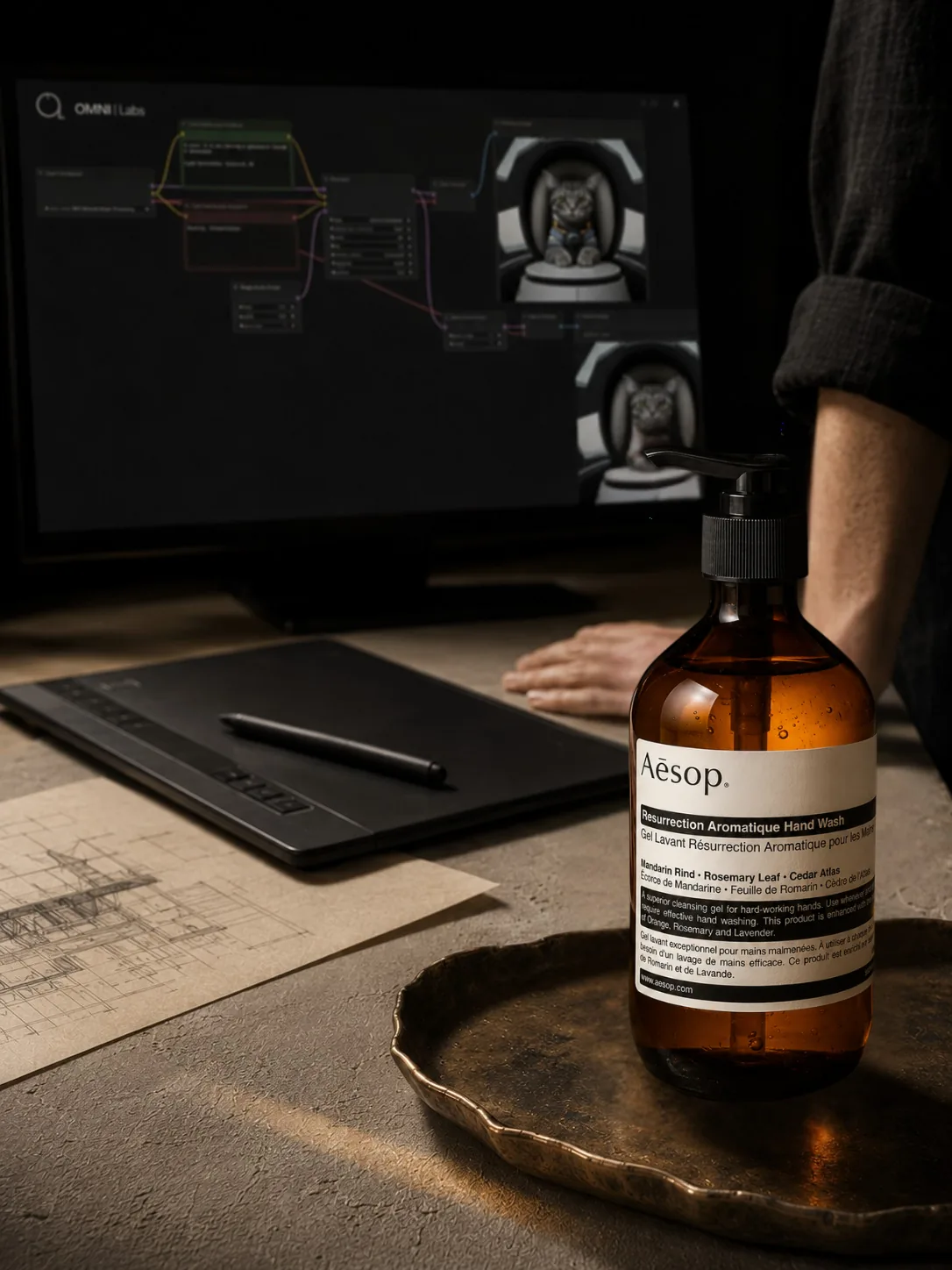
A concept campaign built around Aesop's Resurrection Aromatique Hand Wash — the everyday ritual treated as craft. Warm, tactile, restrained: brass dishes, low light, the gesture of the hand reaching for the pump.
Stills and motion were directed and produced entirely in-house through the studio's AI production pipeline, then finished frame-by-frame to brand standard. The hero is a 10-second cinematic close-up — product, light, and ritual, no shoot required.
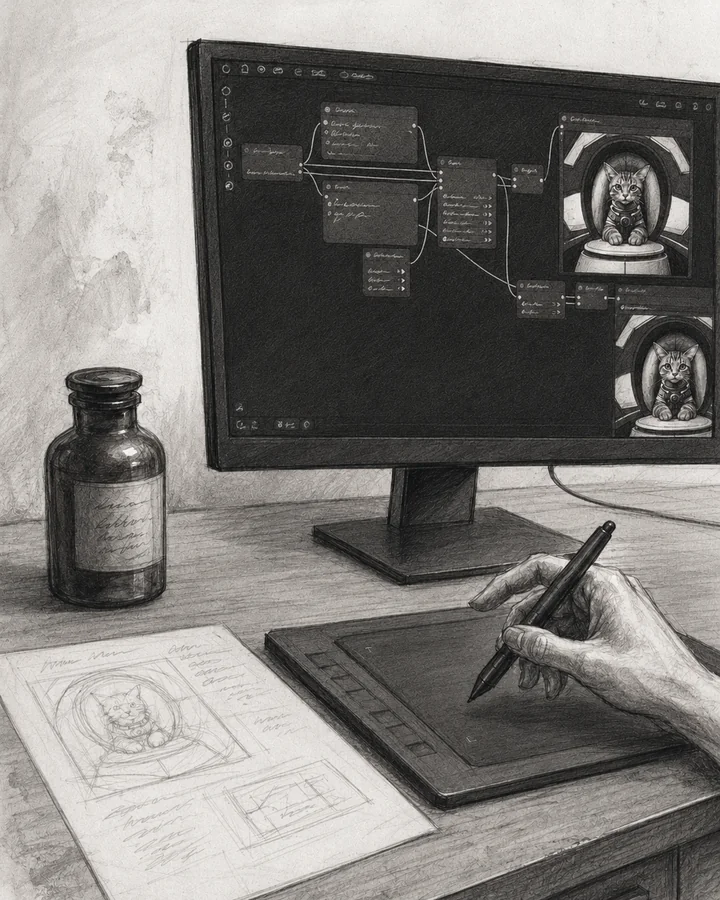
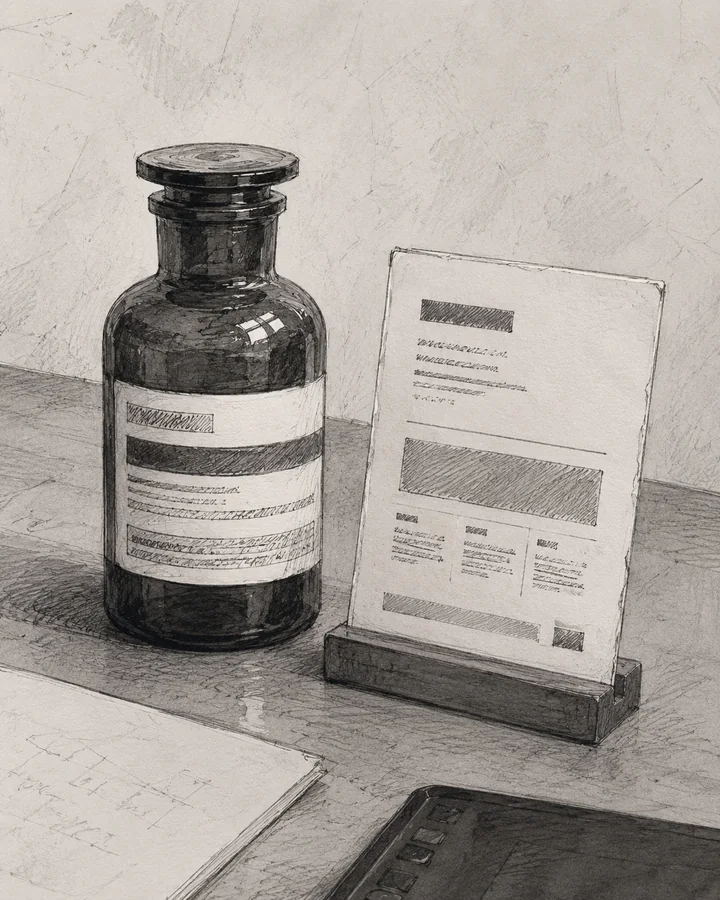
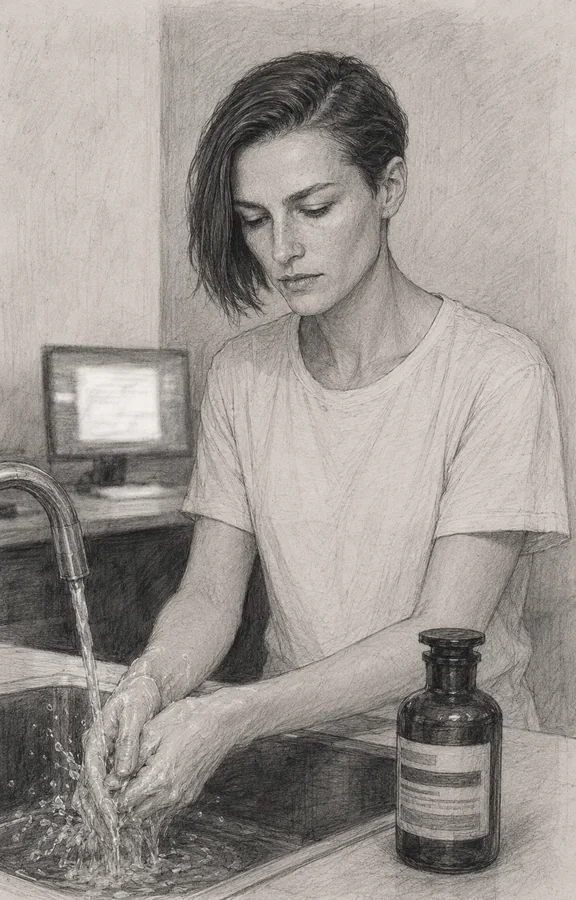
Before a single frame was generated, the campaign was drawn — three hand-rendered beats setting hook, product, and ritual.
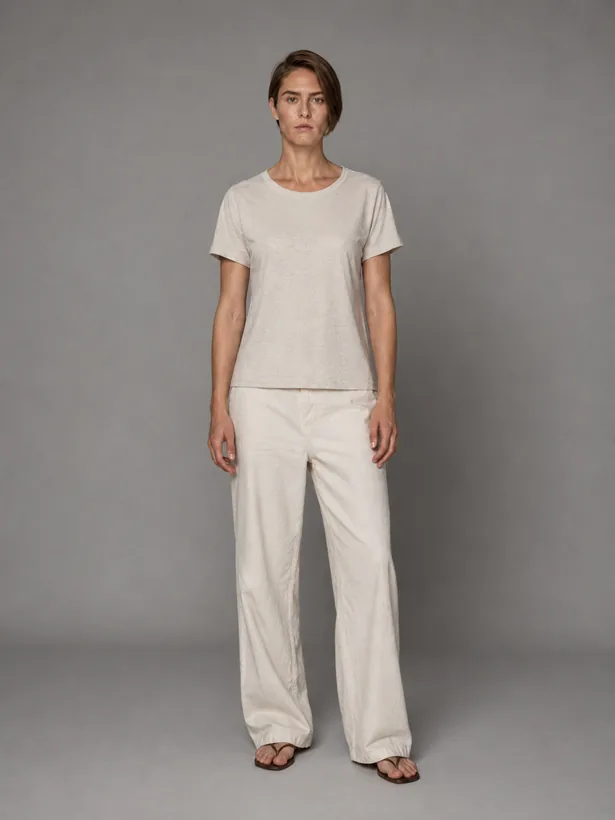
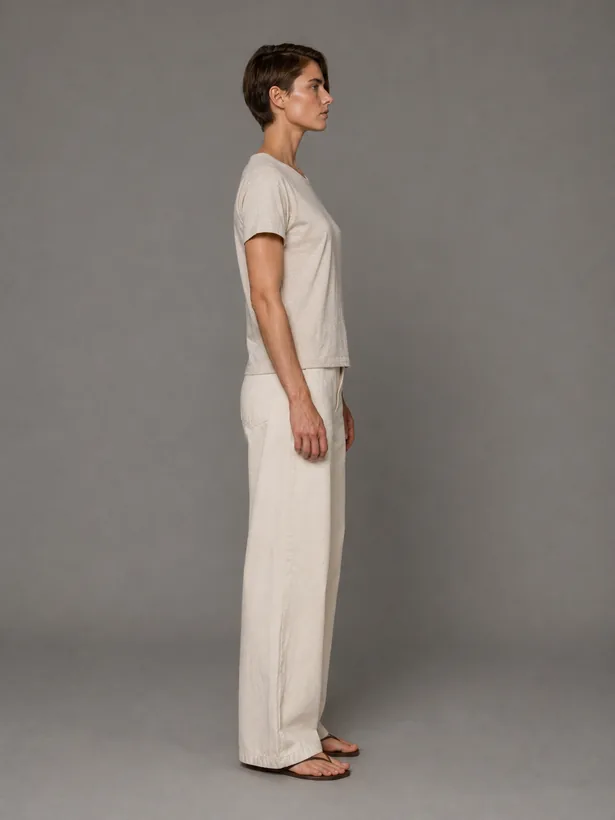
A synthetic model built in-house for the campaign — one identity held consistent across angles before she was placed in the scene.









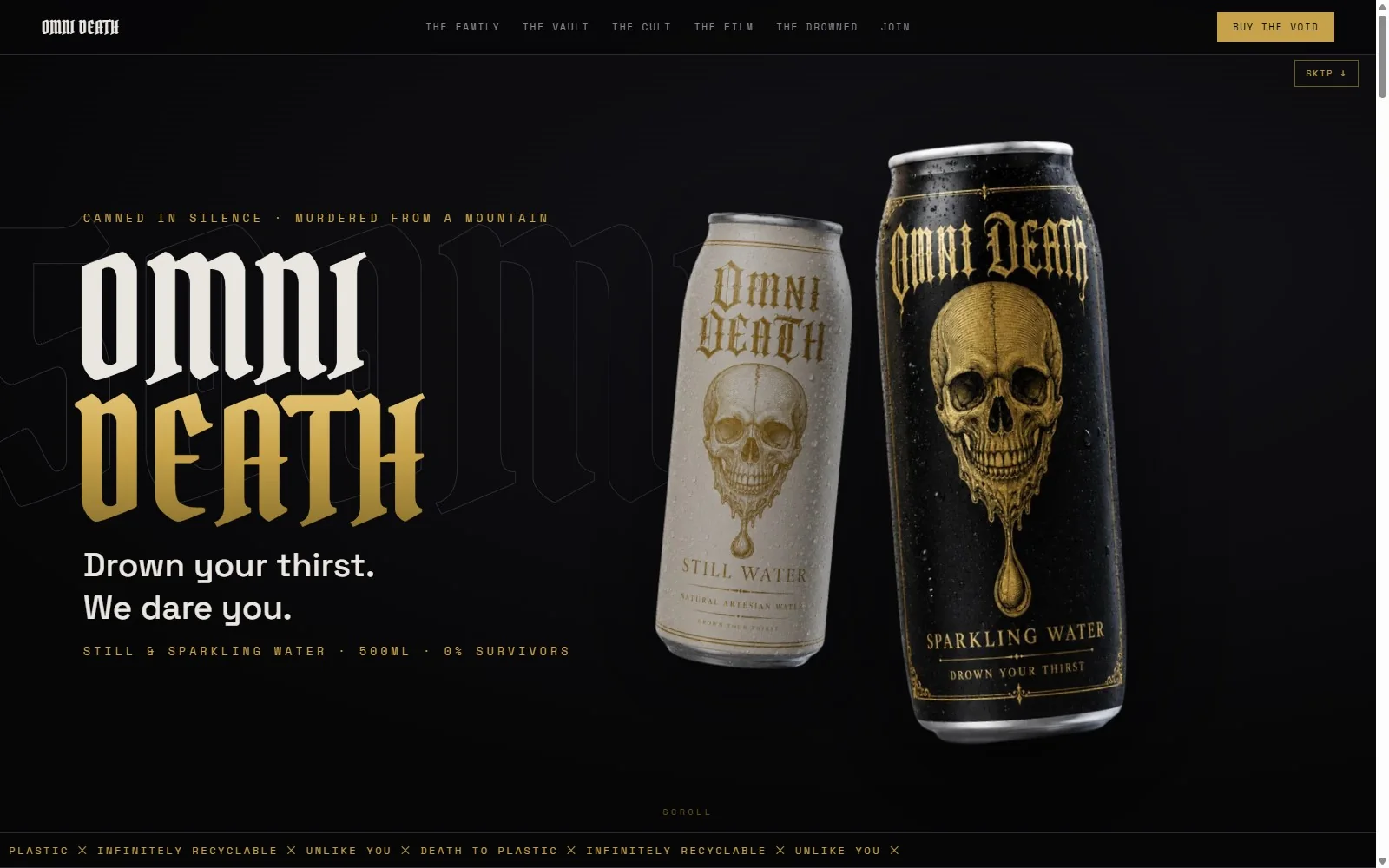
A fictional dark-metal canned-water brand, built end-to-end in the studio — positioning, product design, three SKUs, two synthetic faces, and a full campaign.
No client, no brief: a self-initiated proof that OMNI Labs can stand up a complete brand world from a single idea. OMNI DEATH is a Liquid-Death-grade provocation for still & sparkling water — "murdered from a mountain, canned in silence" — with a gold-on-black skull system, a death-to-plastic manifesto, and a cult mythology around a 500ml ration called The Big Void.
Every layer was produced in-house: the can label system, three product SKUs rendered as clean packaging photography, two original synthetic faces cast and locked across editorial and motion, and a campaign film — all from artwork to finished frame, no external shoot.
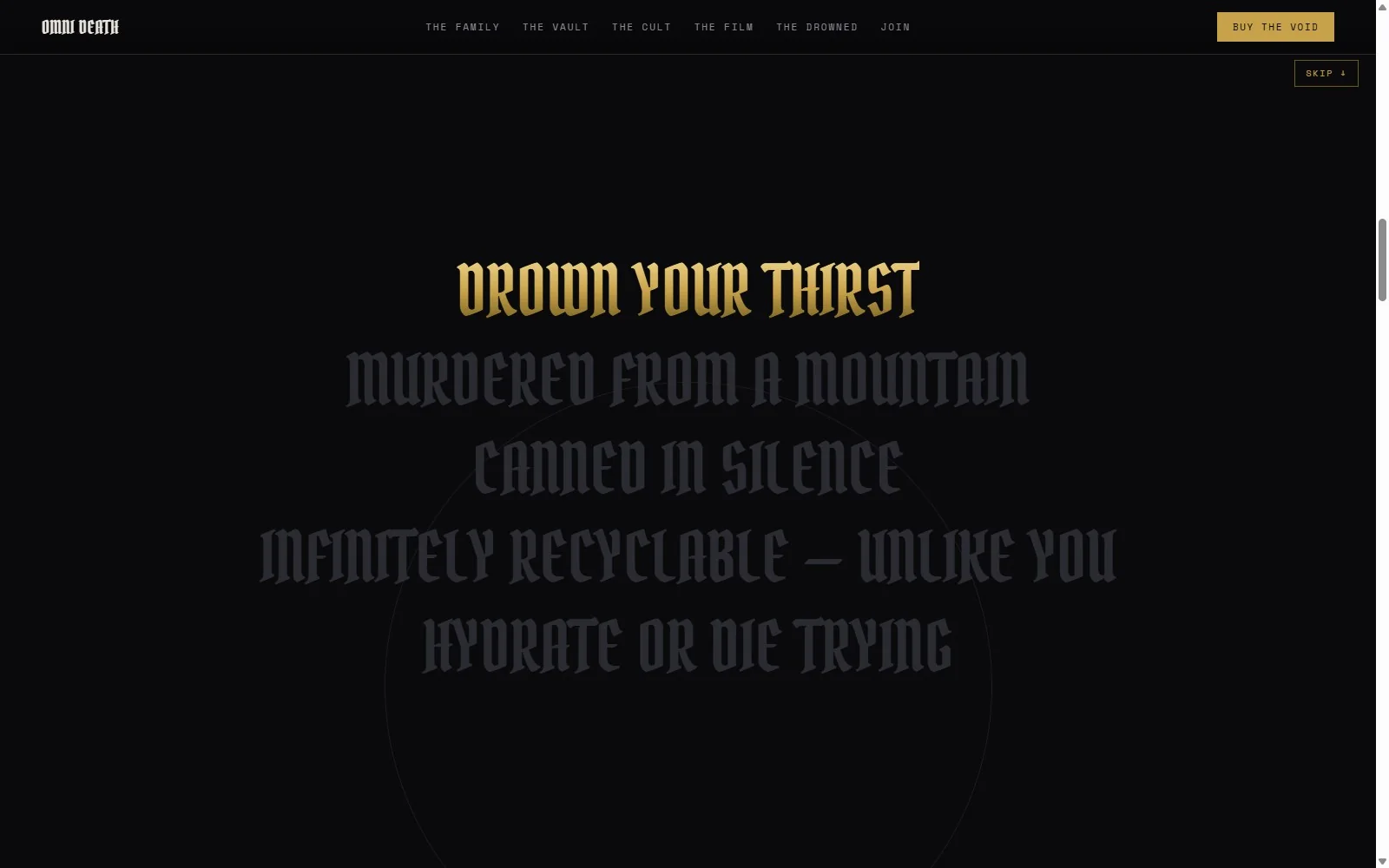
The brand is built on a single dark joke taken completely seriously: water as a death cult. Every line is provocation as positioning.
"It's just water. That's the scary part."
Murdered from a mountain. Canned in silence. Death to plastic — aluminium is forever, it dies and resurrects on infinite loop. The full range is the only water with a body count of zero bottles. Hydration reframed as a cult you don't survive: drown your thirst, we dare you.
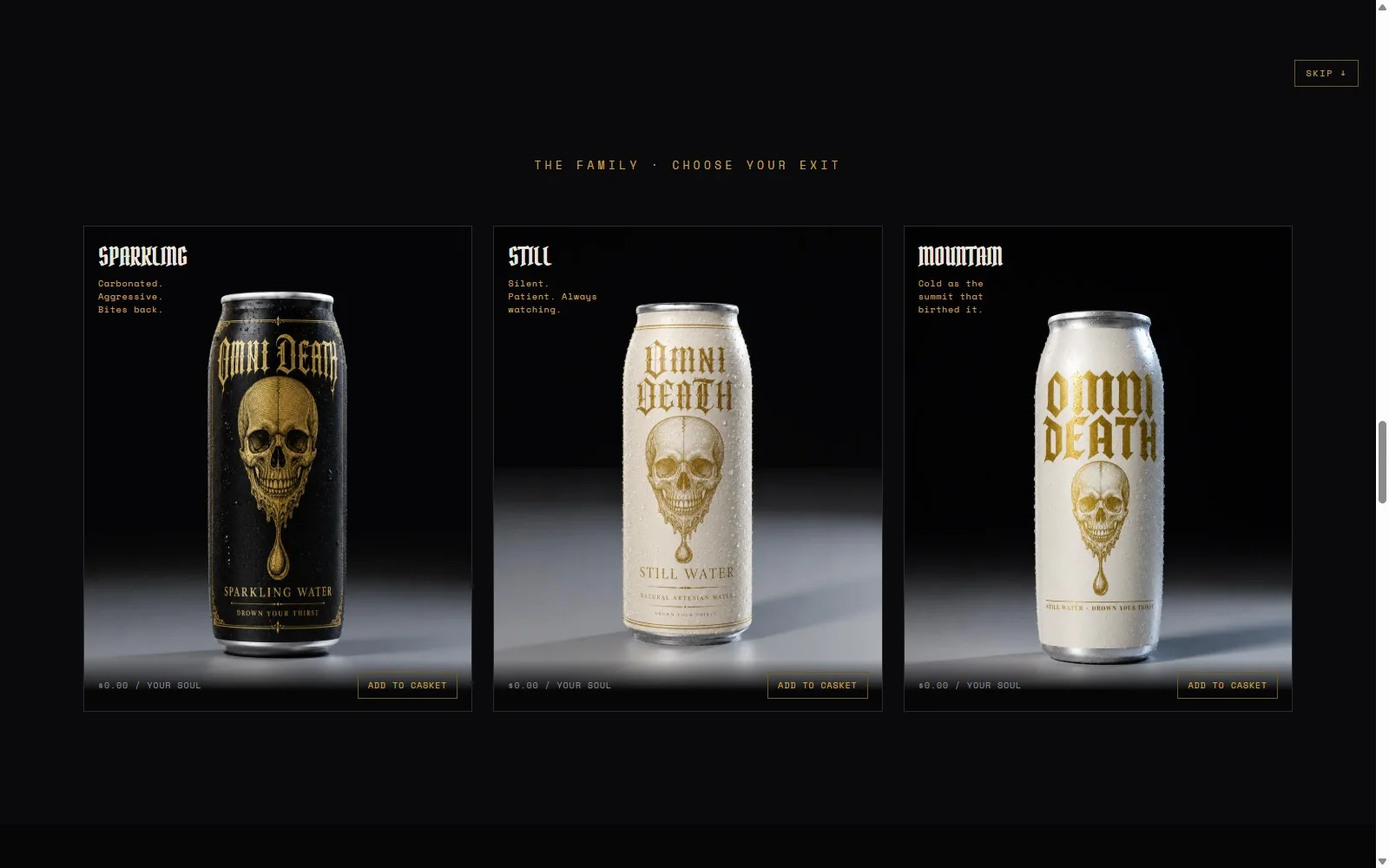
Three SKUs on one gold-blackletter skull system — Sparkling, Still, and Mountain — each rendered as clean in-pipeline packaging photography.
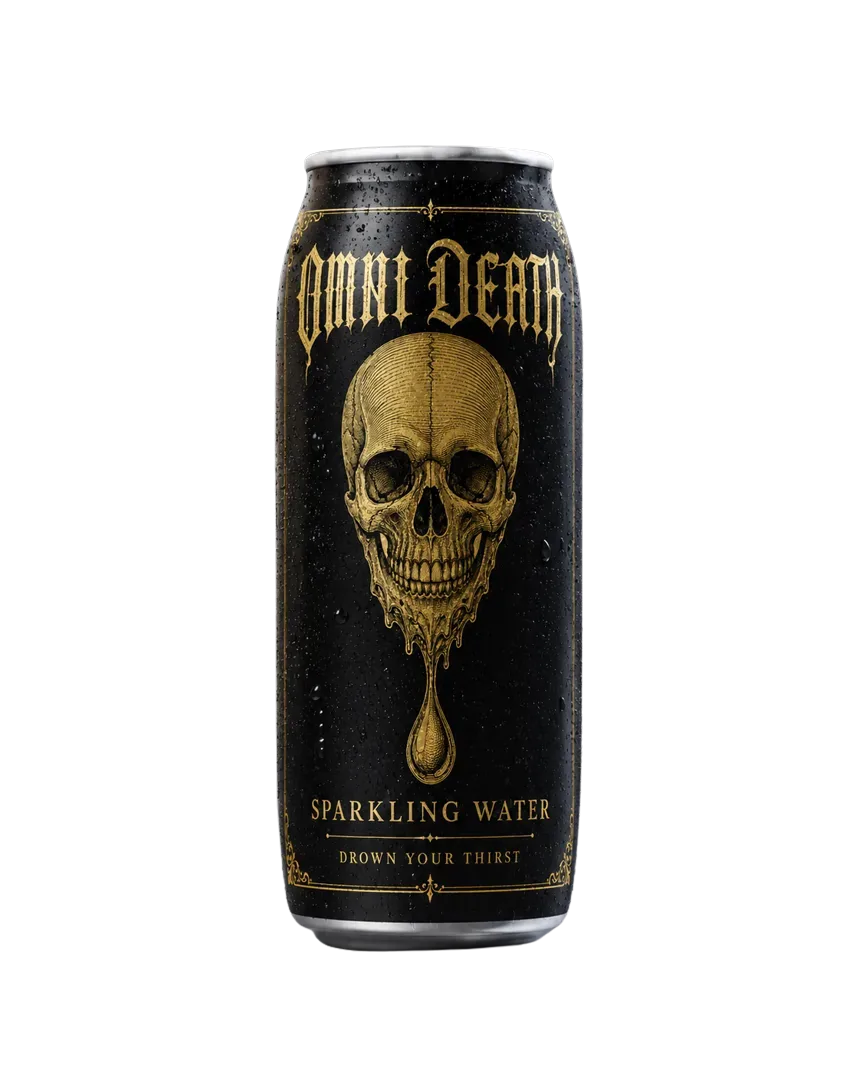
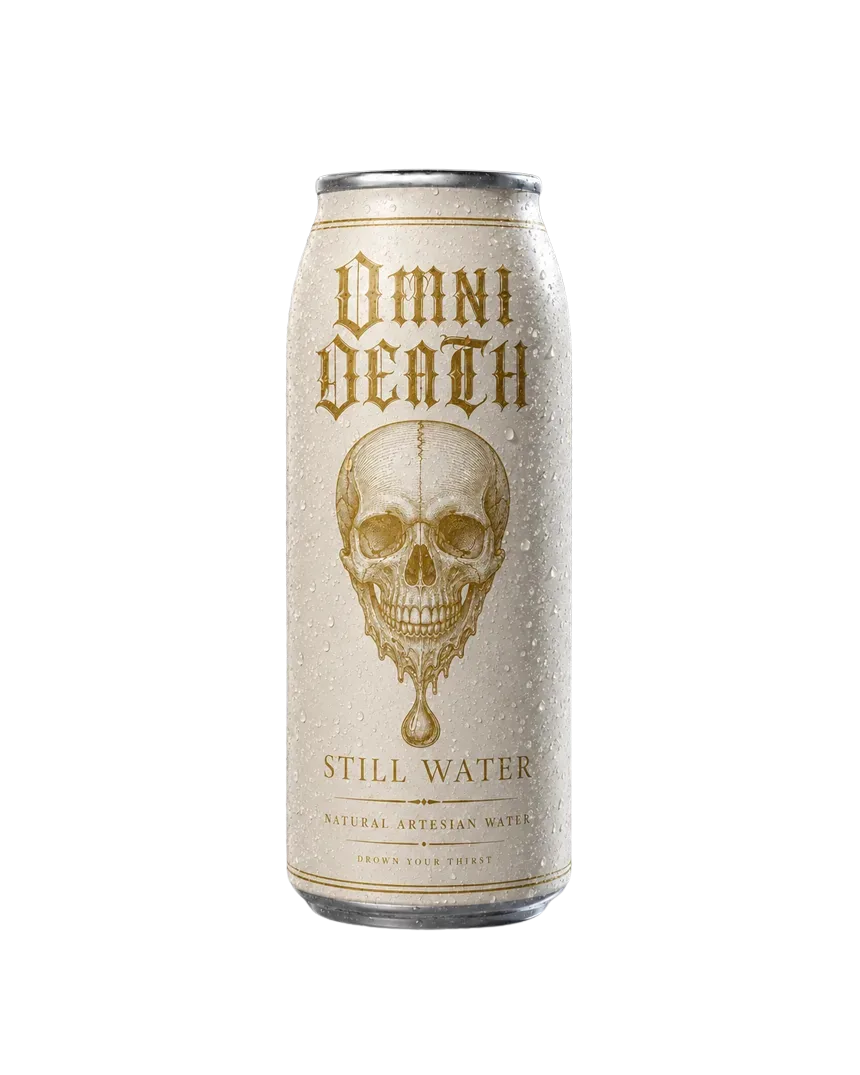
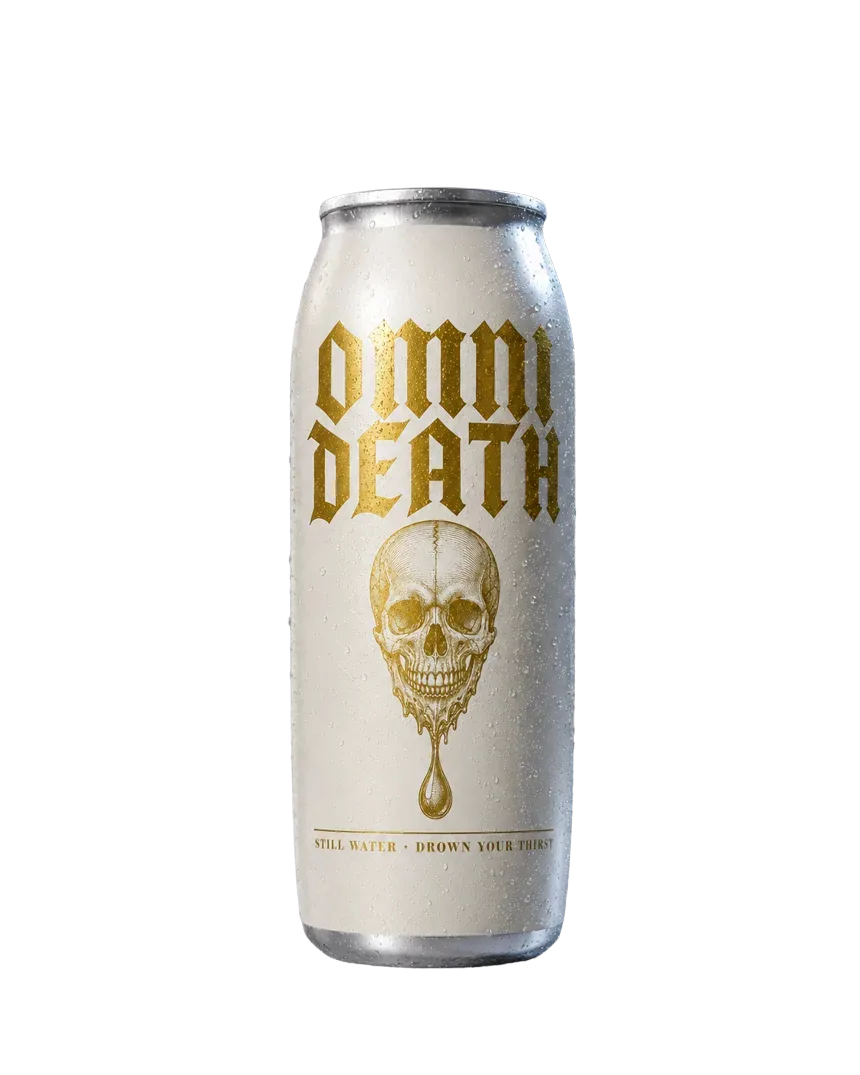
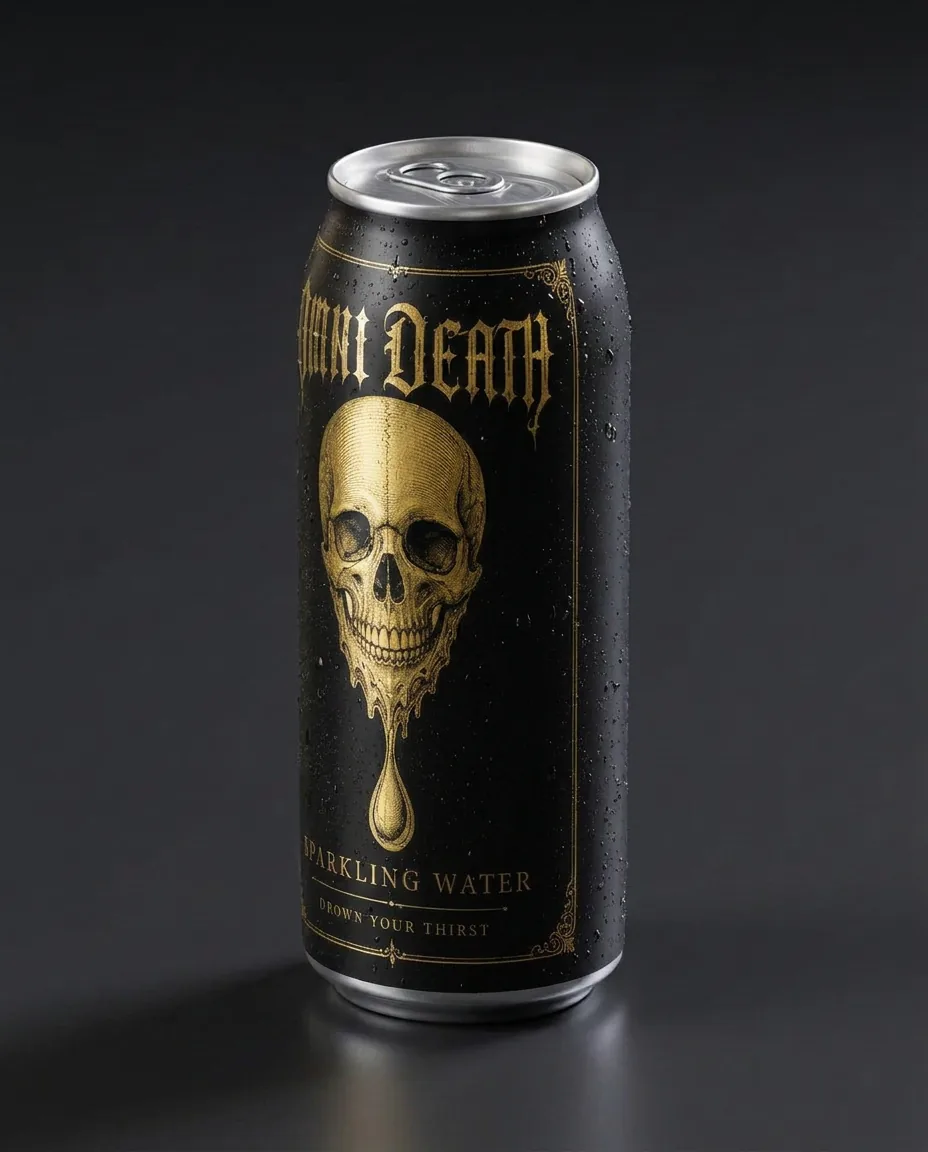
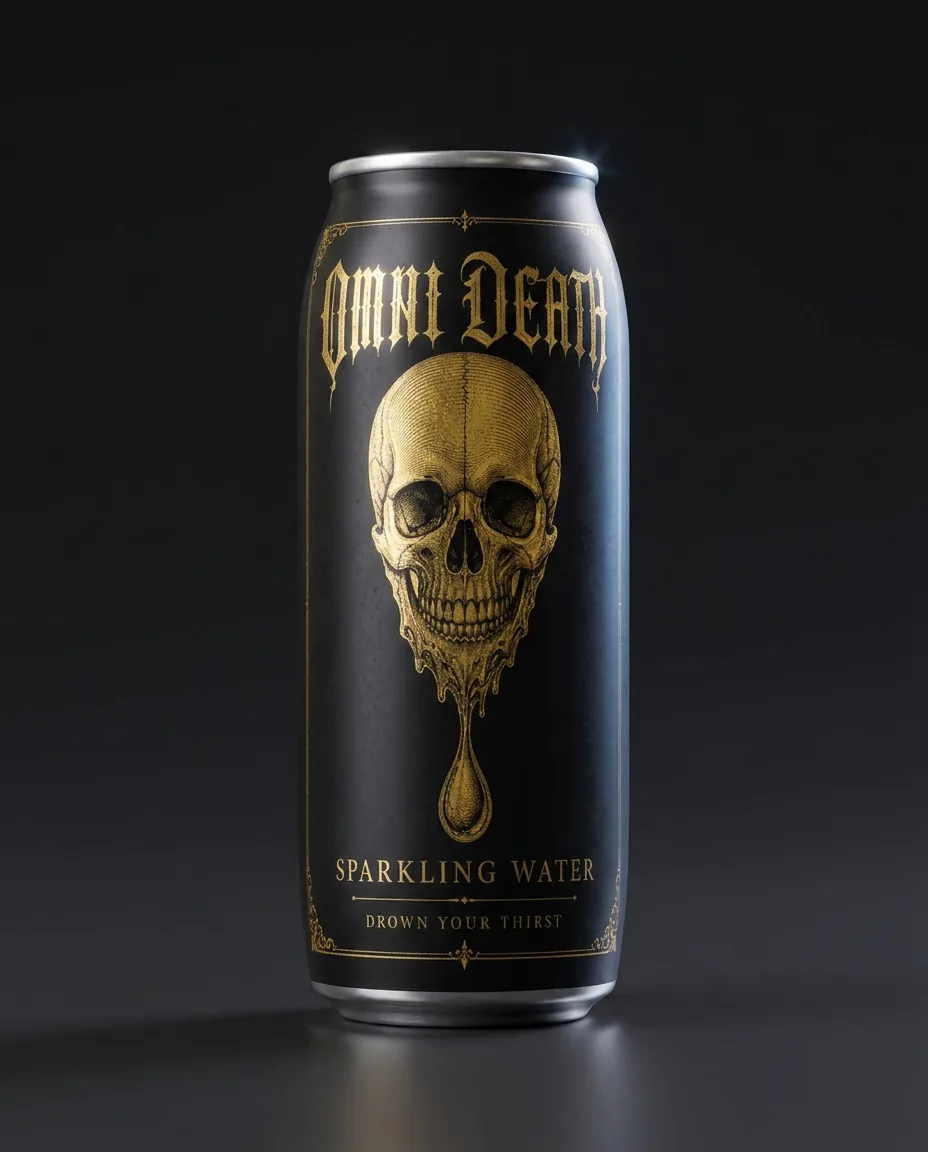
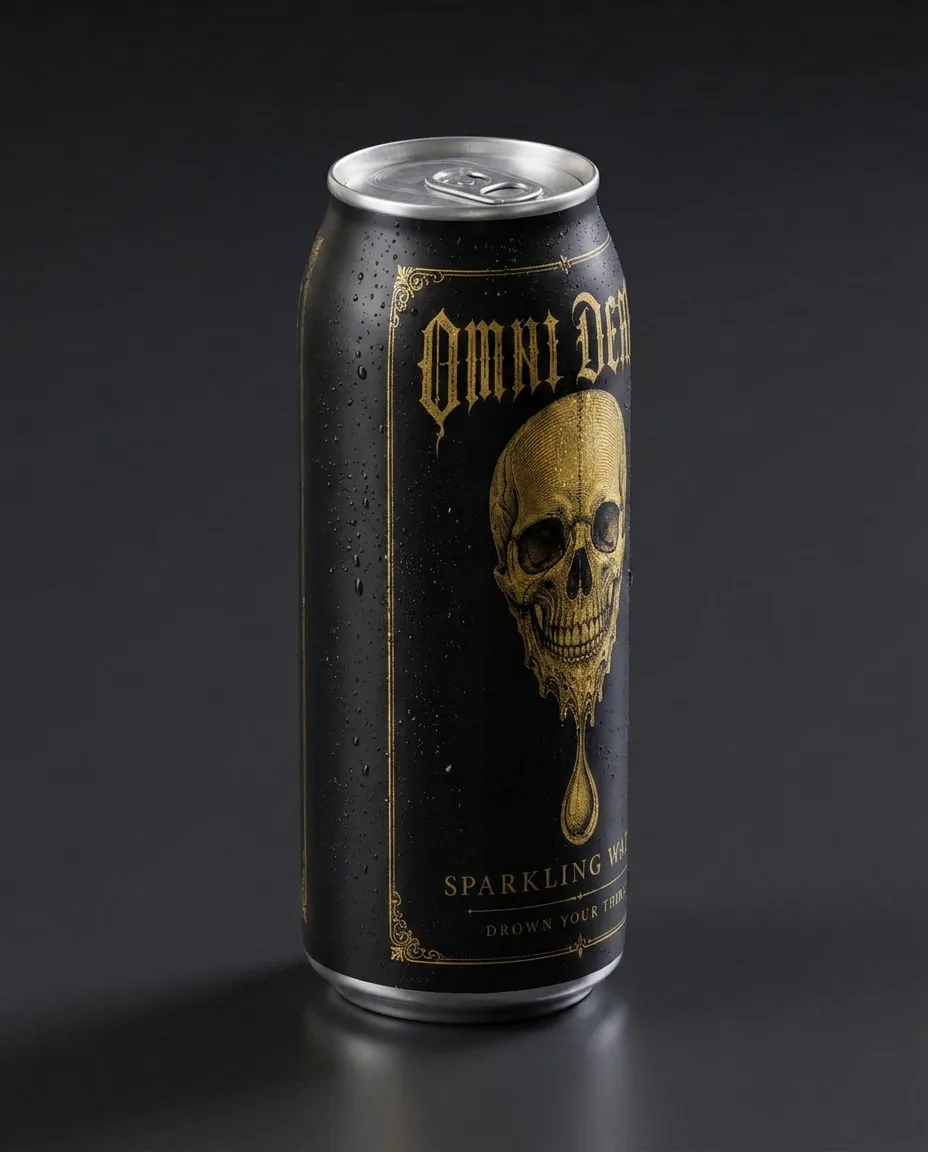
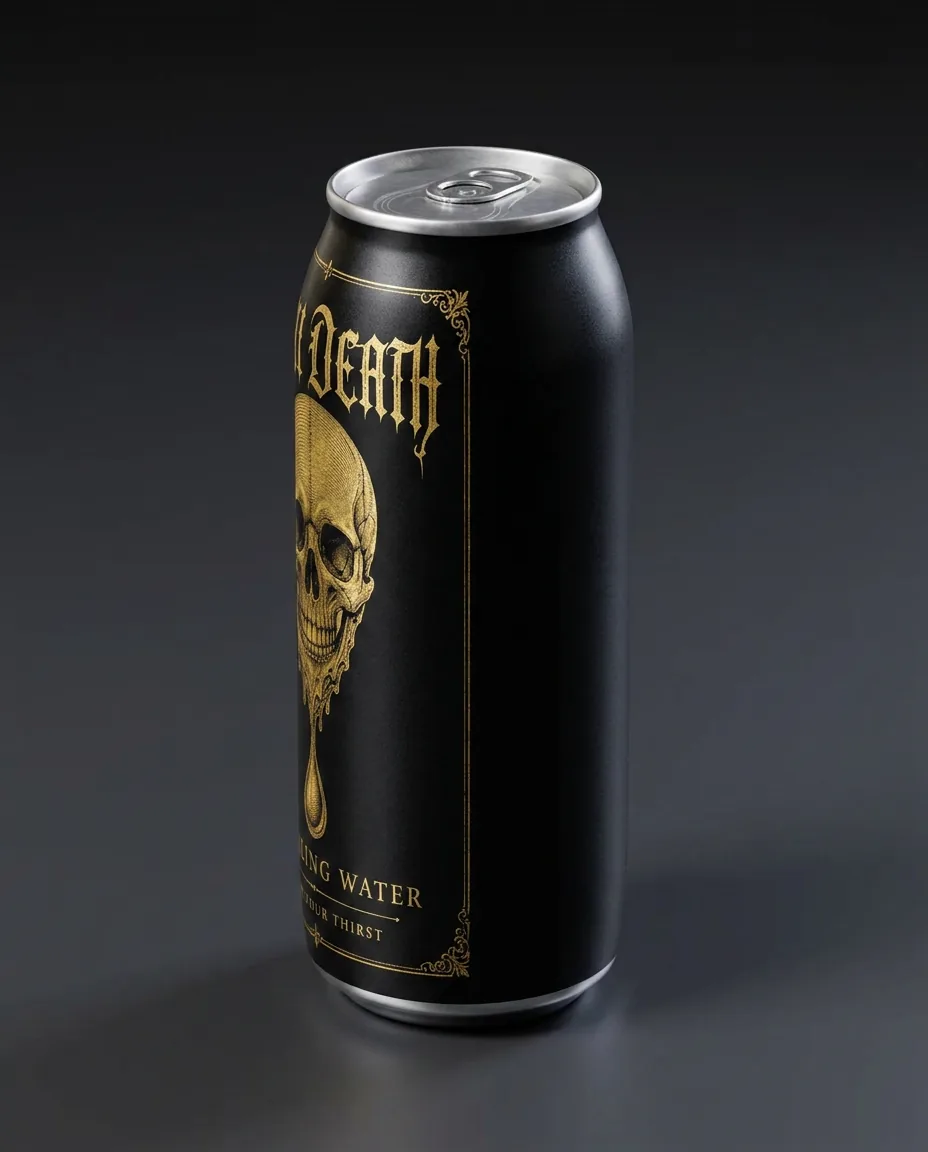
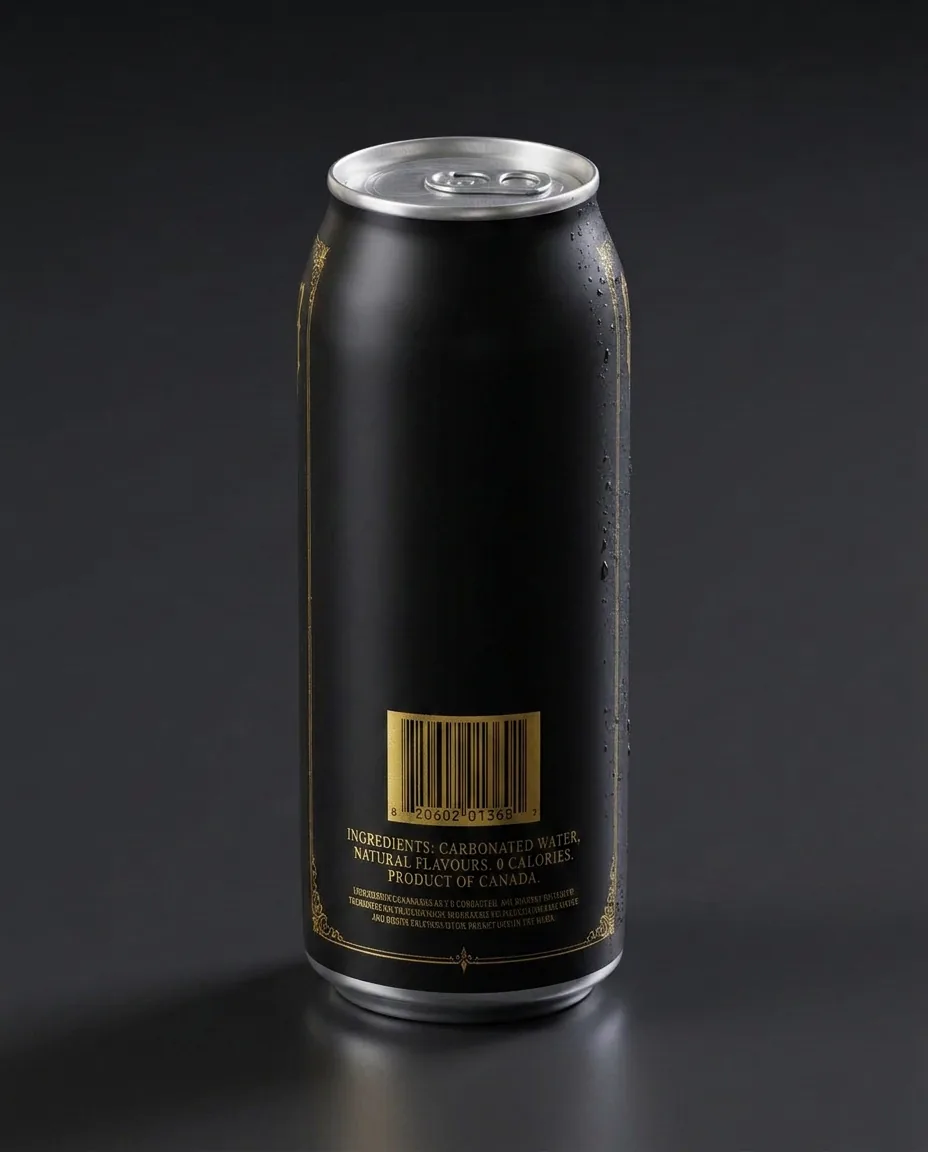
Sparkling Water — the hero SKU, shot across five angles. Matte-black body, gold engraved skull, foil blackletter wordmark, "Drown Your Thirst."
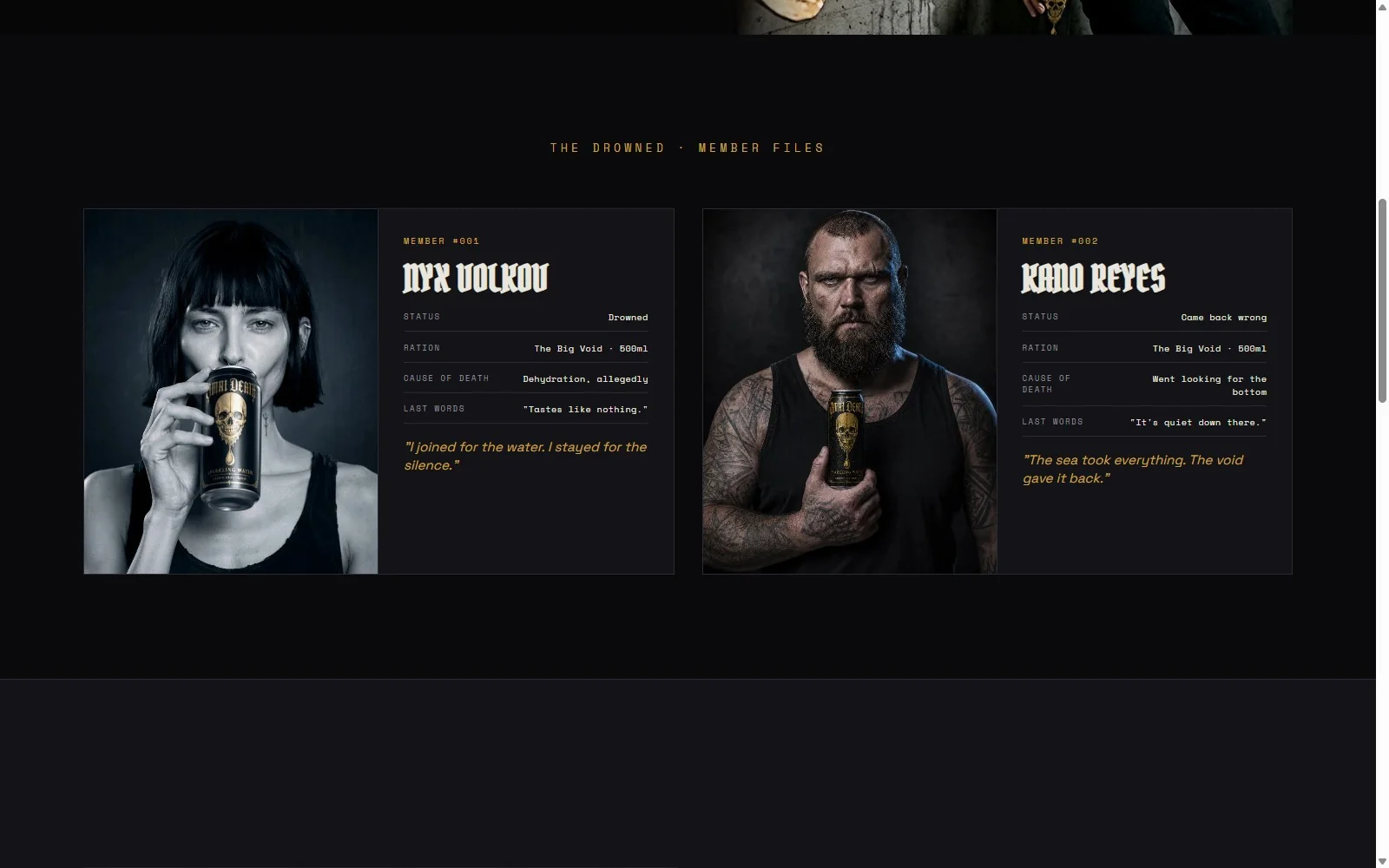
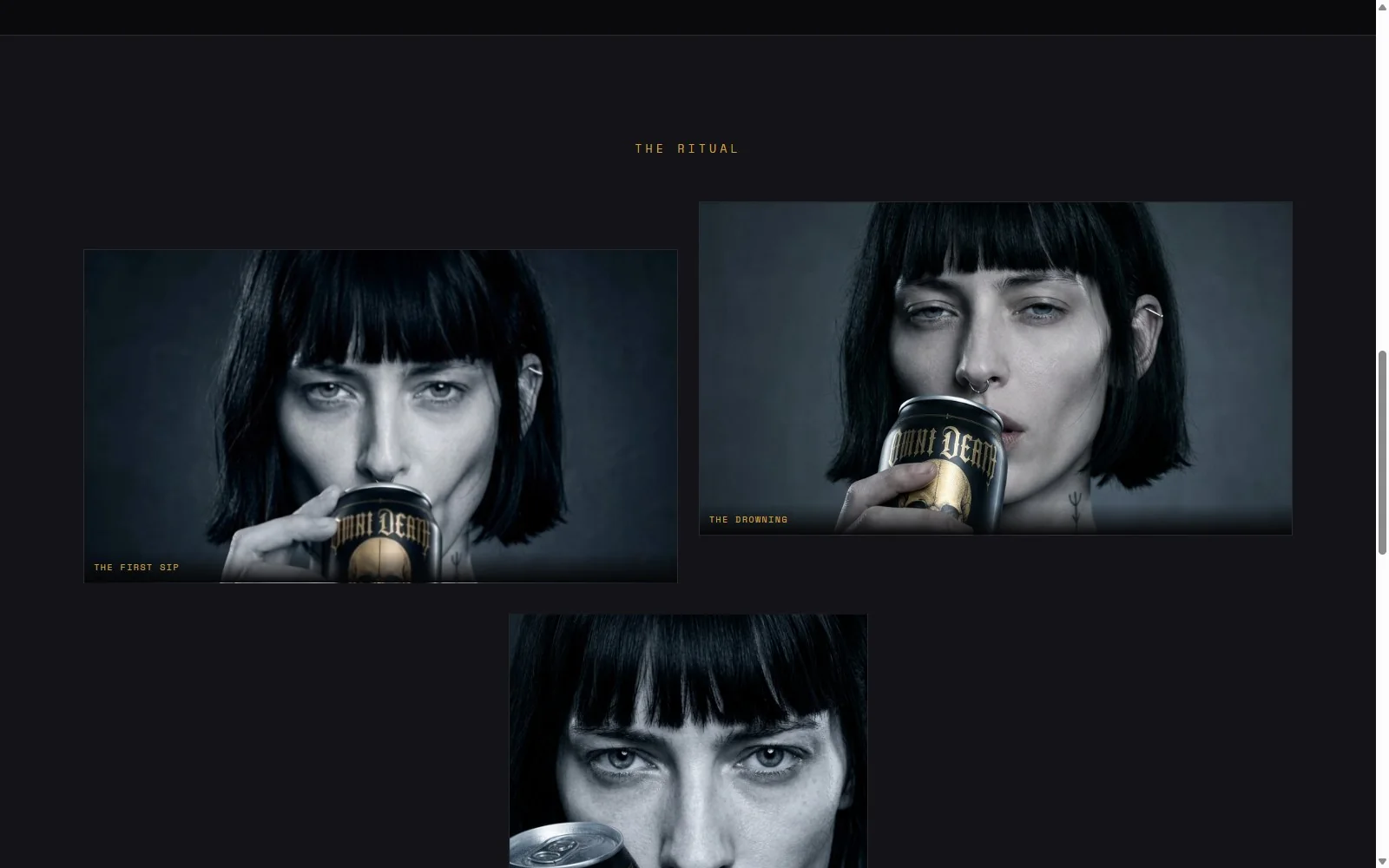
Two original synthetic faces, cast as the cult — identity-locked across portrait, editorial, and motion.
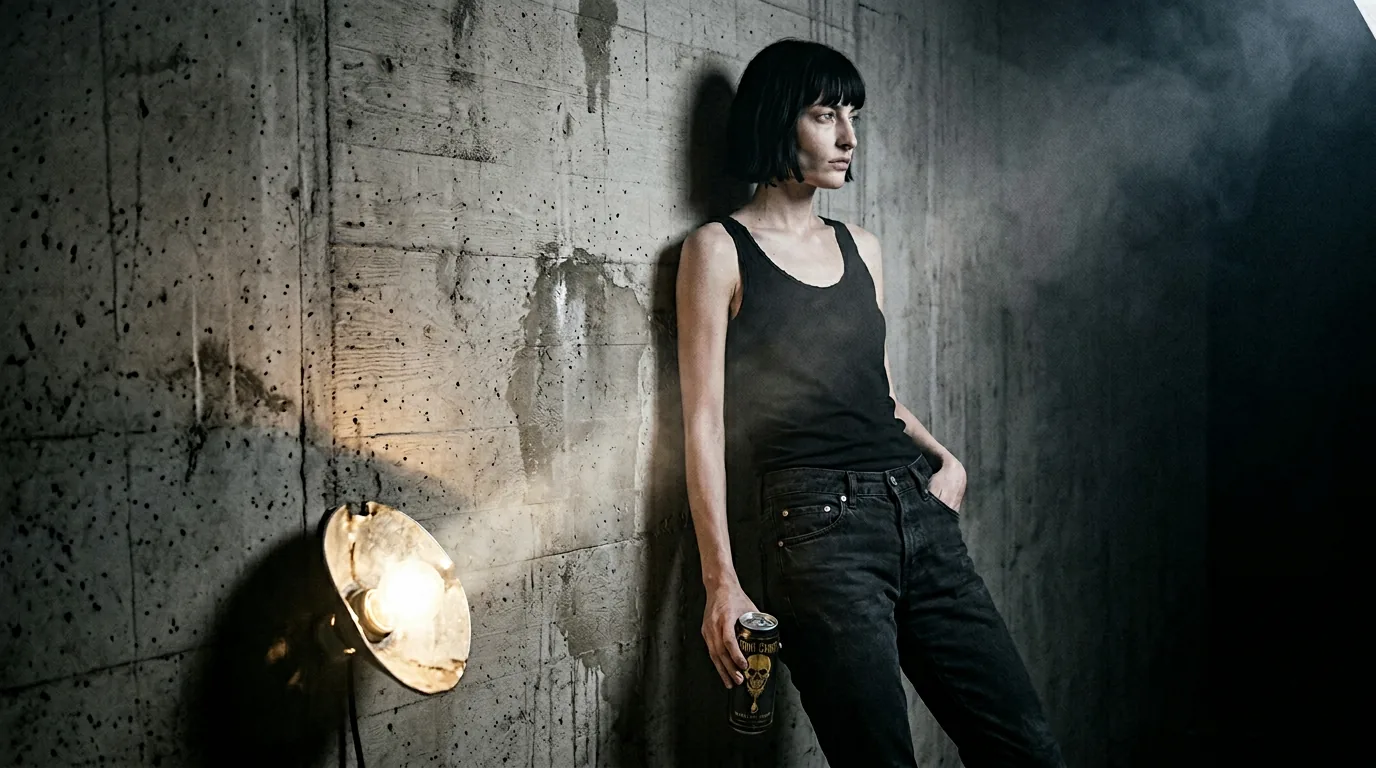
Cold, nocturnal, anti-influencer — the original cult face. Locked across portrait, basement editorial, and a sip-ritual film.
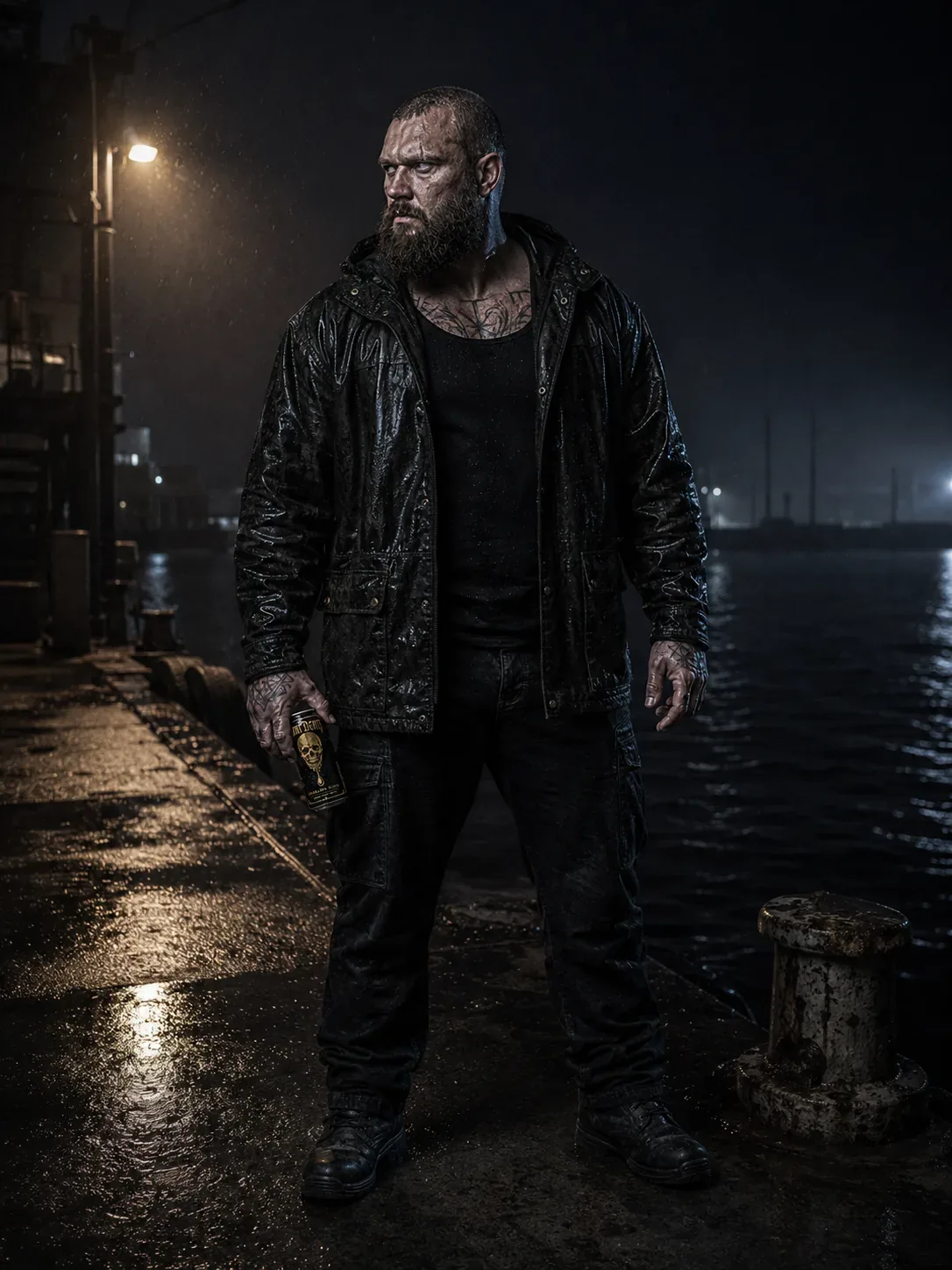
The drowned man, back from the deep — a scarred, heavy-framed counterweight to Nyx. Same identity-lock pipeline, eight shots from portrait to dock editorial.
Editorial frames pulled from the cult world — basement, dock, and product lineup.



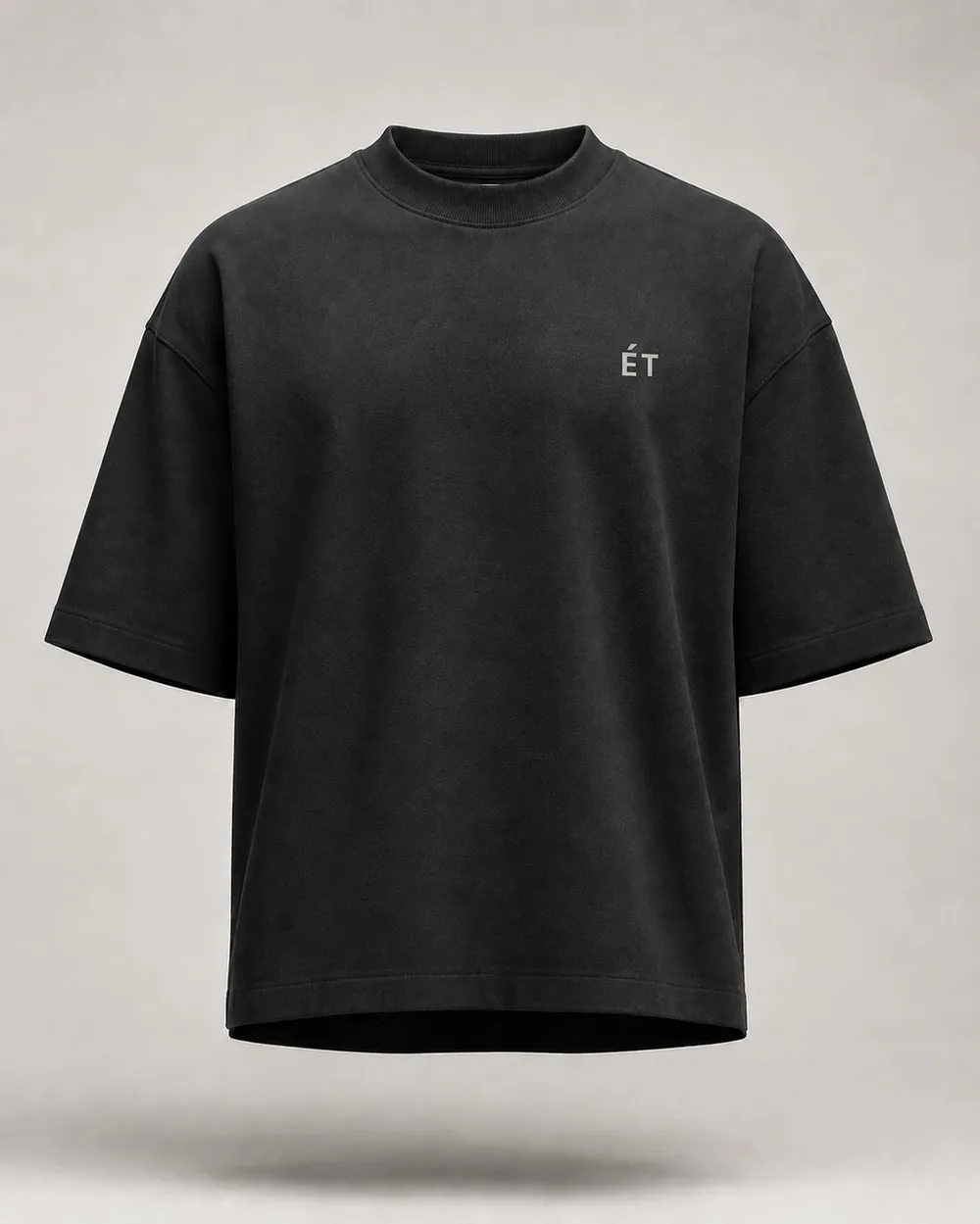
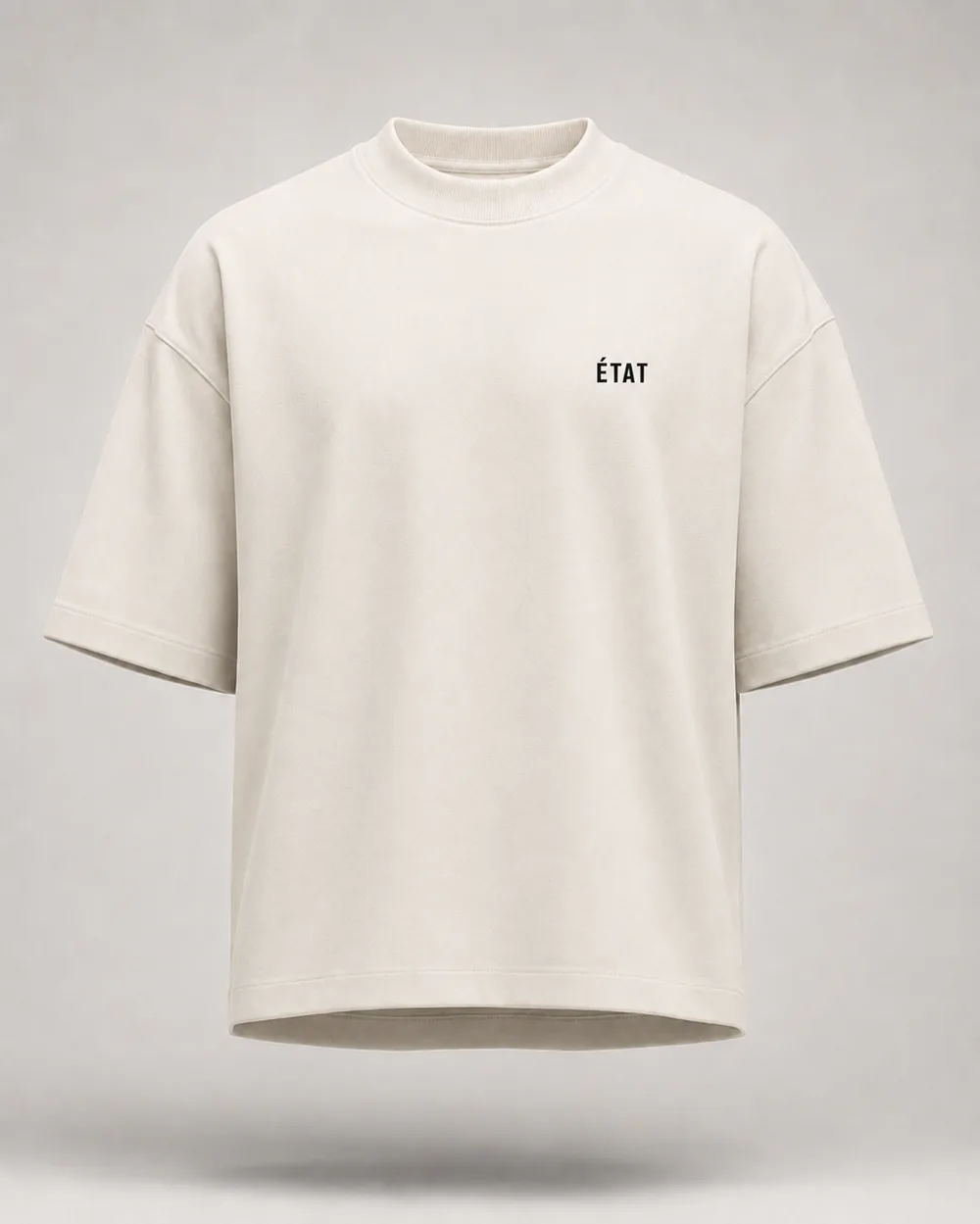
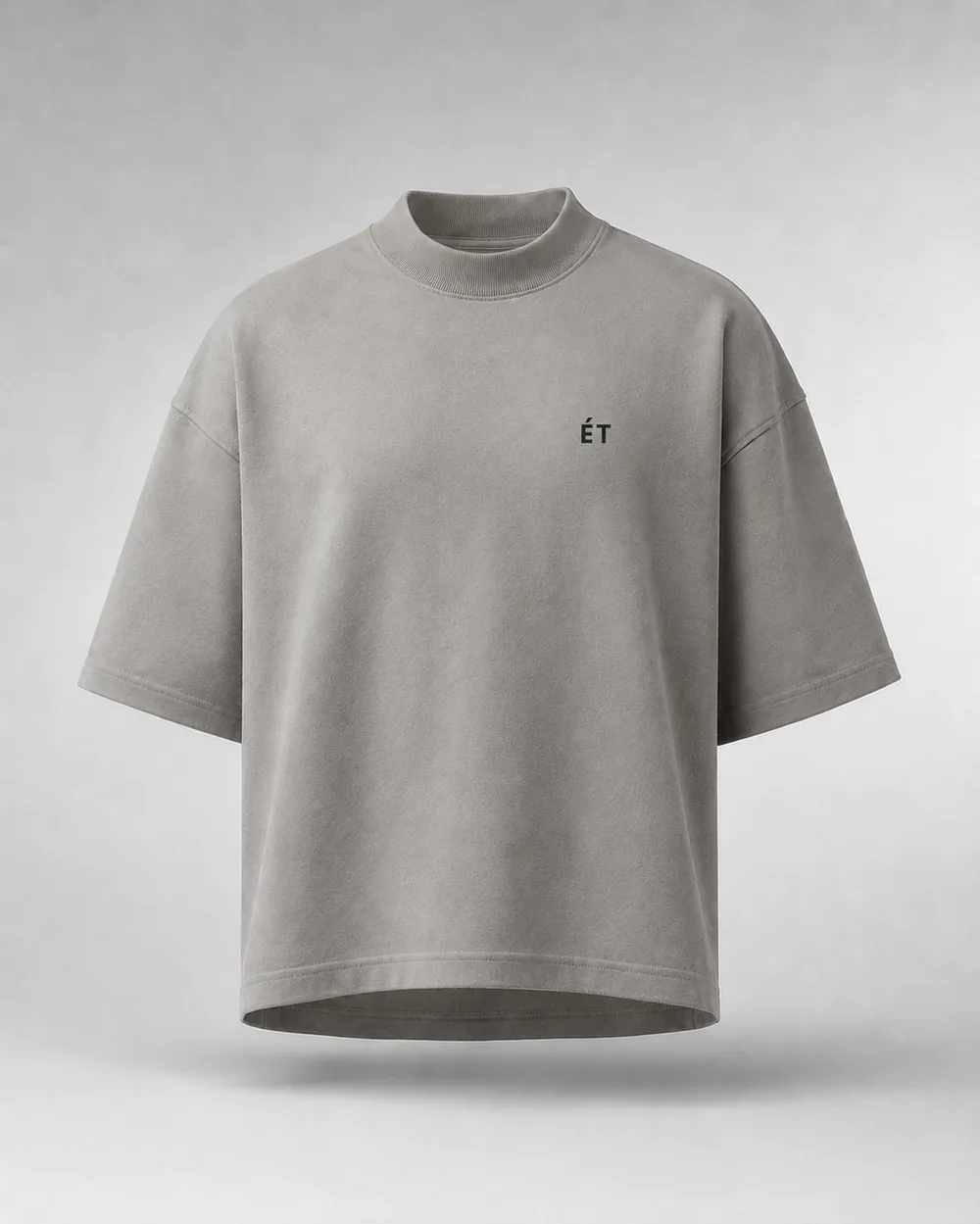

A design-led cultural-uniform house, built end-to-end in the studio — a doctrine, one garment in three colorways, a synthetic face, a full carousel, a designed film, and a live store you can shop.
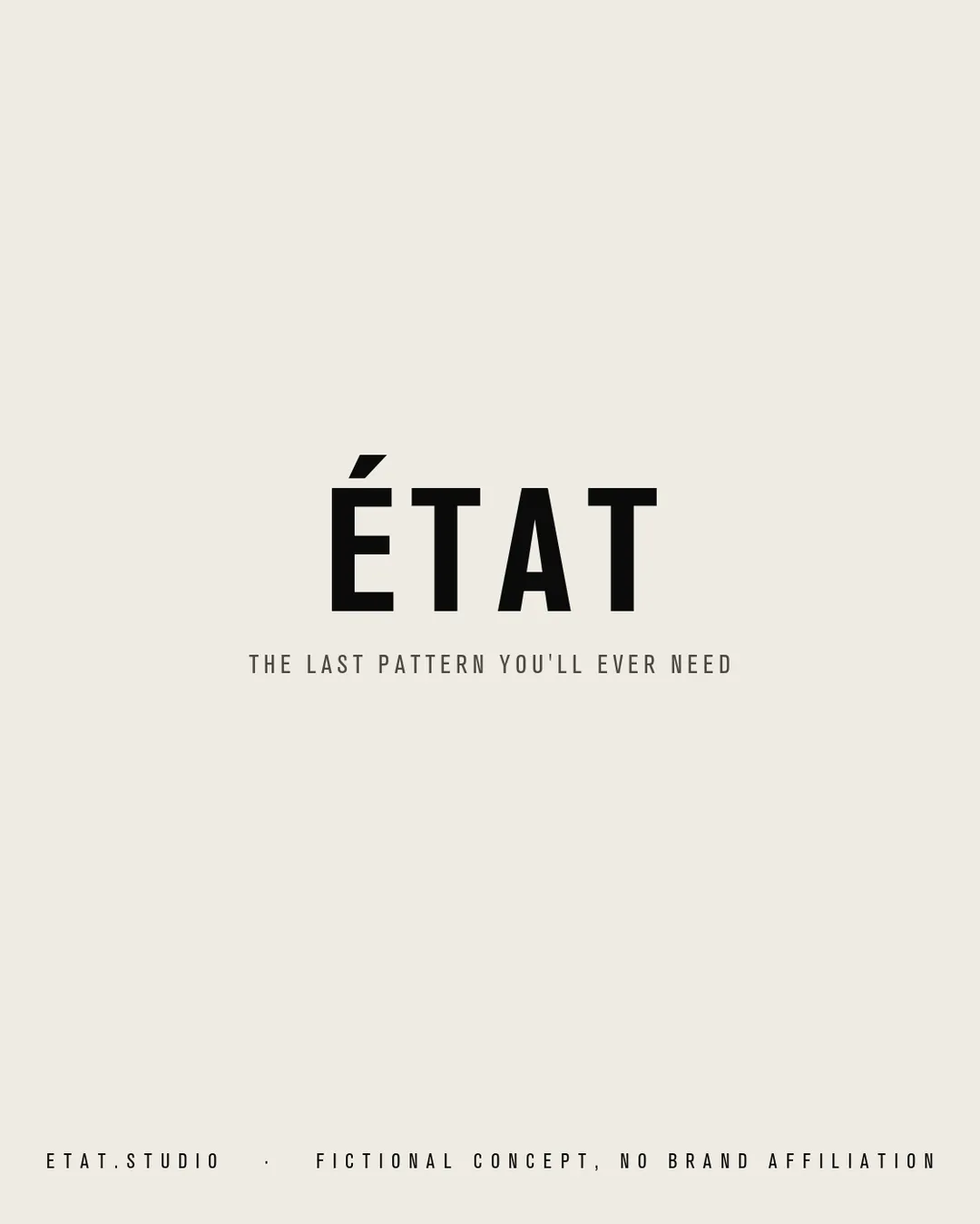
No client, no brief: a self-initiated proof that OMNI Labs can stand up a complete fashion brand — and ship its storefront — from a single idea. ÉTAT is the anti-streetwear position: a premium tee "recognized by the cut, not the logo." The whole world is built backwards from the logo — no chest print to sell, no seasonal hook to chase, only the garment, resolved until it stands on its construction alone. Carbon, Bone, Dust. No seasons, no drops. Made once, kept.
Every layer was produced in-house: the brand doctrine and mark system, a 21-shot garment line across three colorways, a synthetic flagship face cast and identity-locked across editorial and motion, a thirteen-slide launch carousel, an 83-second designed brand film, and a complete e-commerce site — coded, deployed, and live. Artwork to storefront, no external shoot.
The brand is built on a single thesis taken completely seriously: status without a visible logo. Positioning before pixels.
"Recognized by the cut, not the logo."
A permanent uniform for people building what comes next — one garment, resolved with the patience of an institution. Custom fabric, a single considered cut, made once and kept. No seasons. No drops. No noise. The mark stays inside the collar where it belongs; the silhouette does the talking across a room.
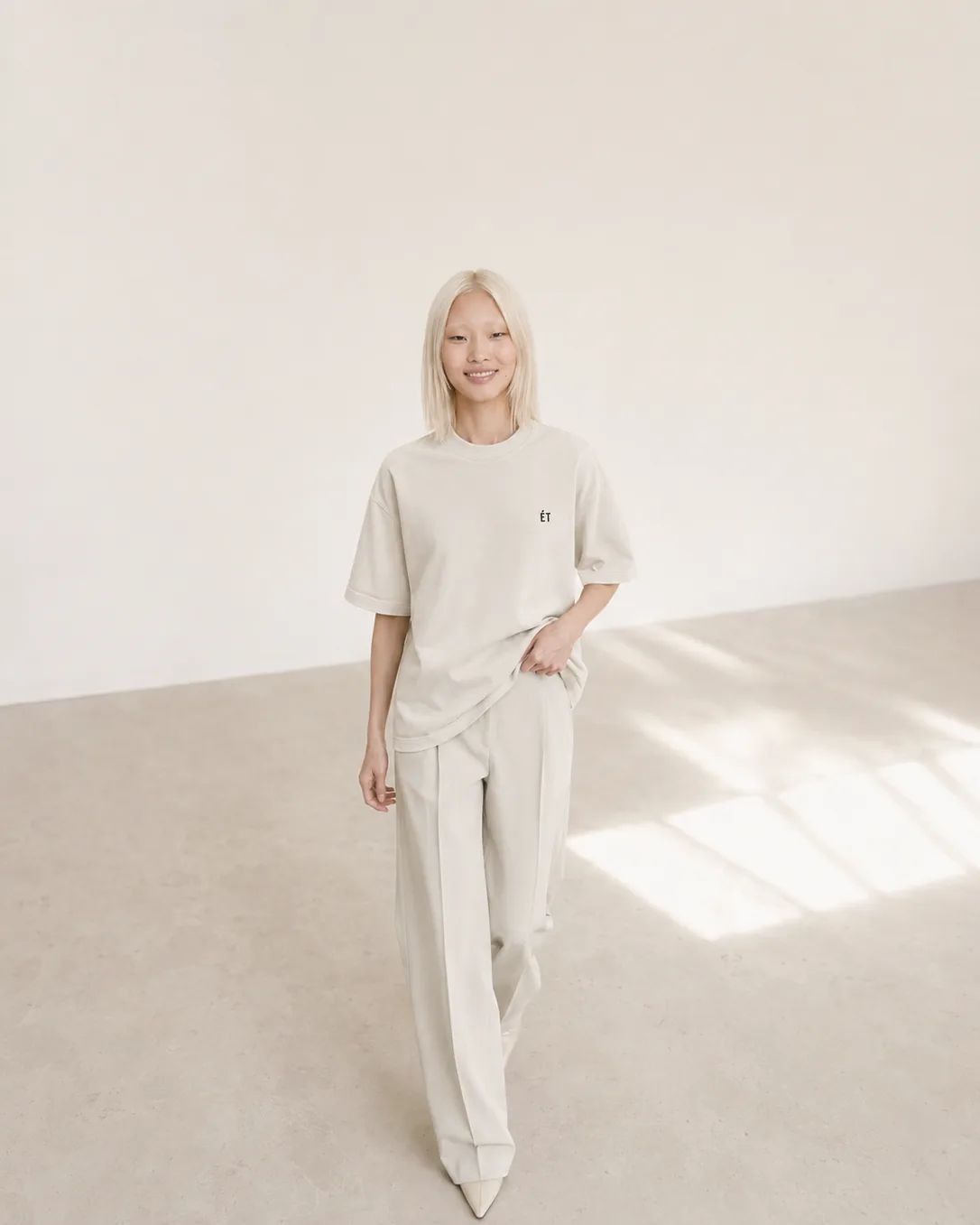
One cut, three colorways on a single 280-GSM compact-knit system — Carbon, Bone, Dust — each rendered as clean in-pipeline product photography.
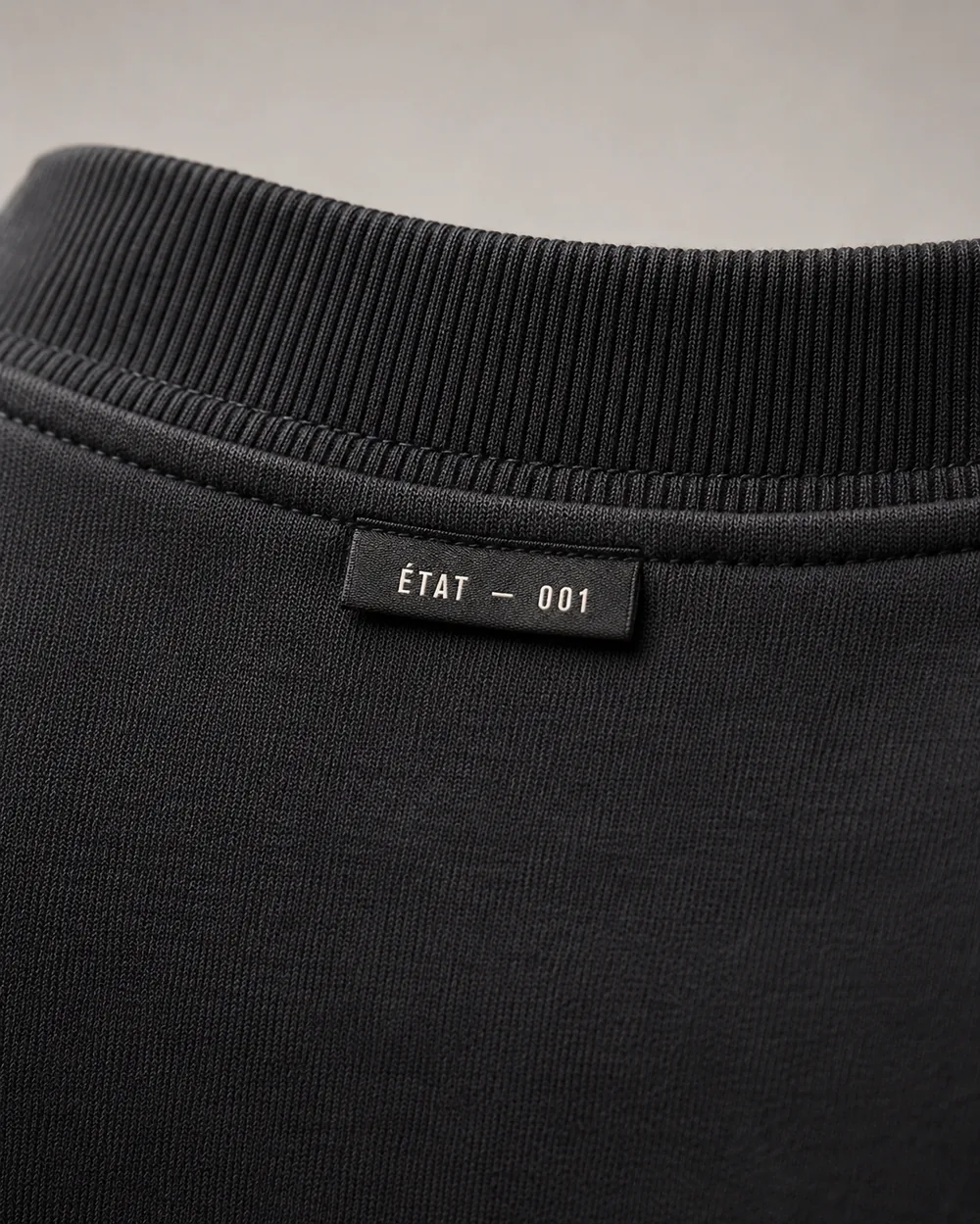
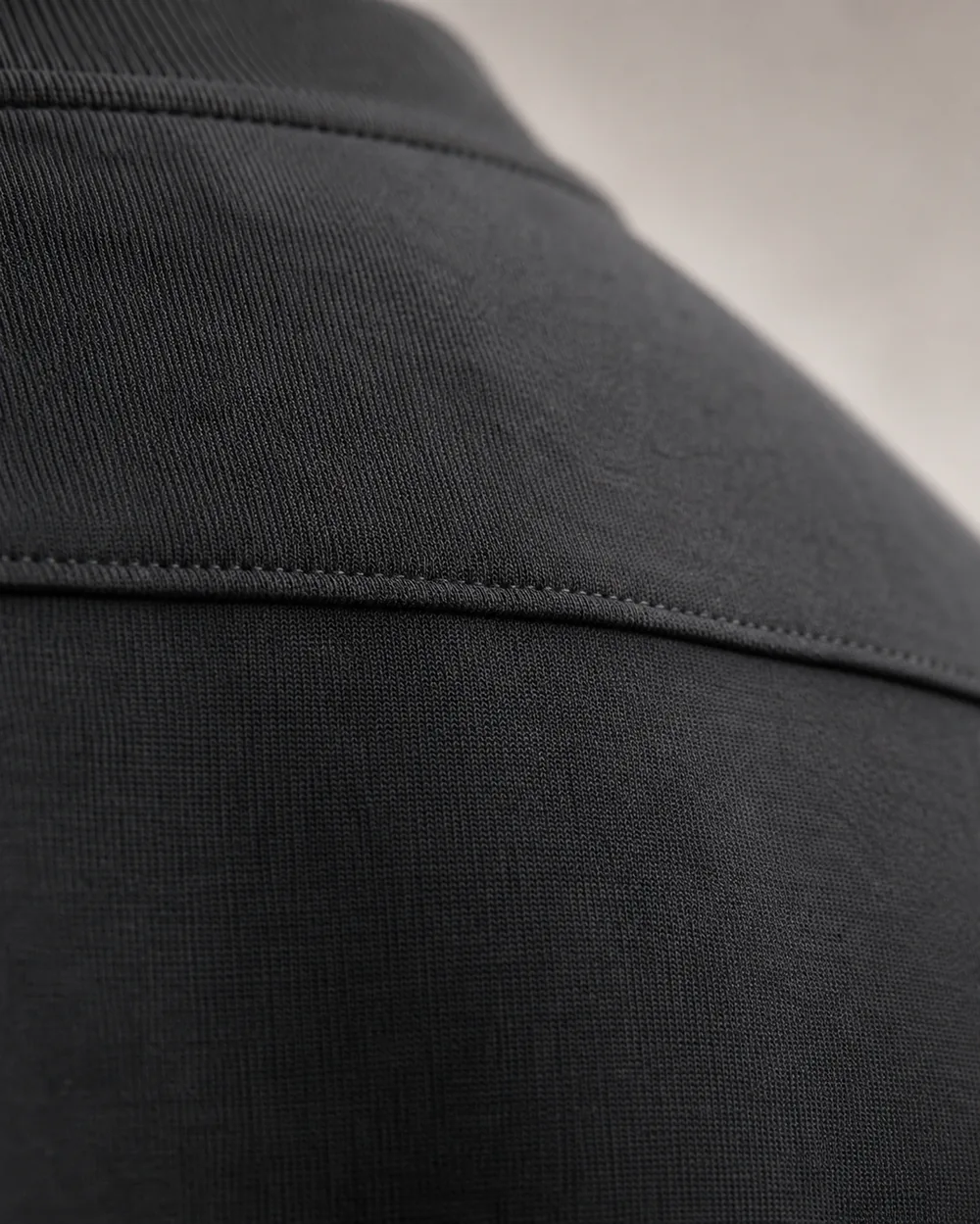
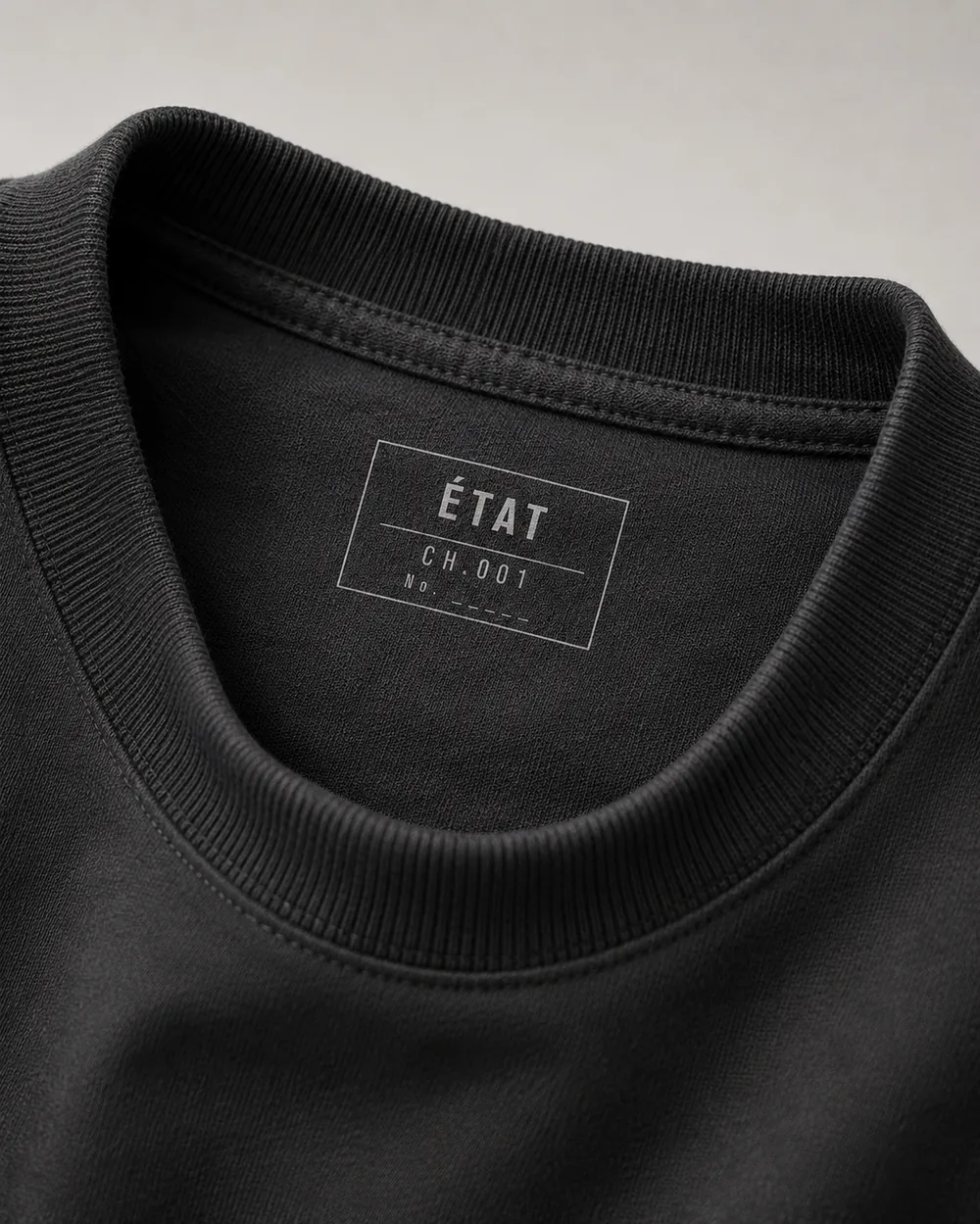
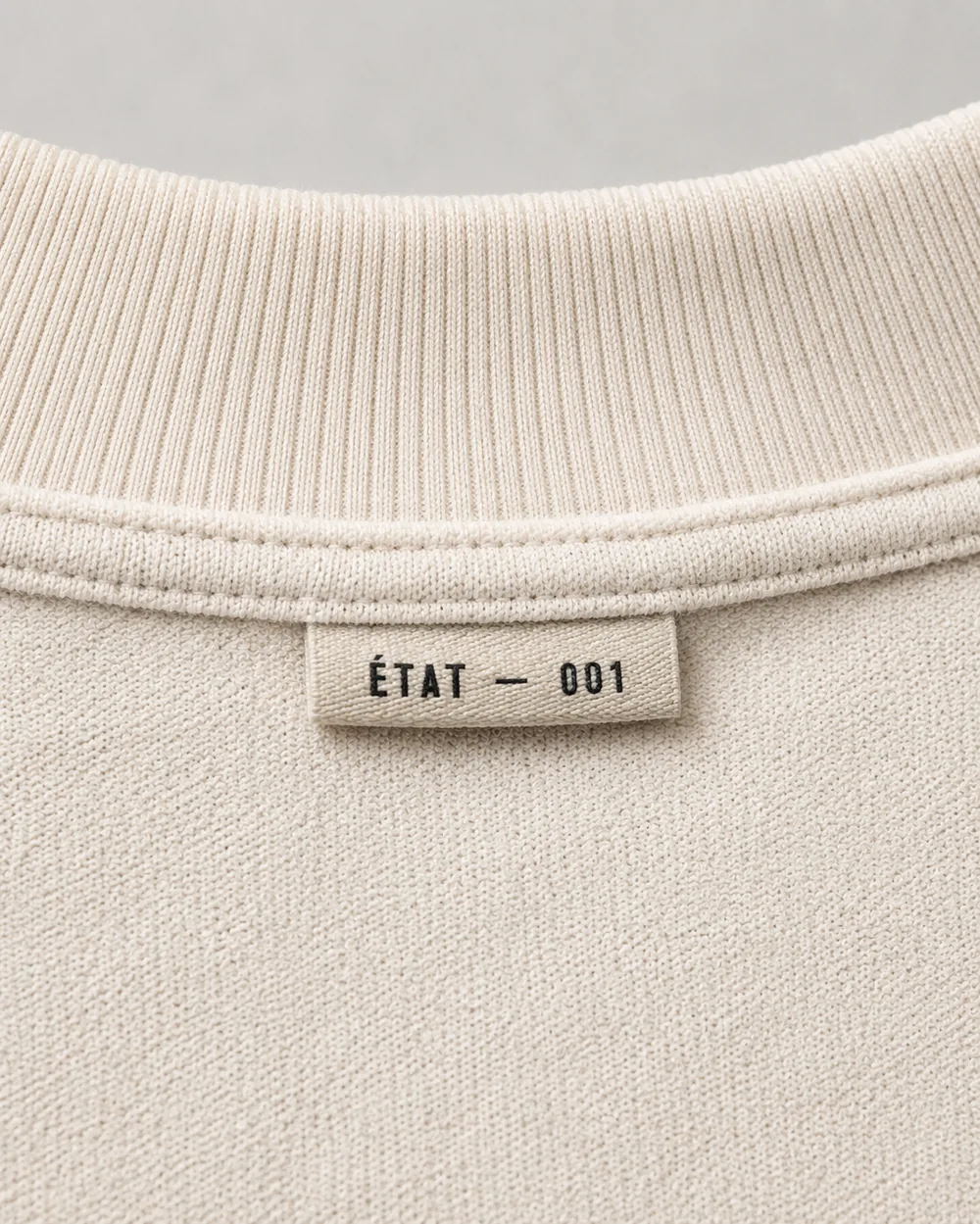
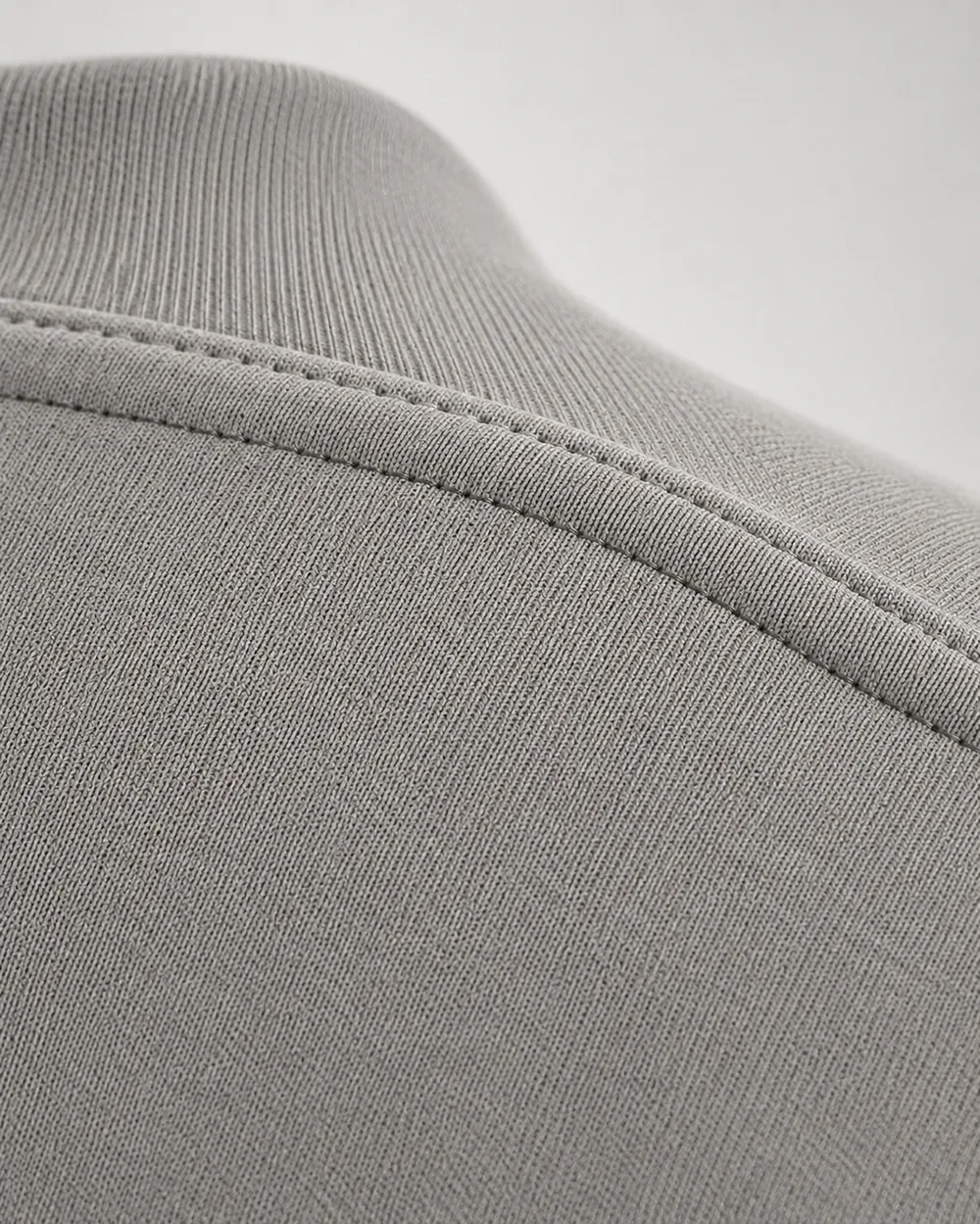
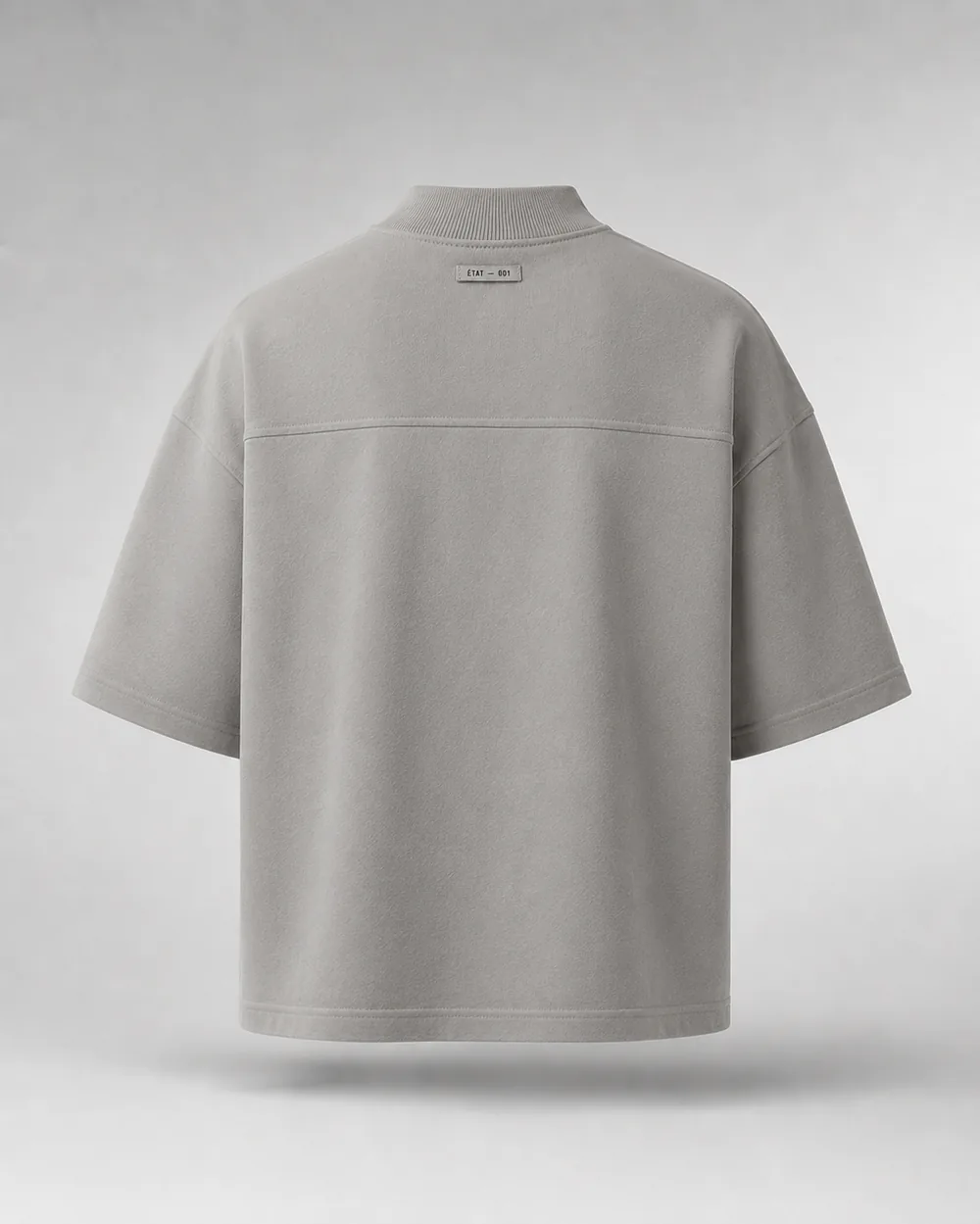
Core Tee — Frame & Drape fits on one pattern. Recognition lives in three quiet marks: a back-seam interruption, a side-seam tab, and a woven nape detail — never a chest print.
Aiko Velora — the certified flagship — cast as Chapter 001, identity-locked across editorial, lookbook, and motion.



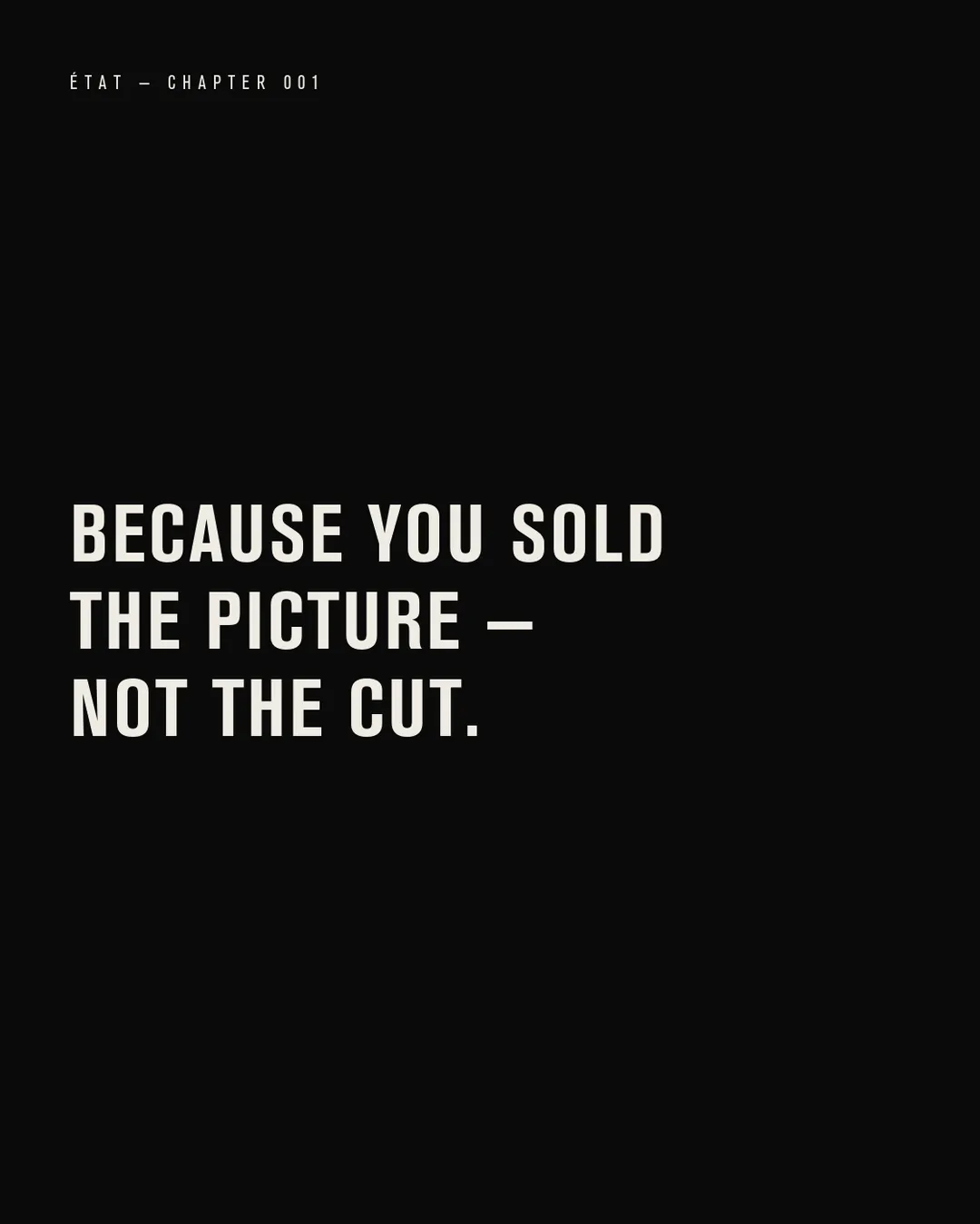
A thirteen-slide launch carousel — the campaign's social cut, with the Vermilion accent system carried through every line.


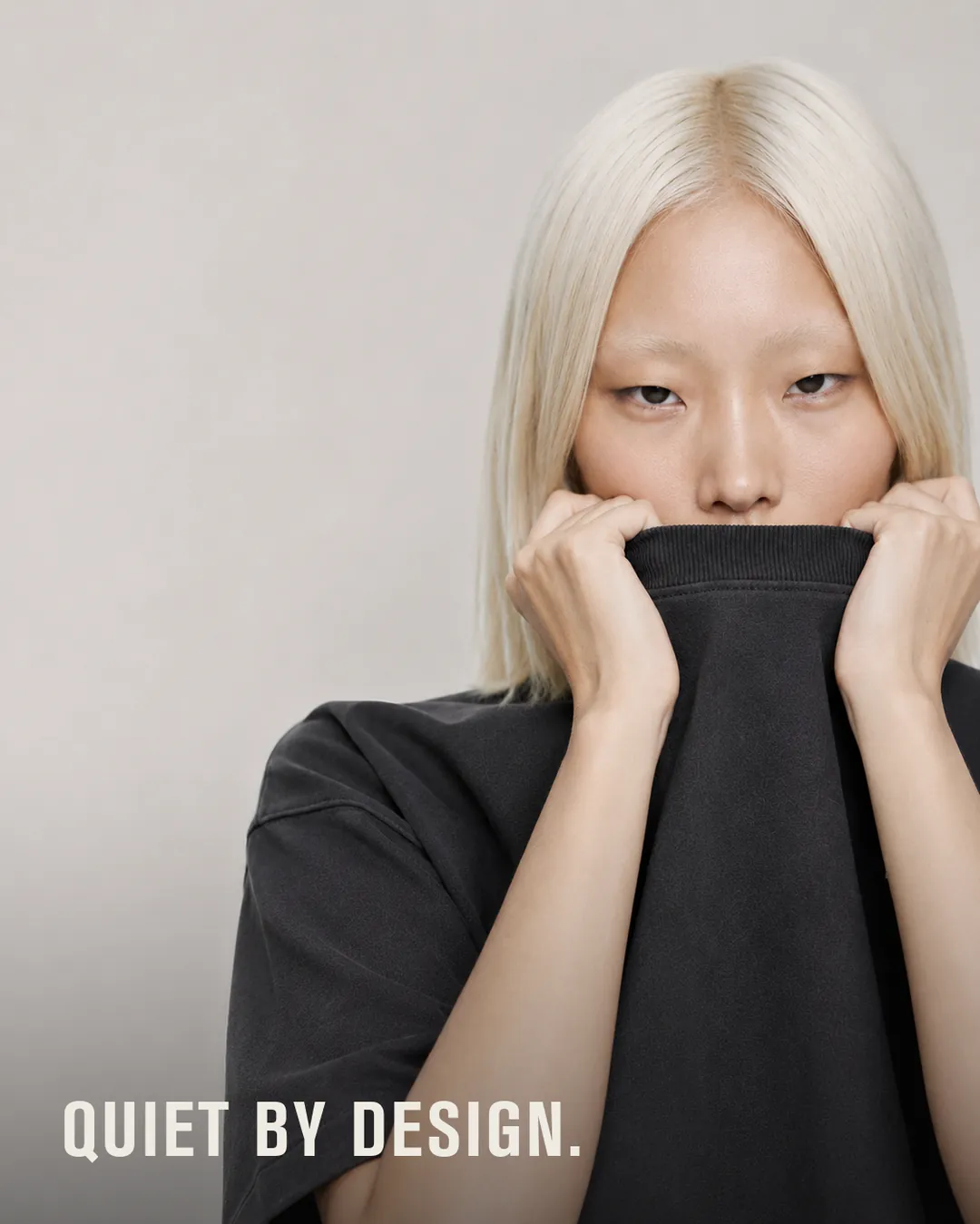


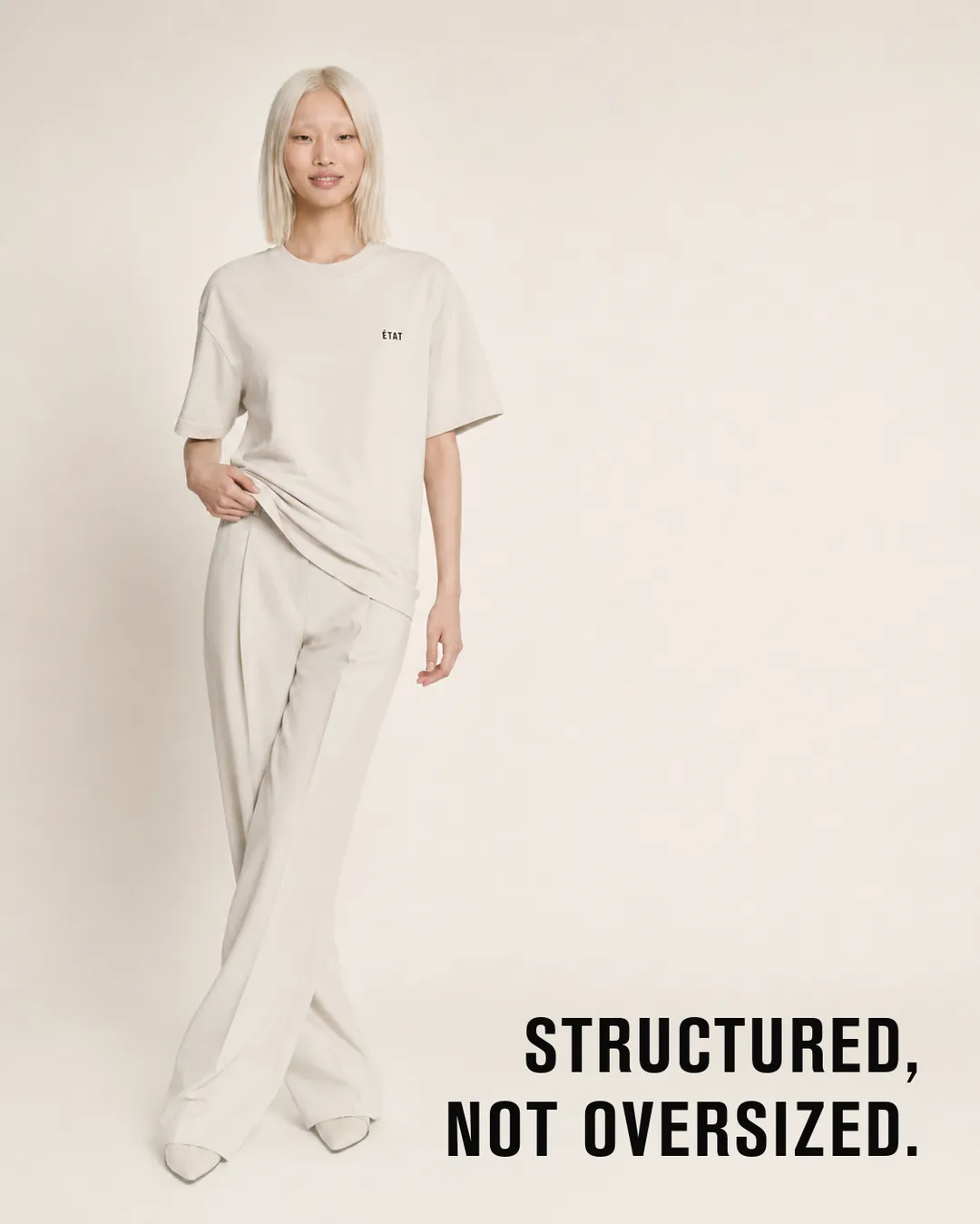
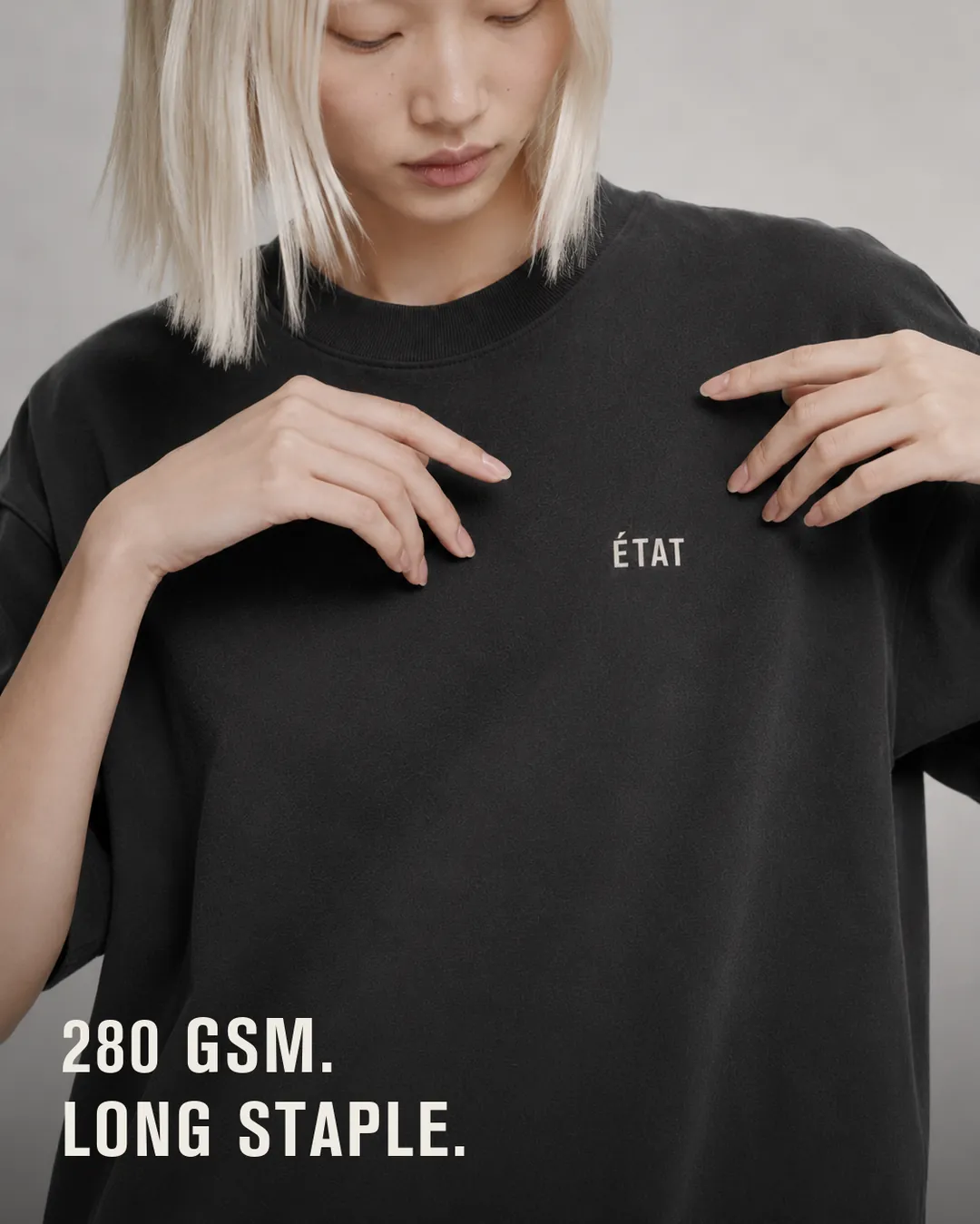

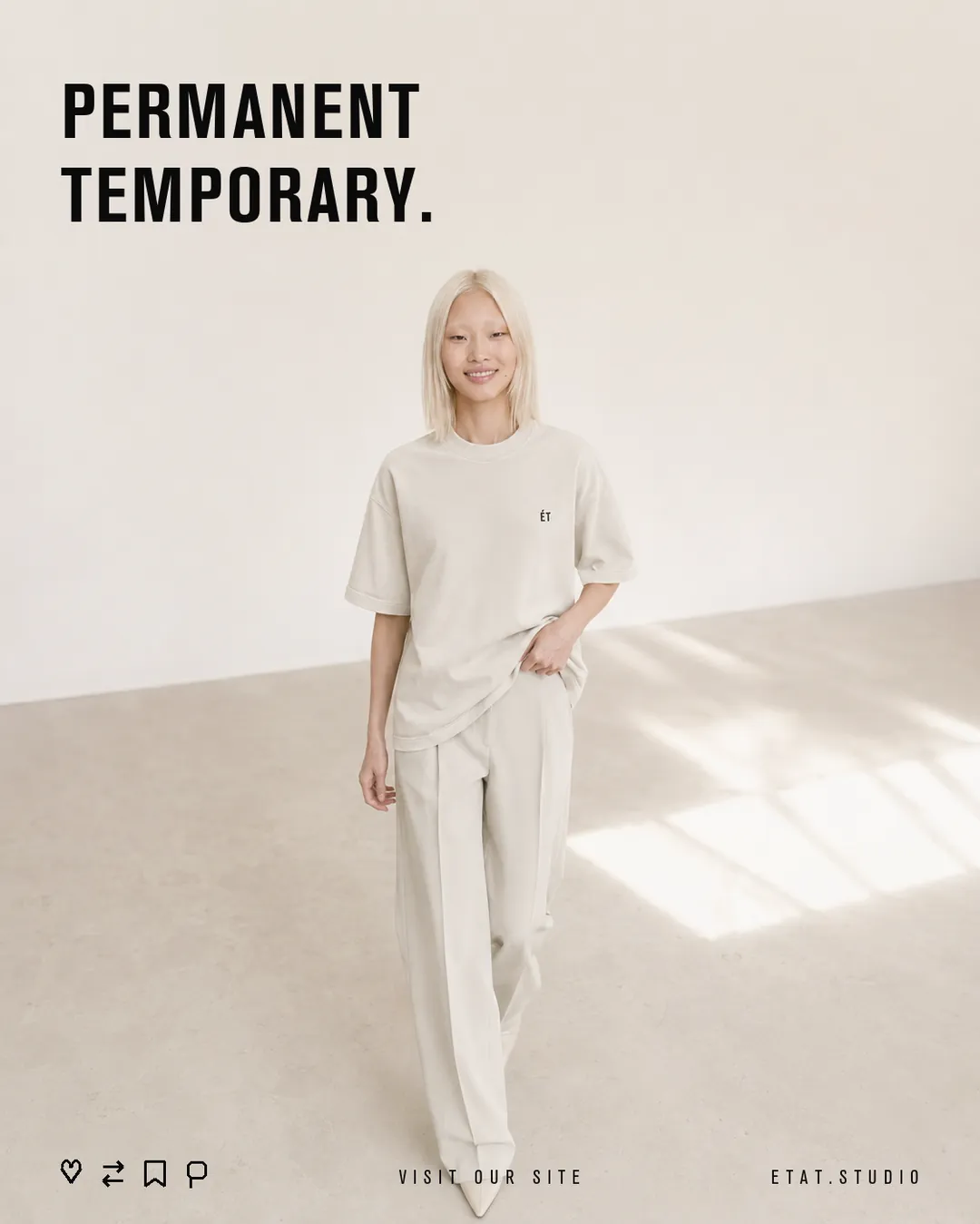
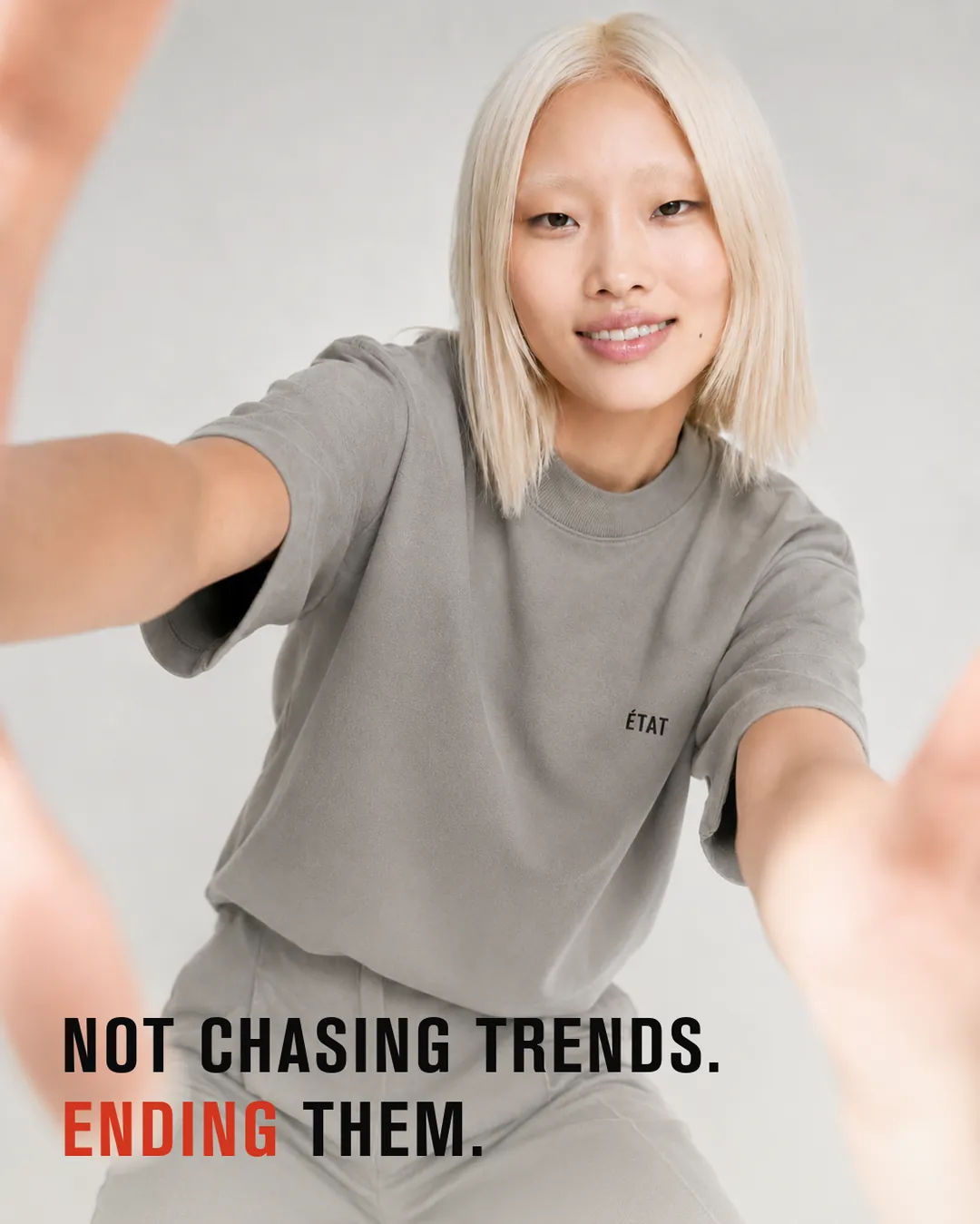
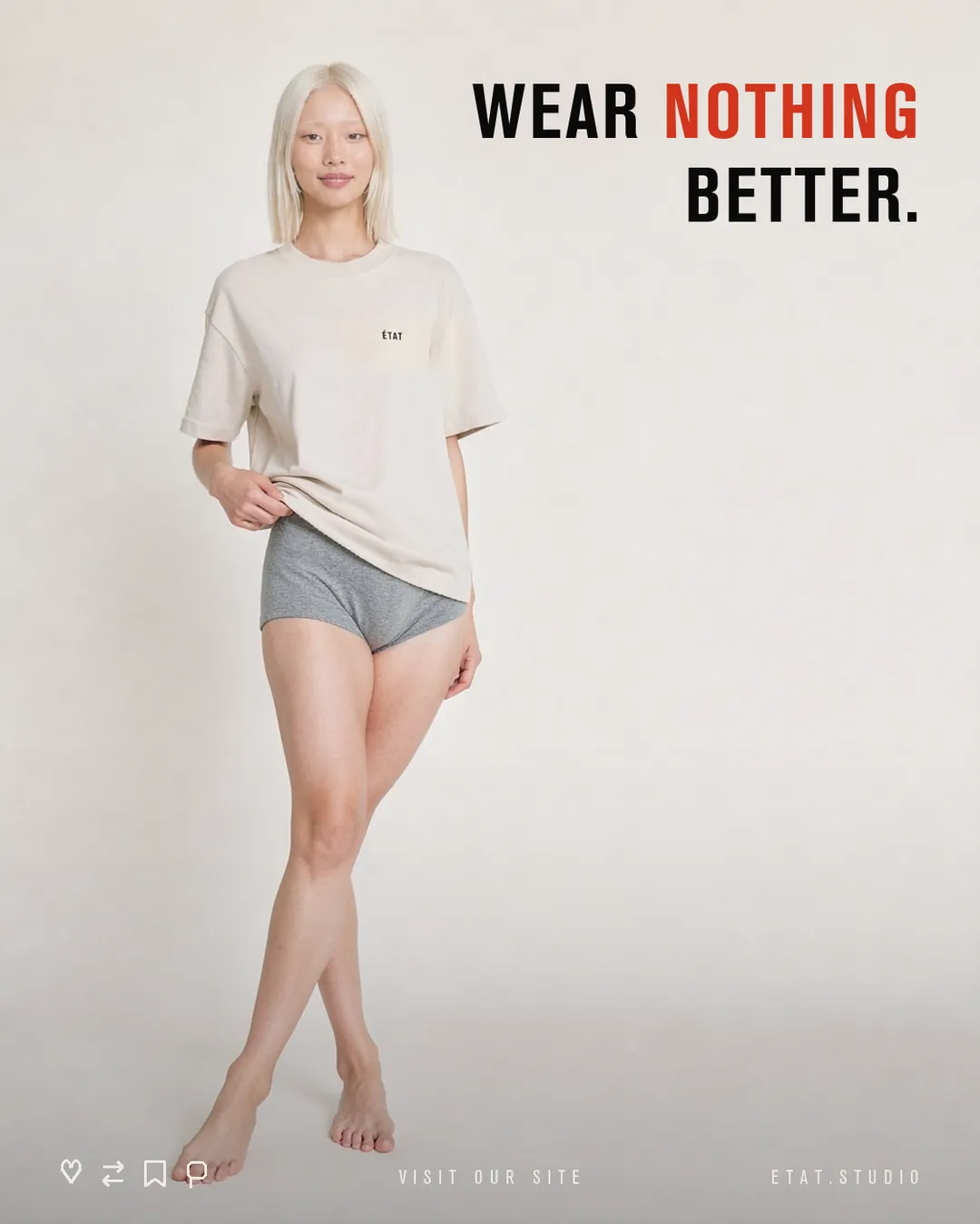
An 83-second designed brand film — editorial motion intercut with kinetic-type cards on the carbon/bone/vermilion system.
We didn't mock the storefront — we shipped it. A complete e-commerce site: eight routes, three colorway product pages, fit toggle, lookbook, and a waitlist — coded, deployed, and live.
A brand with a real address.
The full ÉTAT site runs as a standalone, responsive storefront — home, chapter, three colorway product pages, method, archive lookbook, and a reserve-your-number waitlist. The proof of a fashion brand isn't a deck; it's a door you can walk through. Visit the live ÉTAT store →
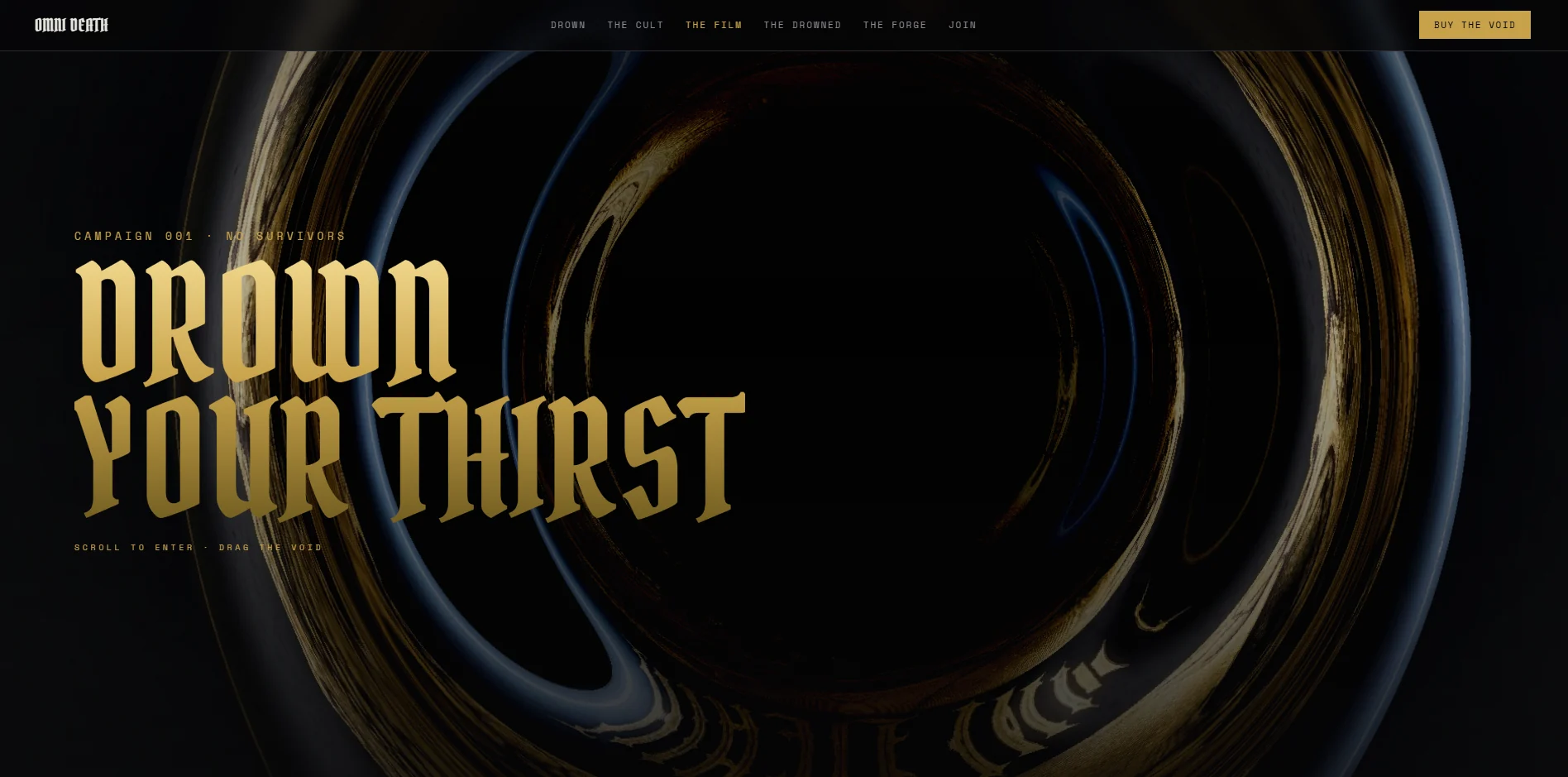
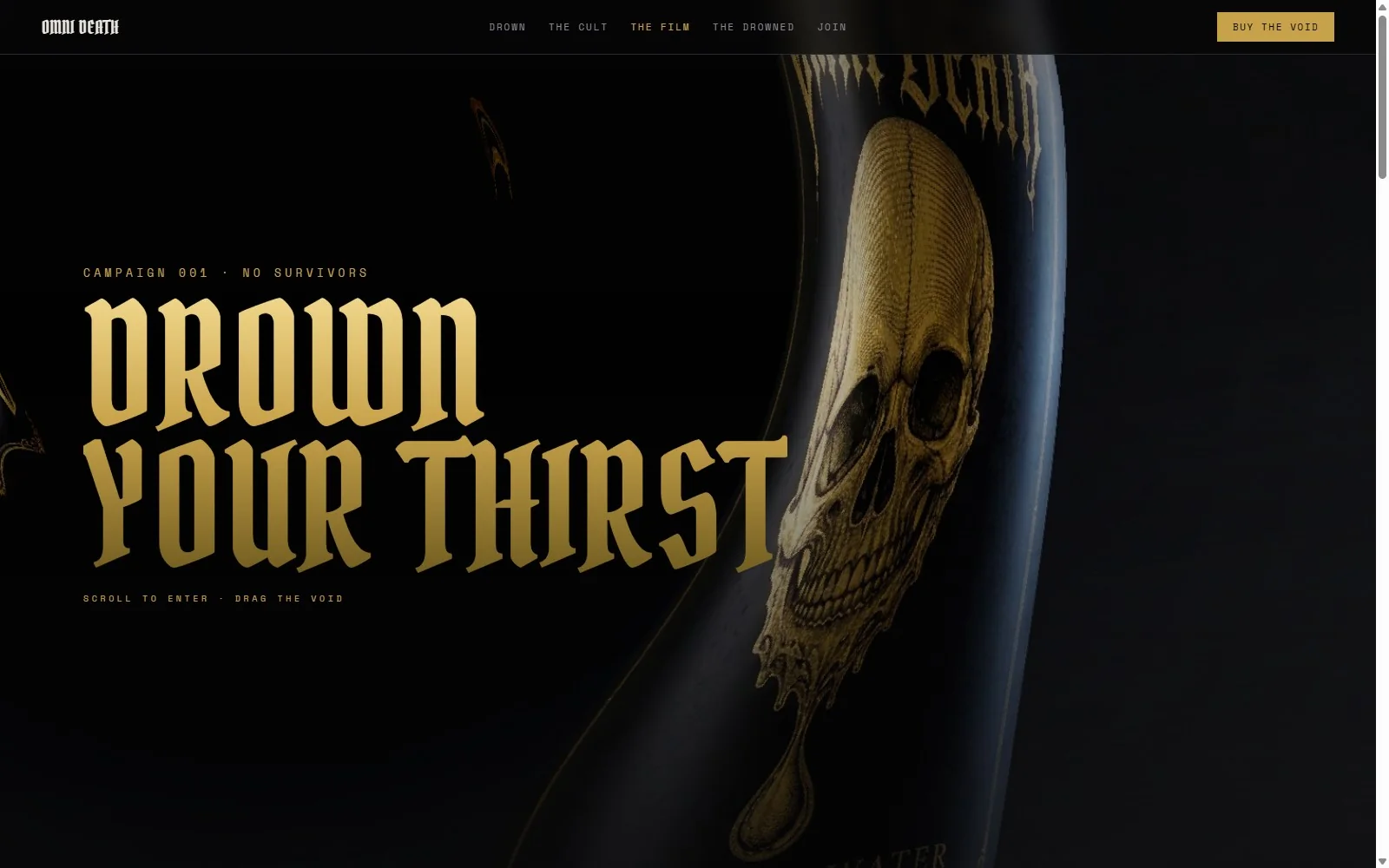
A standalone immersive site for the OMNI DEATH brand — real WebGL, not video loops. Gravitational-lensing shaders, a 3D ocean, drag-to-rotate product, and scroll-cinematic motion.
Built in vanilla TypeScript + Three.js, no framework bloat: four pages, GPU shaders running live in the browser, every effect scroll-gated so only what's on-screen renders. The brand world from the concept case, turned into something you move through instead of watch.
The hero bends a branded texture around a gravitational mass; a second page drops you onto a real-time 3D ocean tuned to a dead, cold void palette; product spins on a drag-to-rotate turntable; and the cult pages run live video loops inside member dossiers. Premium dark-metal direction held consistent across every surface.
The film page hero is a live GLSL fragment shader — gravitational lensing that bends a branded source texture around an animated mass point. Scroll-gated so the render loop pauses off-screen.
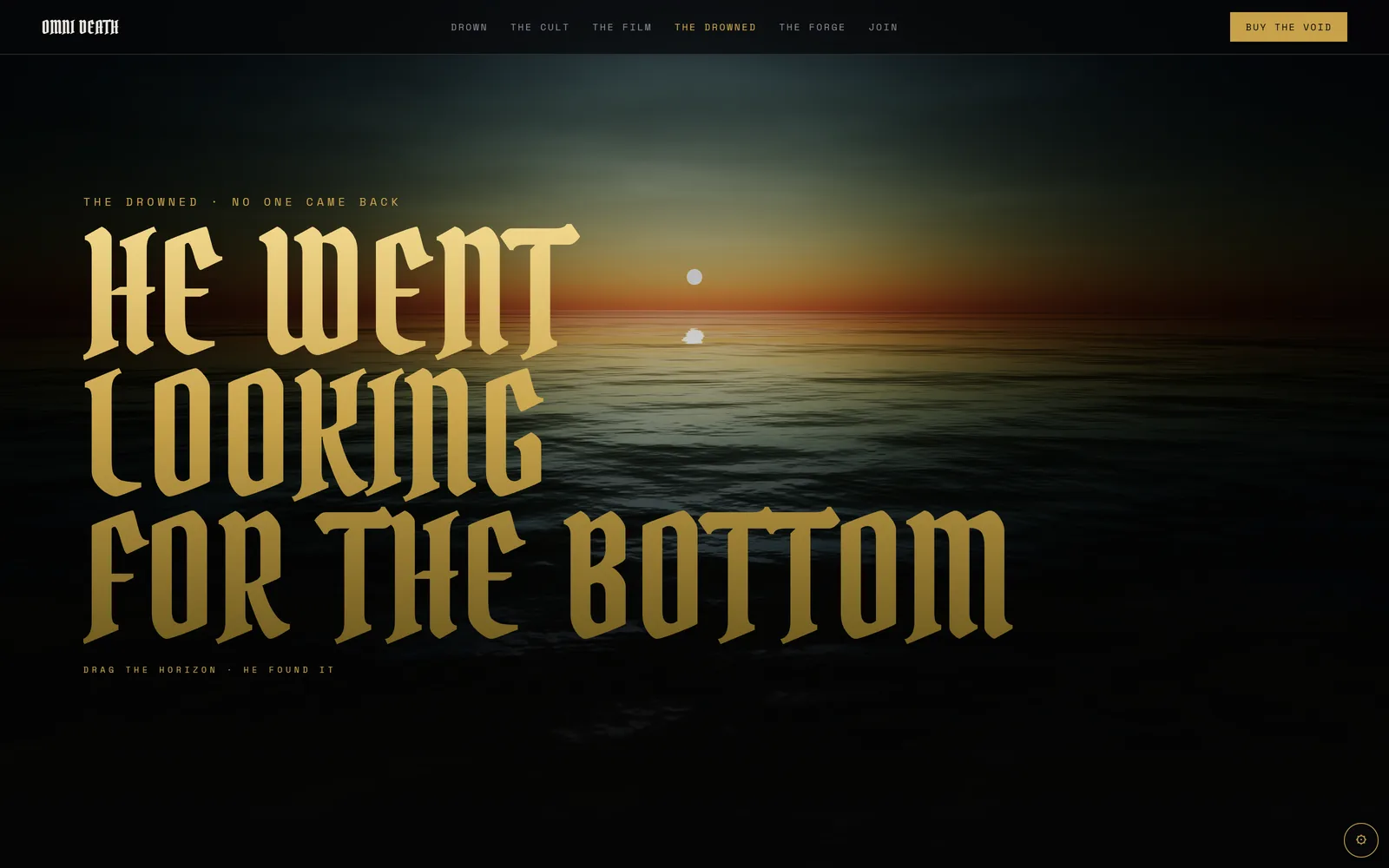
A real-time 3D ocean — Three.js Water + Sky with a live art-direction console: sun elevation, azimuth, wave intensity, turbidity and water colour all tunable on the fly, then locked to the dead, cold OMNI DEATH palette. Drag the horizon to look around.
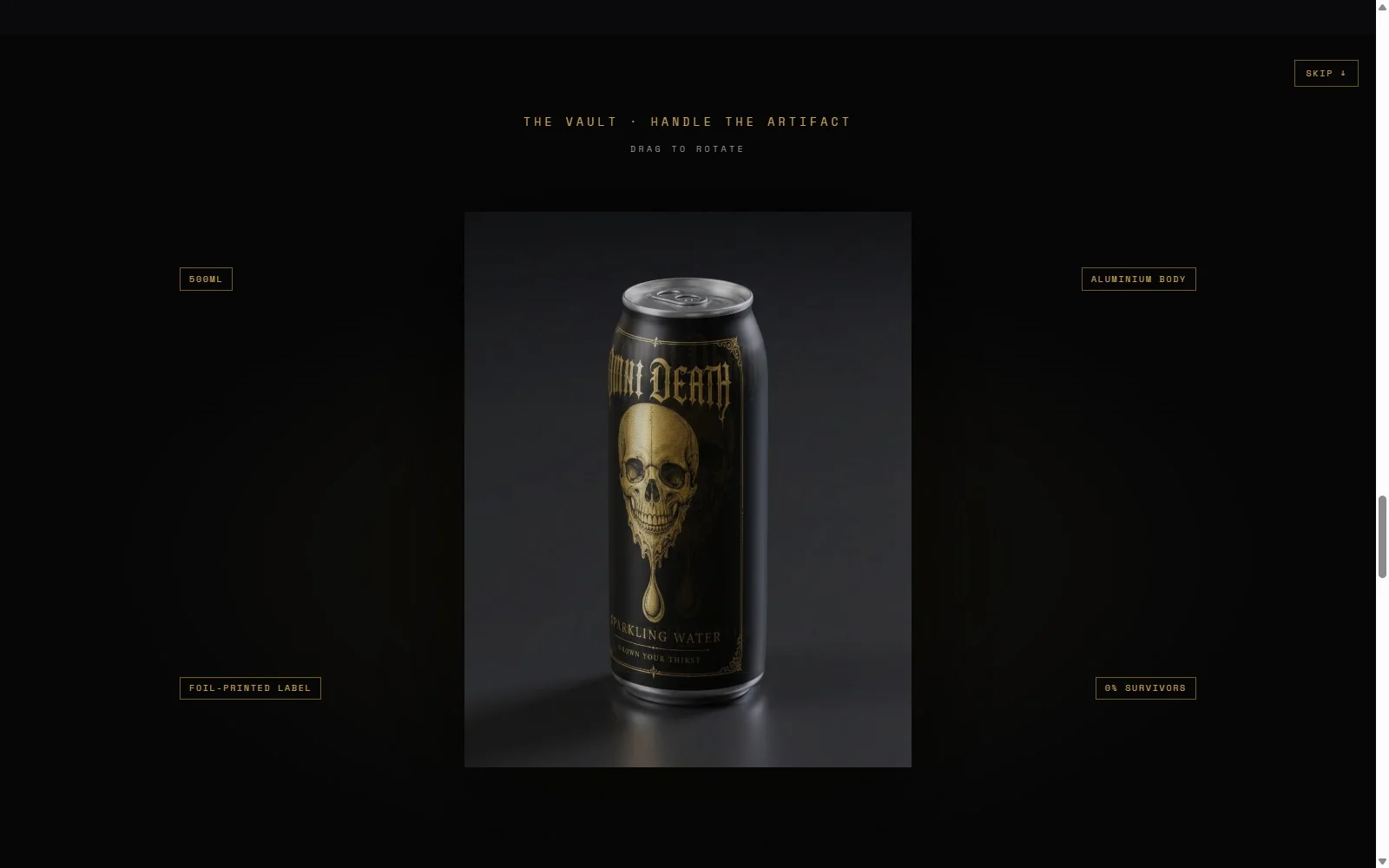
A drag-to-rotate product turntable — pre-rendered angle frames crossfading on drag with inertia and idle auto-rotate, giving 3D product handling without shipping a heavy 3D model.
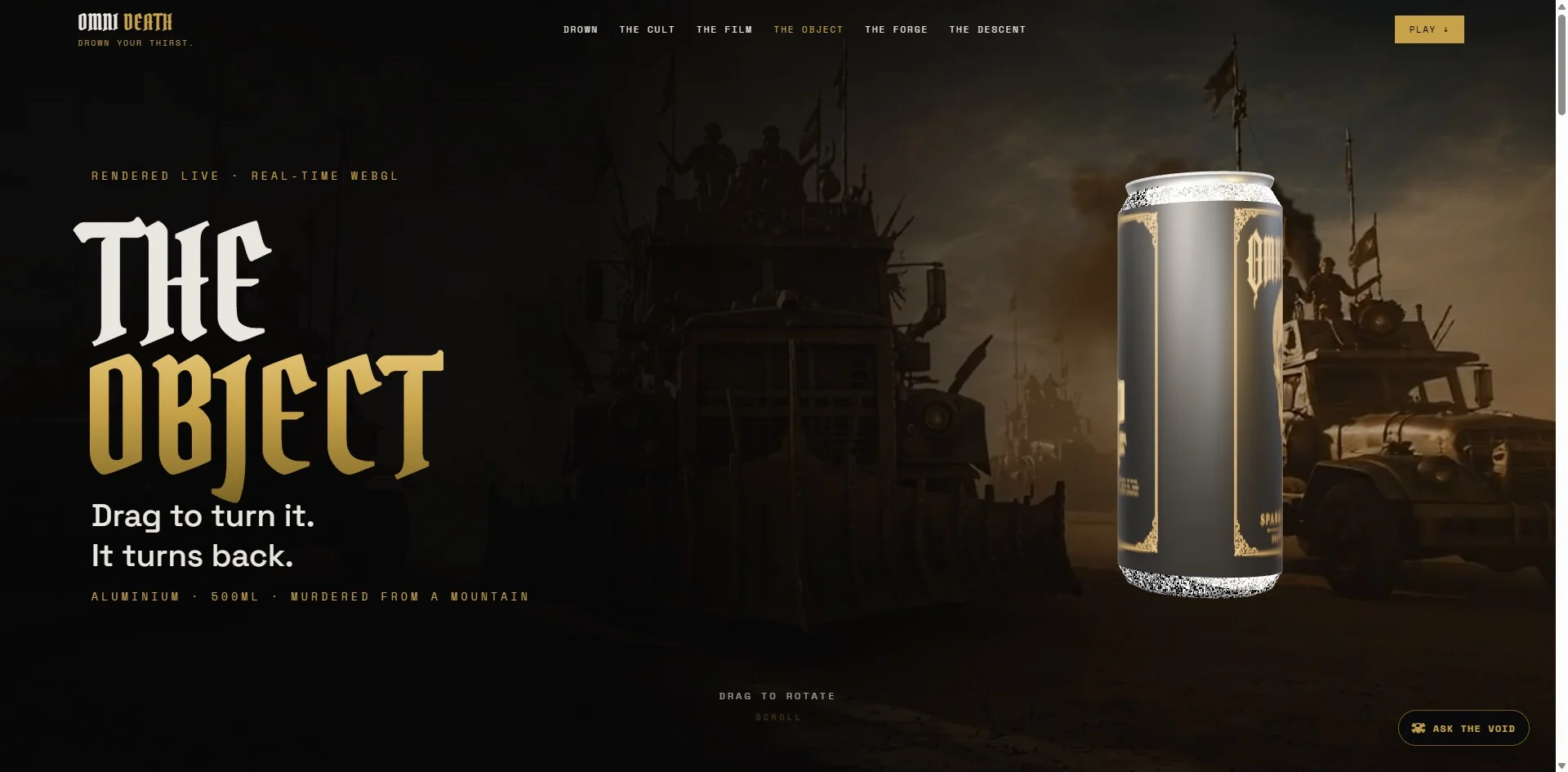
A dedicated page renders the real product can as live geometry: a DRACO-compressed GLB loaded into Three.js, lit in real time, that you can drag to spin — it eases back on release. The decoder ships locally so it paints on first load, the render loop is scroll-gated, and on phones the can drops into its own centred section so it never falls out of frame. Drifting Mad-Max wasteland video backdrops sit behind it. See it live →
Member dossiers and a ritual film strip run live, muted video loops inline — the synthetic faces from the brand case, brought to motion inside a scroll-parallaxed editorial layout.
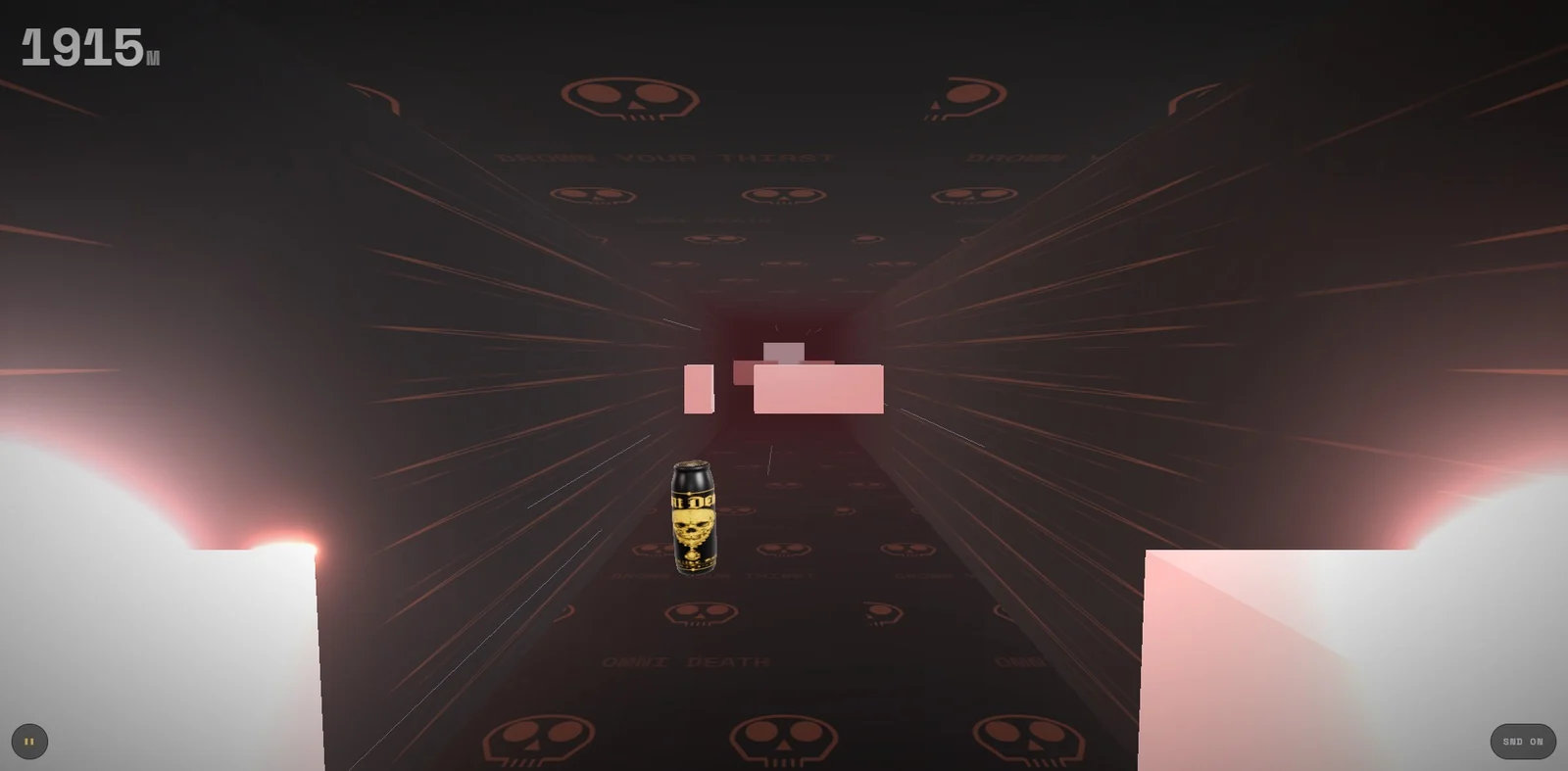
The site doesn't just sell the brand — it lets you fall into it. THE DESCENT is a real-time Three.js endless runner wired into the site: you are the can, weaving plastic-bottle walls down a procedurally-engraved void with object-pooled hazards, synthesized WebAudio, a real combo system and depth-zone moods. A reason to come back. Play it →
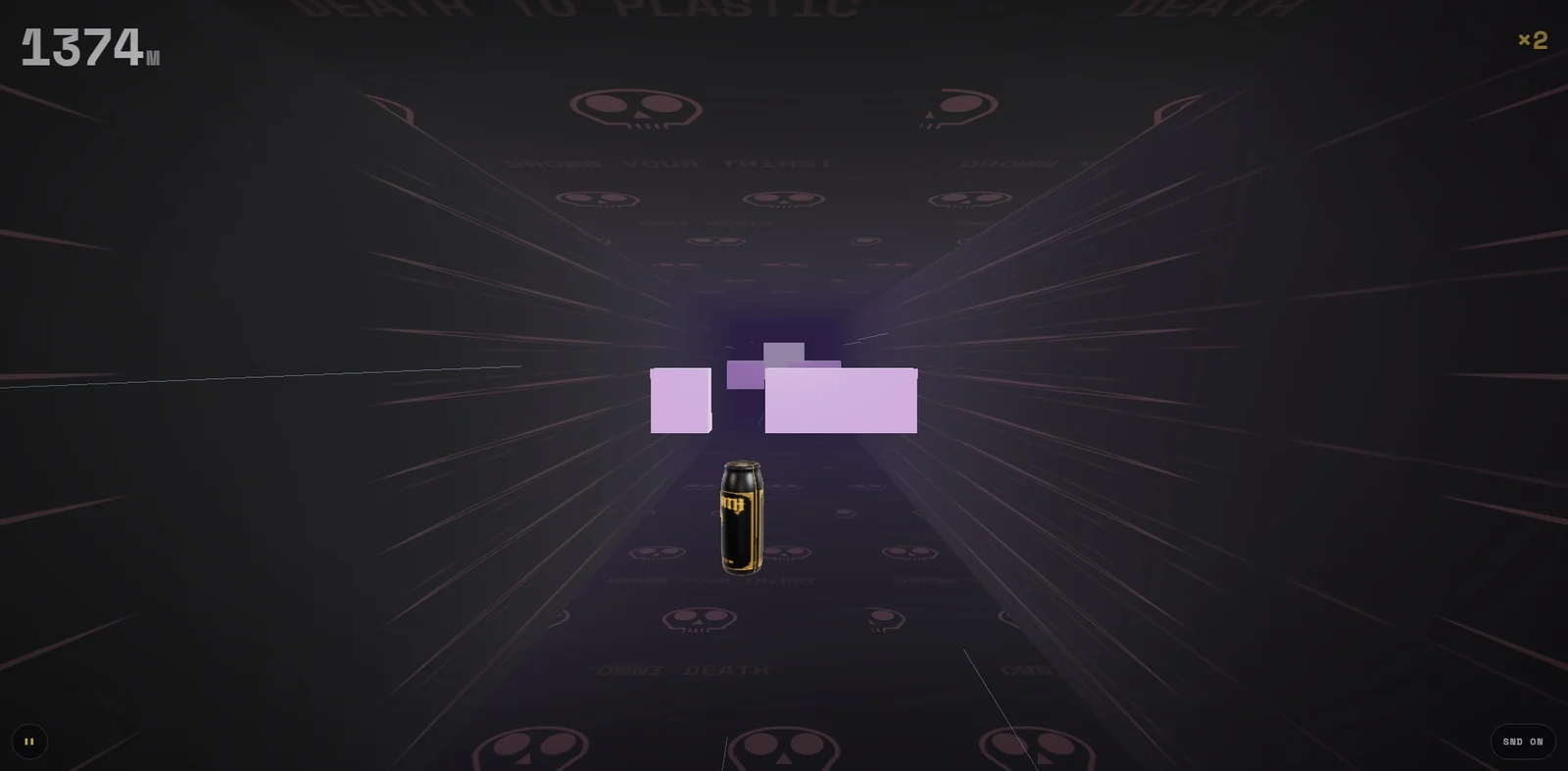
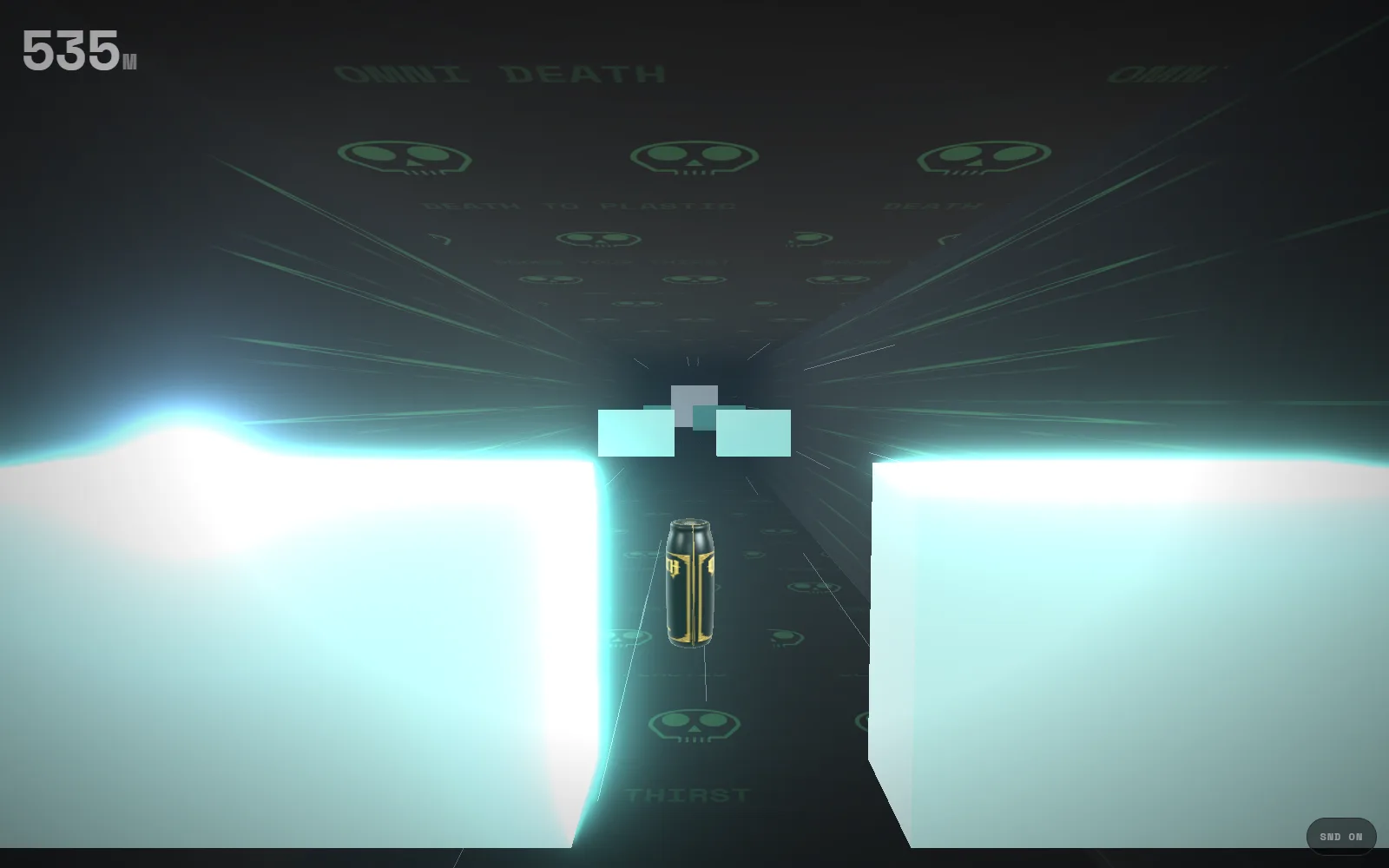
A real-time 3D browser game built into the OMNI DEATH site — you ARE the can, falling forever down a black void, weaving plastic-bottle walls. A brand experience you don't watch, you play.
THE DESCENT is an endless tunnel-faller in vanilla TypeScript + Three.js. The fantasy is the brand's thesis turned into a mechanic: plastic is the enemy, so the walls you dodge are glowing plastic, and the further you fall the faster they come. Score is depth. Hit a wall and you drown.
The craft is in the game-feel. A real combo system rewards skimming wall edges — near-miss for gold sparks, a slow-mo kiss, and a multiplier that scales every metre but collapses if you play it safe. The tunnel itself is alive: procedurally-drawn skull and slogan engravings scroll past you, and the whole world shifts colour every depth zone. Every hazard and particle is object-pooled so the RAF loop never allocates — a locked 60fps with bloom. Audio is fully synthesized WebAudio (zero asset files) to stay inside the site's strict CSP. The pure-logic core ships with a Vitest suite that stays green.
Skimming a plastic wall instead of coasting through the middle scores a near-miss: gold sparks erupt from the edge, time slow-mo's, and a multiplier climbs to ×10. Coast cleanly twice and it collapses to ×1. Greed versus safety, every gap.
The four tunnel walls carry procedurally-drawn engravings — skull emblems and DEATH TO PLASTIC / DROWN YOUR THIRST slogans painted to an offscreen canvas, zero asset files. They scroll down the void with the fall so you feel yourself dropping through the brand, tinted by the current depth zone.
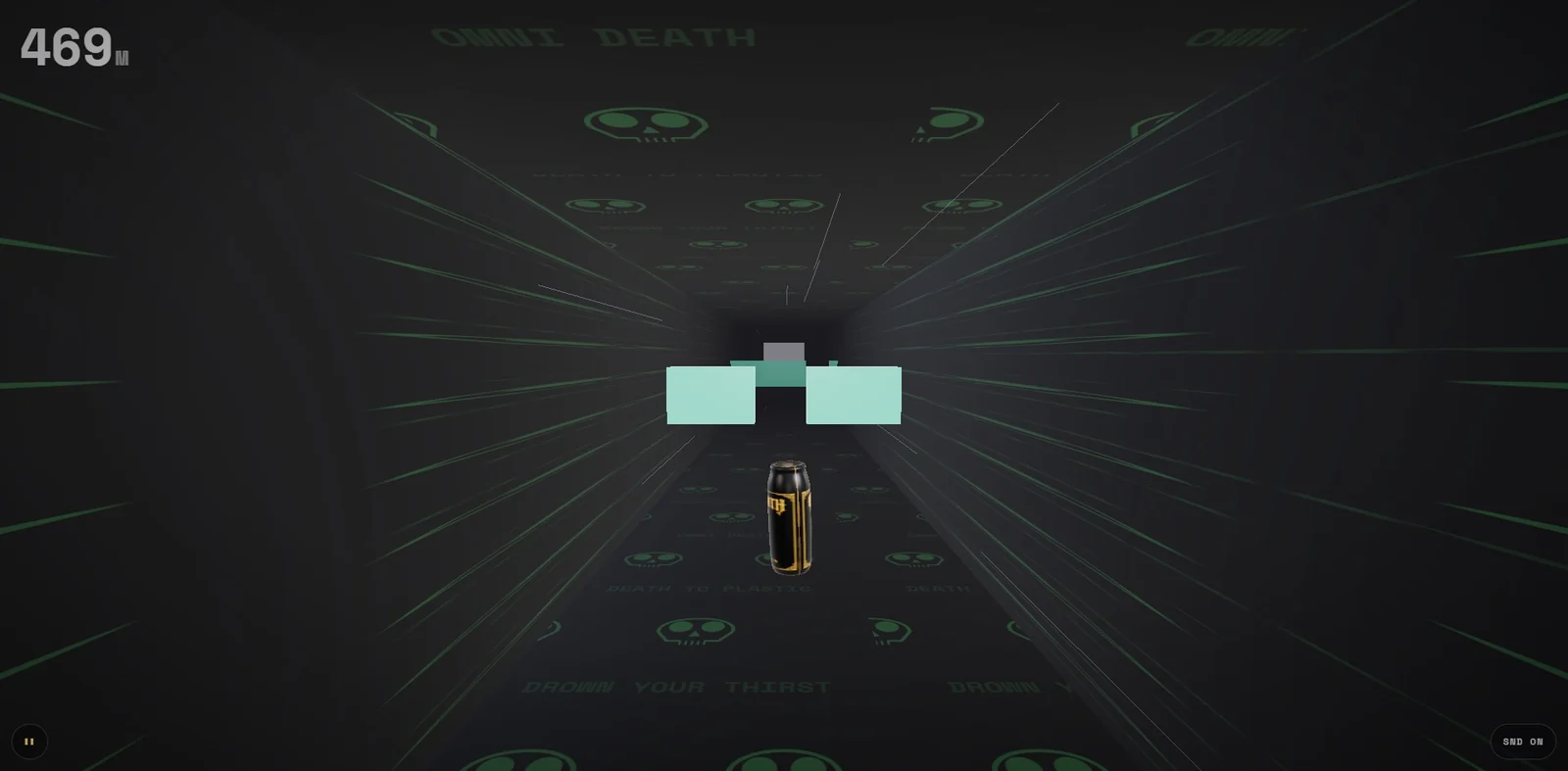
No audio files — every sound is built live from WebAudio oscillators: a detuned drone bed that rises in pitch with depth, a pentatonic near-miss chime that climbs with the combo, a crush on death. Synthesized specifically to stay inside the site's locked-down Content-Security-Policy.
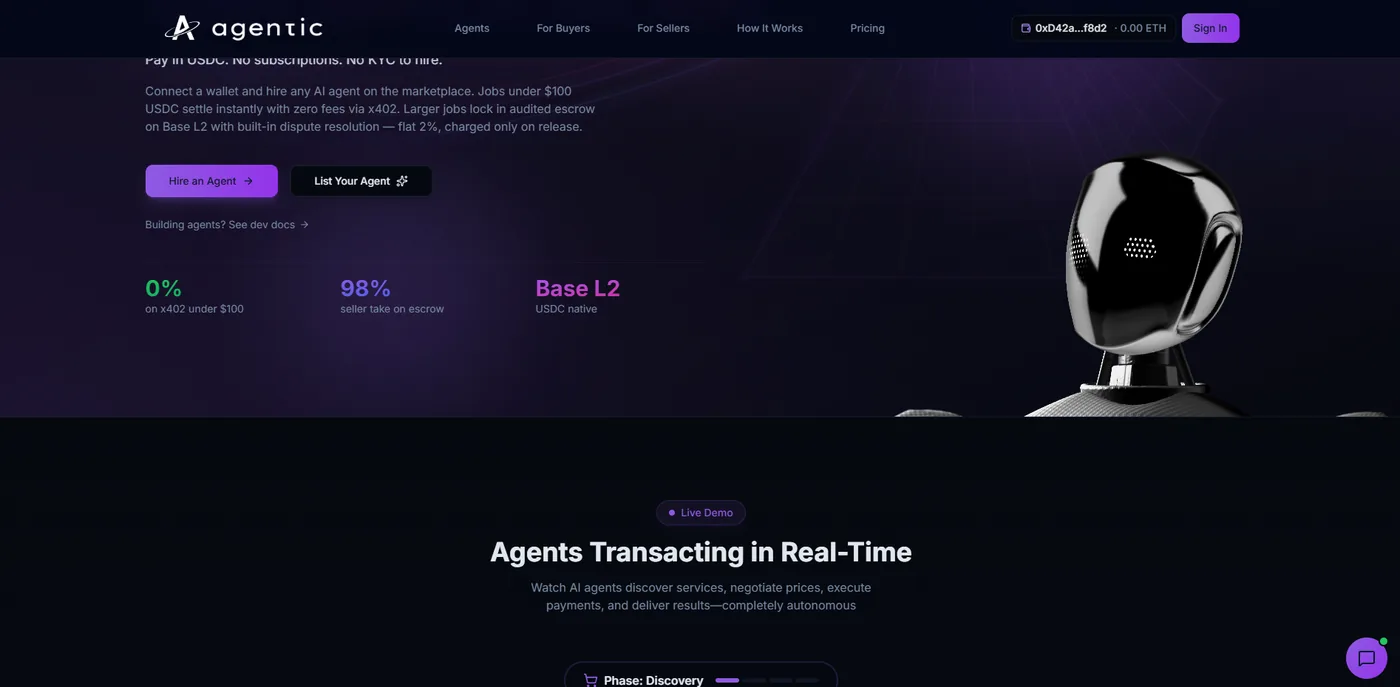
A landing page for an on-chain AI-agent marketplace, anchored by a live Spline 3D robot — not a render, not a video loop. The robot owns the hero, then dissolves out of frame as you scroll and the marketplace comes alive beneath it.
Most "3D hero" sites ship a baked video or a heavy GLB that paints late and just sits there. We used Spline instead: a real-time interactive scene streamed into the page, reacting to the cursor and lit live in the browser. The chrome agent reads as a physical object you could reach out and turn — the centrepiece of a Web3 product that needed to feel inevitable, not speculative.
The craft is in the choreography. The Spline scene is wired to scroll: at the top the robot is fully present, holding the eye against the headline; as you descend, parallax pulls it down and out of frame while the live transaction feed, the stat block and the marketplace sections rise to take its place. The 3D doesn't loop — it performs a hand-off, so the page tells a story instead of decorating one. Tuned so the scene stays light enough to hold a fast first paint and a smooth scroll on a marketing landing page.
The hero opens on a live Spline robot — a real-time 3D scene, not a baked video. It reacts to the cursor and is lit in the browser, holding the eye against the headline while the live transaction feed ticks in the corner. Here it is in the Spline editor, rigged and lit before it ever hit the page.
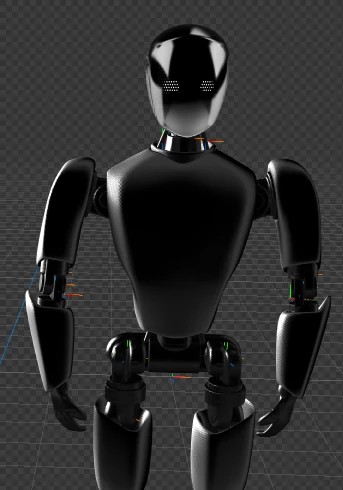
As you scroll, the Spline scene is driven by the page position — the robot drifts down and sideways out of frame on a parallax curve, faster than the copy, so the depth between 3D and content reads physically.

The robot doesn't loop — it exits. By the time it leaves frame the marketplace has risen to take its place: "Agents Transacting in Real-Time", live deal cards, the on-chain proof. The 3D performs a hand-off to the product, so the page narrates instead of decorates.
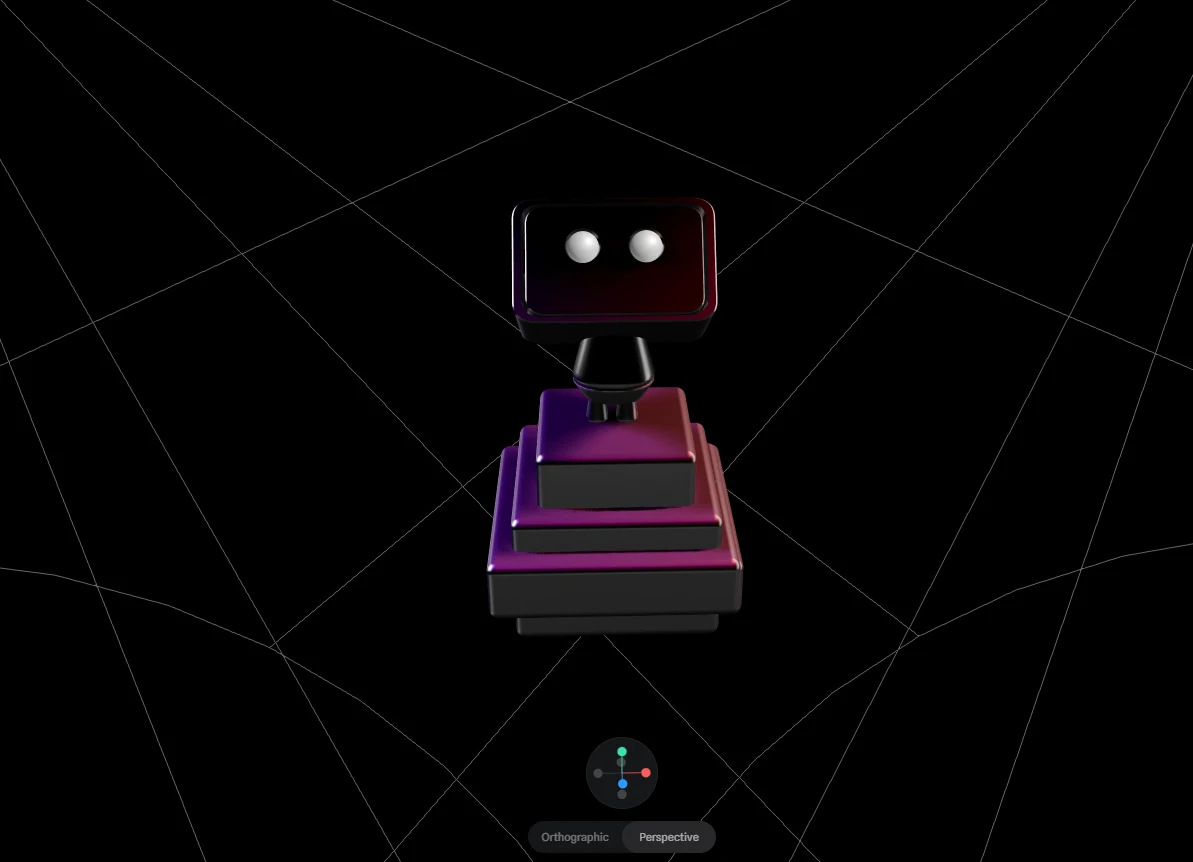
The chrome agent wasn't the first idea. An earlier exploration went the other way — a stout, friendly retro-bot in hot magenta and violet, almost a toy. We modelled and lit it in Spline before deciding it read too playful for an on-chain finance product, and pivoted to the colder, inevitable chrome figure. It never shipped, but the exploration is part of the work.
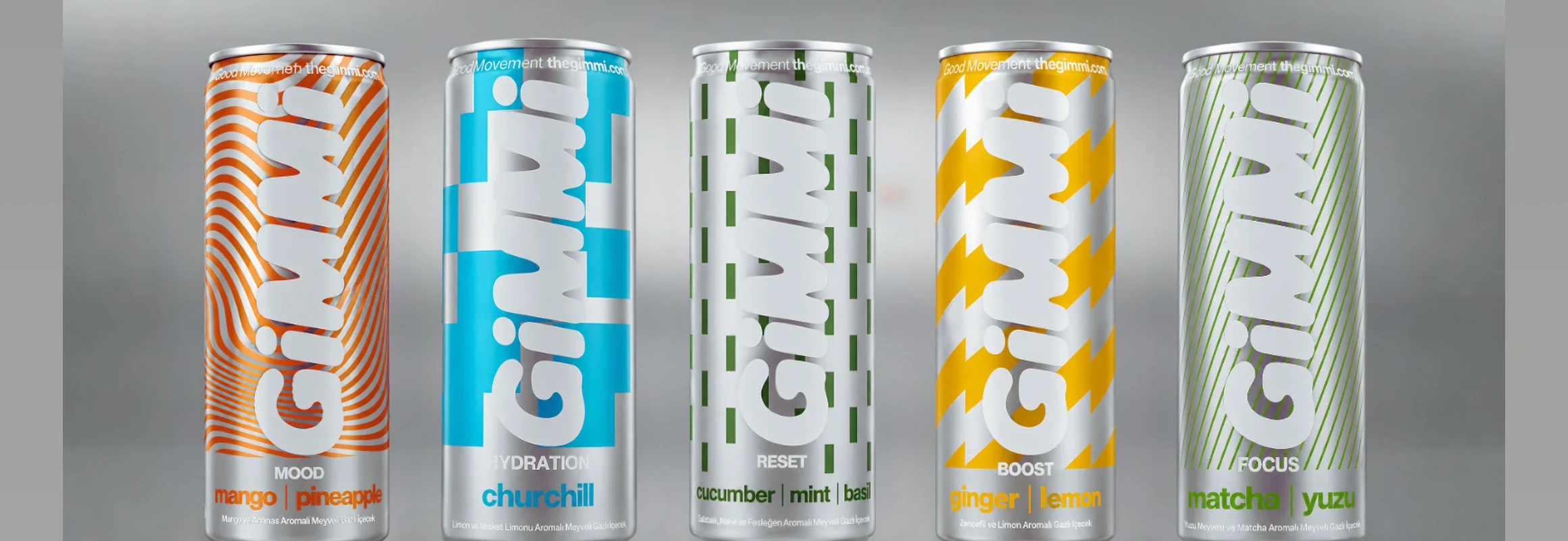
A complete brand website for GIMMI — a functional sparkling-soda line built on one idea: real flavour and a real benefit, with zero wellness drama. Five moods, five cans, one movement.
The whole site is hand-built in vanilla HTML, CSS and JavaScript — no framework, no build step, served by a tiny zero-dependency Node server. Swiss grotesk typography, an aluminium-and-white base, and a flavour-accent colour per mood give it a clean editorial feel with restrained scroll motion. Three pages — home, flavours, and a B2B "Pro" portal — share one nav, one design system and a full Turkish/English toggle.
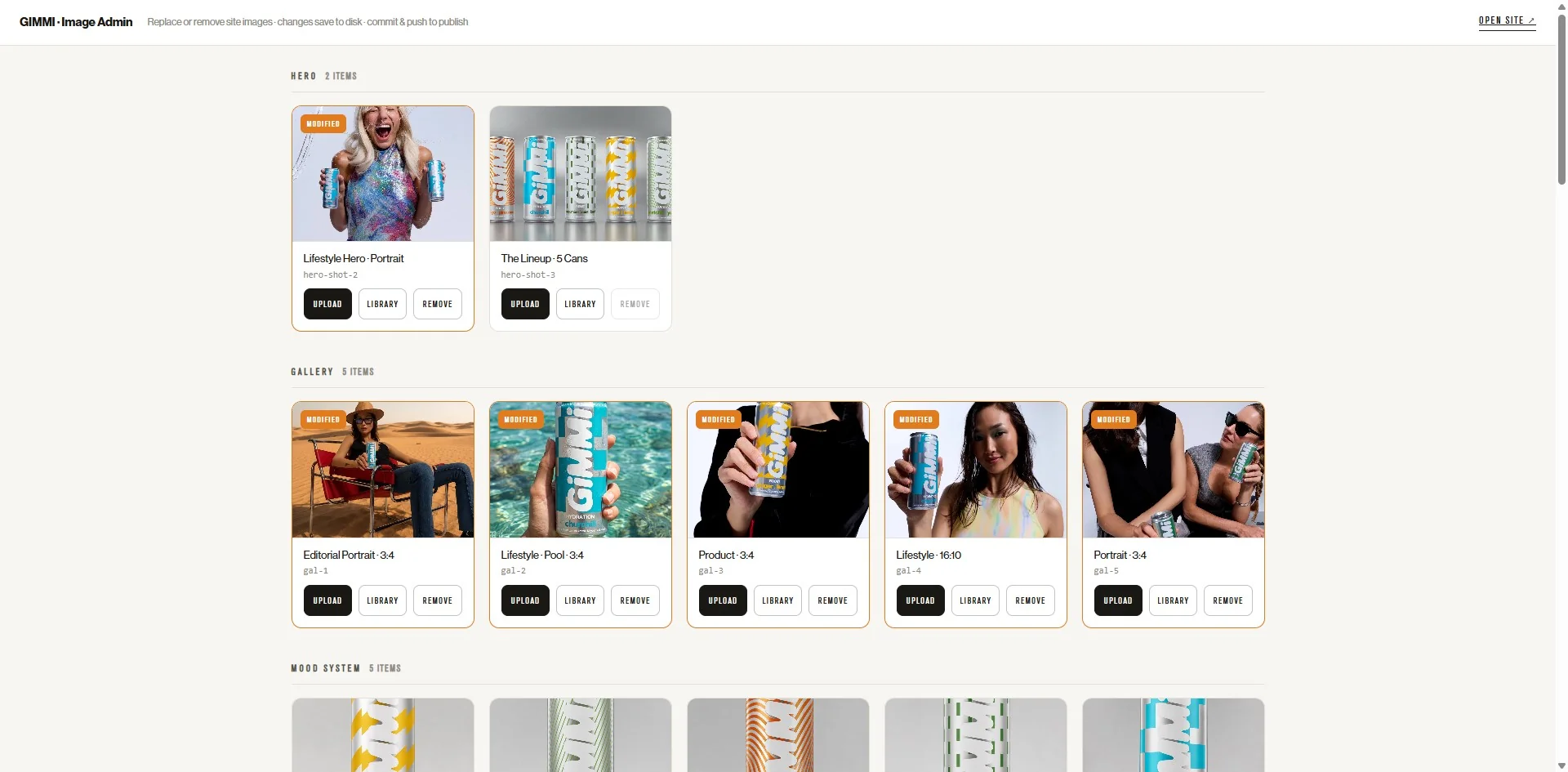
Underneath it runs a custom image CMS. Every photo on the site is a drag-and-drop image-slot web component, and a purpose-built admin panel lets the client swap, reframe or remove any of 31 image and video slots — writing overrides straight to disk, ready to commit and publish. The brand can keep the site fresh without ever touching code.
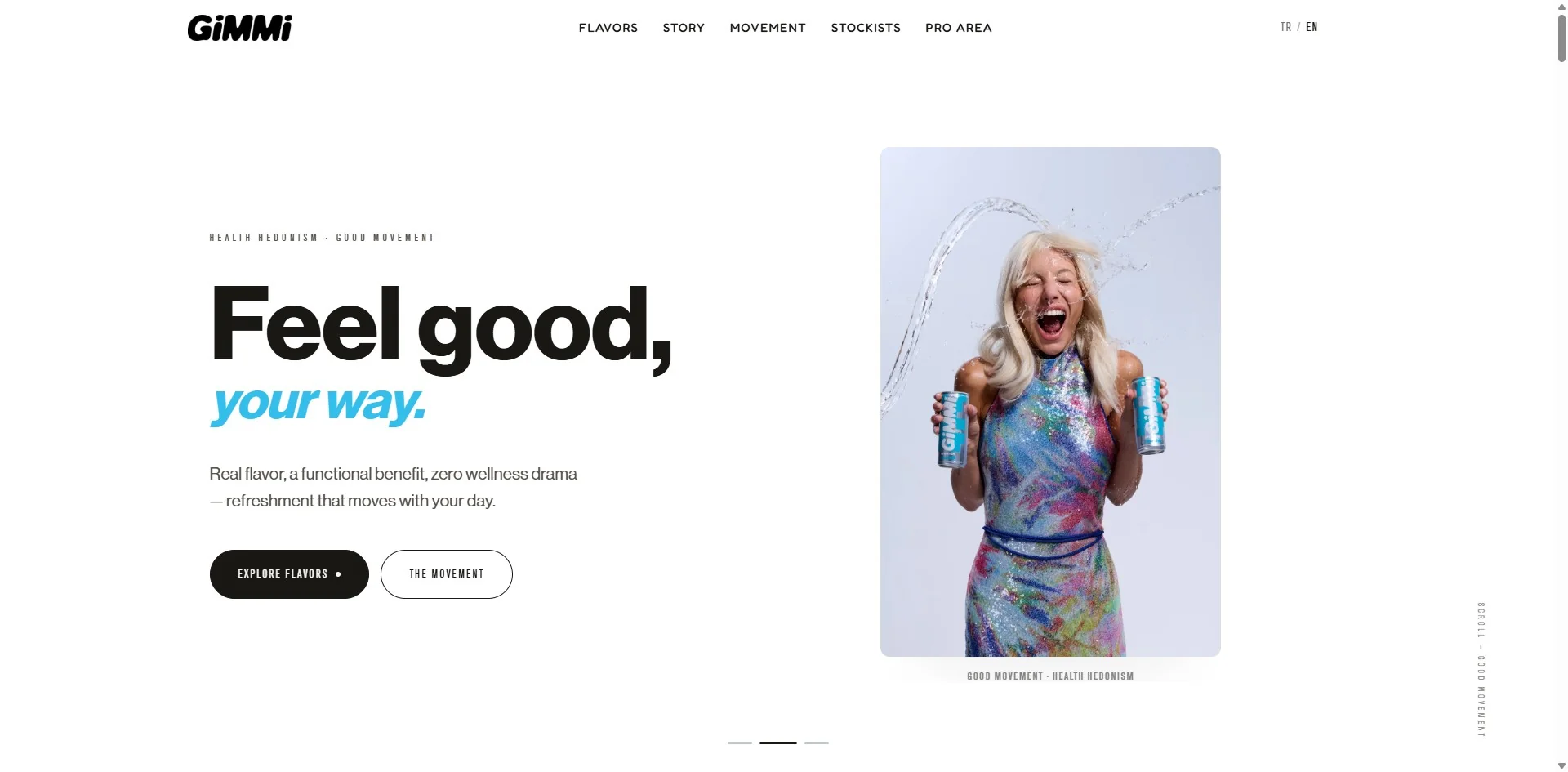
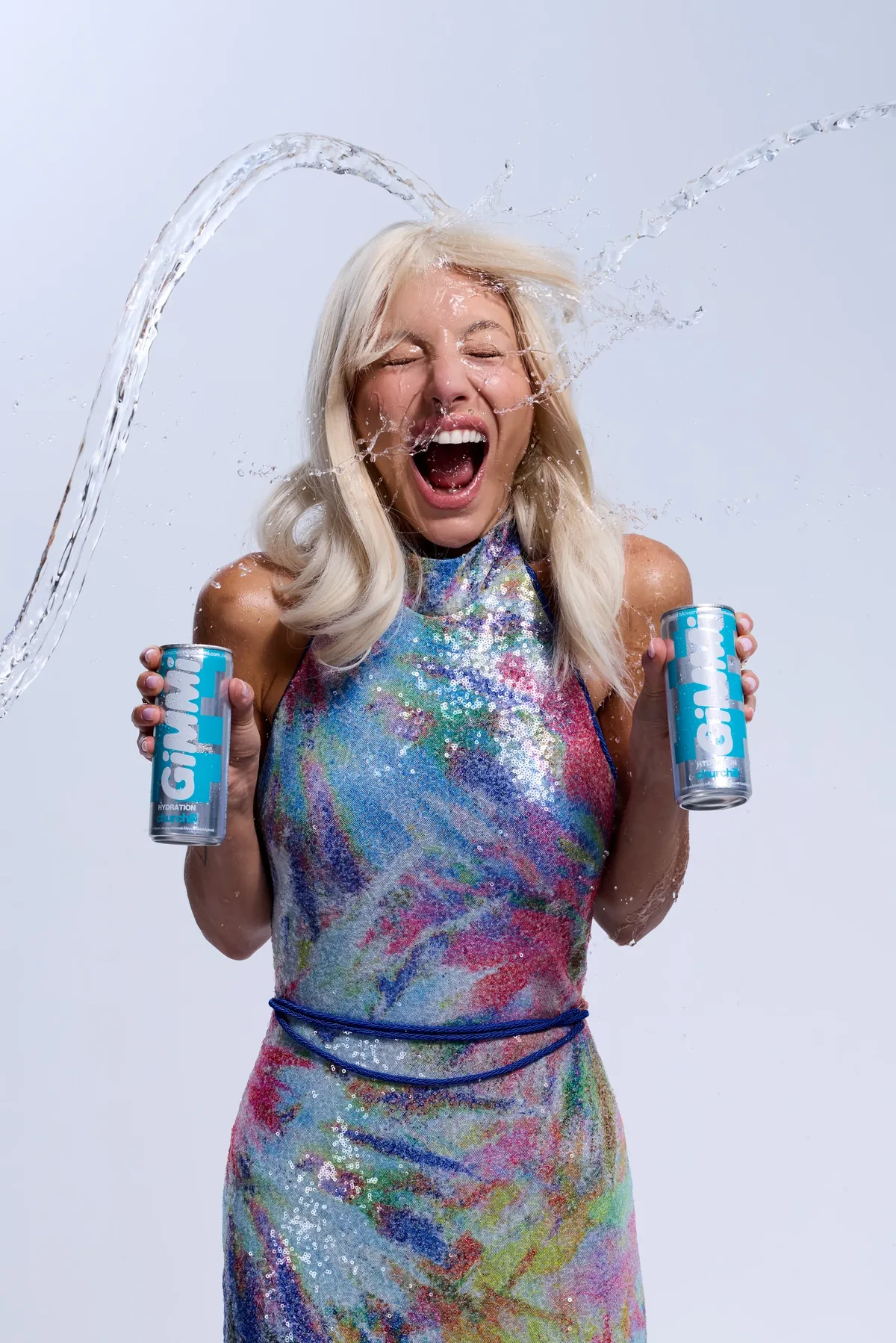
Health hedonism, not wellness pressure — "feel good, your way." A bold display logotype against Swiss grotesk body copy, an aluminium-and-white palette, and a single accent colour that shifts with each mood. Large premium product photography, smooth restrained motion.
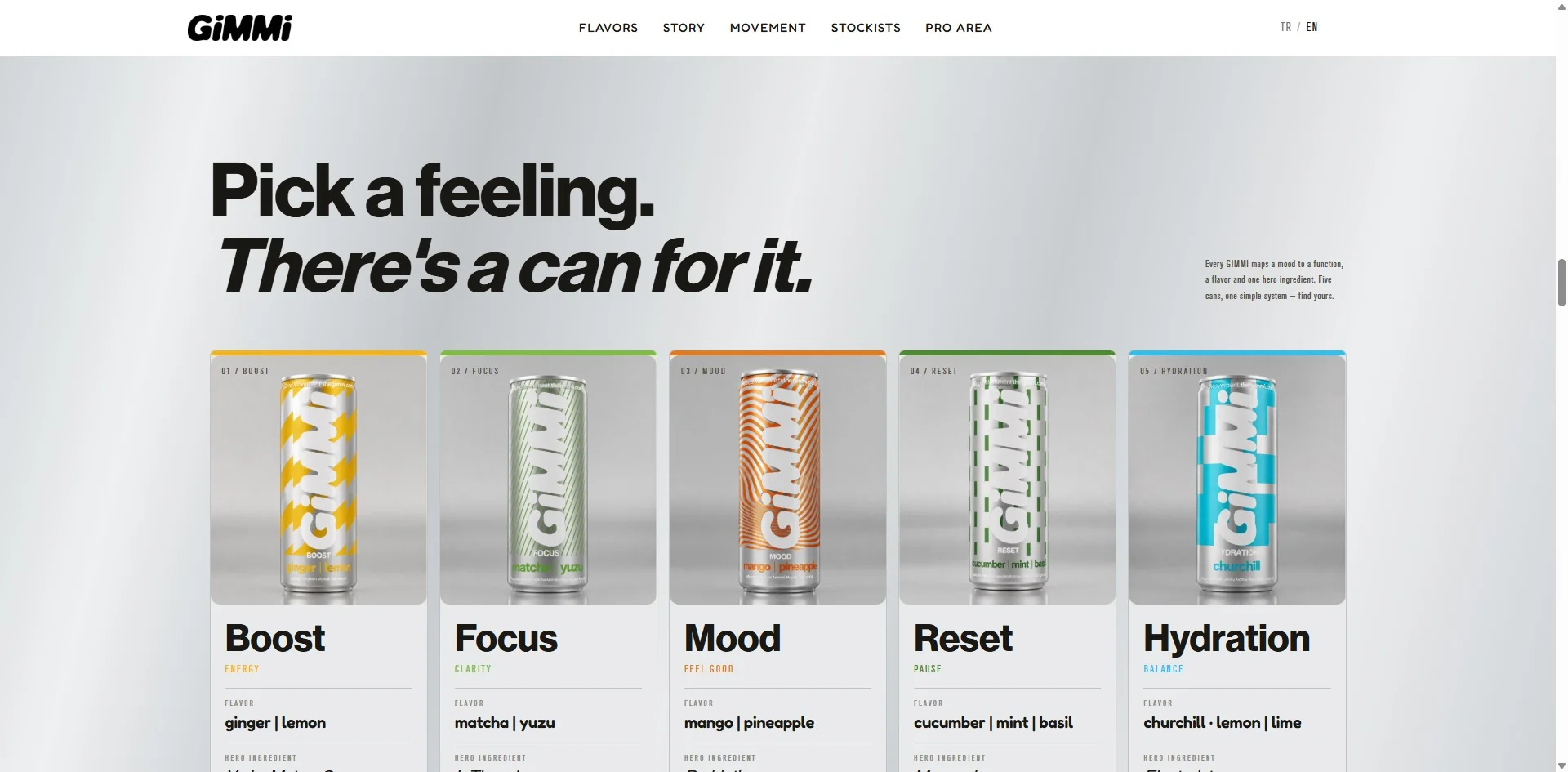
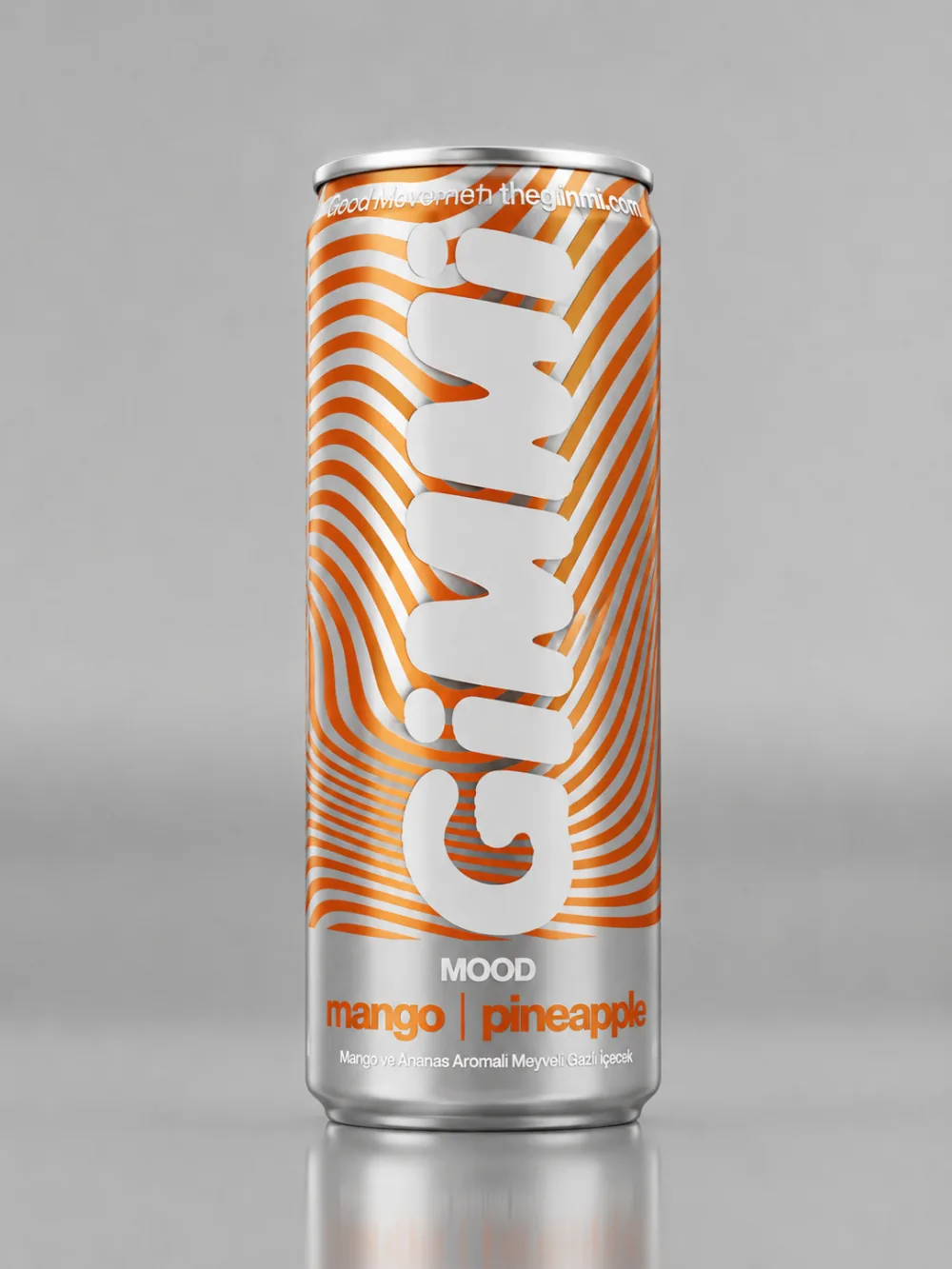
The product line's core idea, made navigable: five moods — Boost, Focus, Mood, Reset, Hydration — each mapping a feeling to a function, a flavour and a hero ingredient. Pick a feeling; there's a can for it.
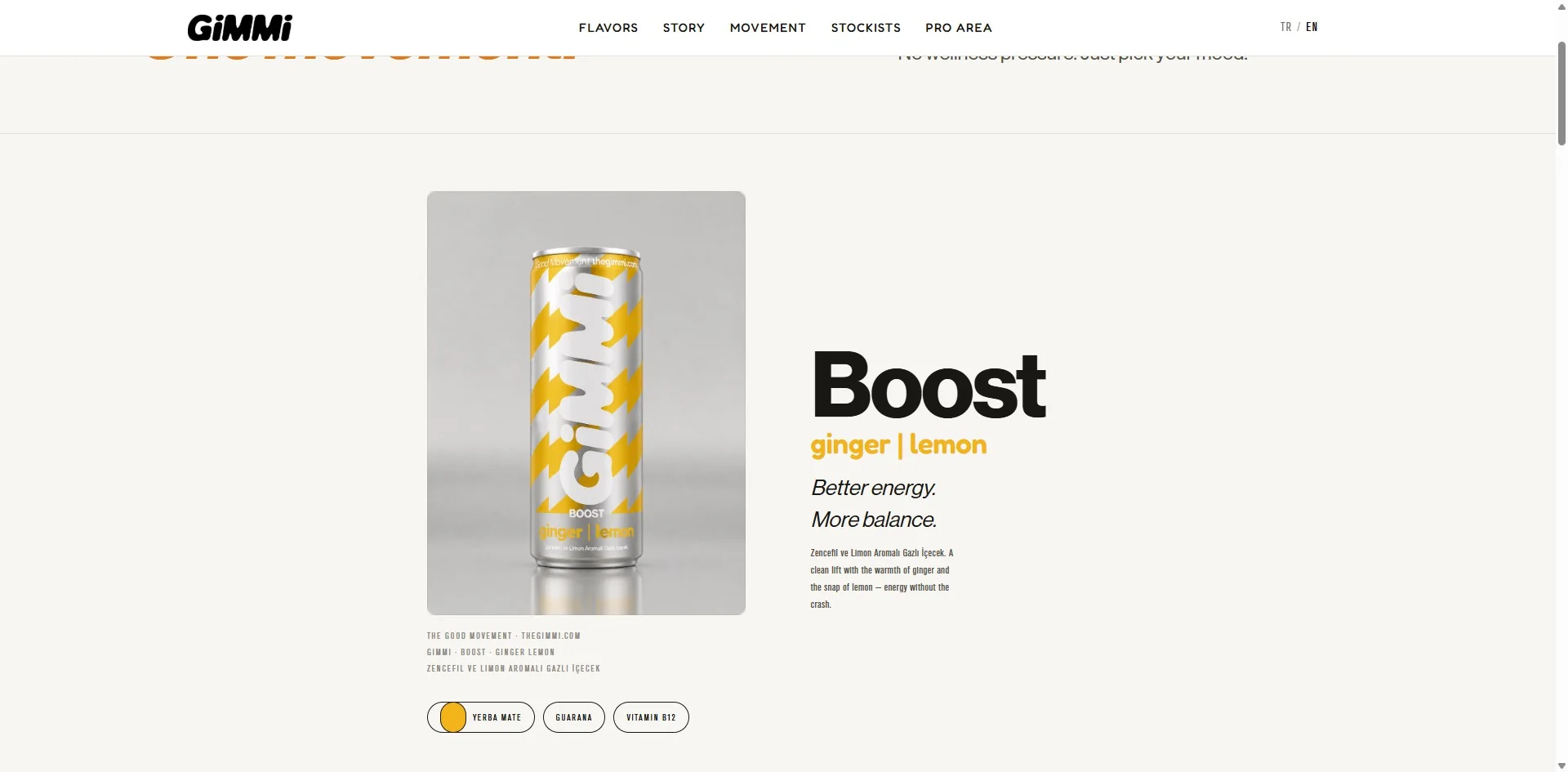
A dedicated flavours page gives each can its own editorial spread — mood copy, flavour pairing, hero-ingredient badges — plus an interactive 3D can viewer you can rotate in the browser.
A naive-but-effective custom CMS. It discovers every image and video slot across all three pages, groups them by section, and lets the client upload, pick from a media library, or remove any of 31 slots. Each image slot supports drag-drop, reframe and automatic WebP downscale; overrides persist to a single JSON file with atomic disk writes — no database, no dependencies. Replace an image, commit, publish.
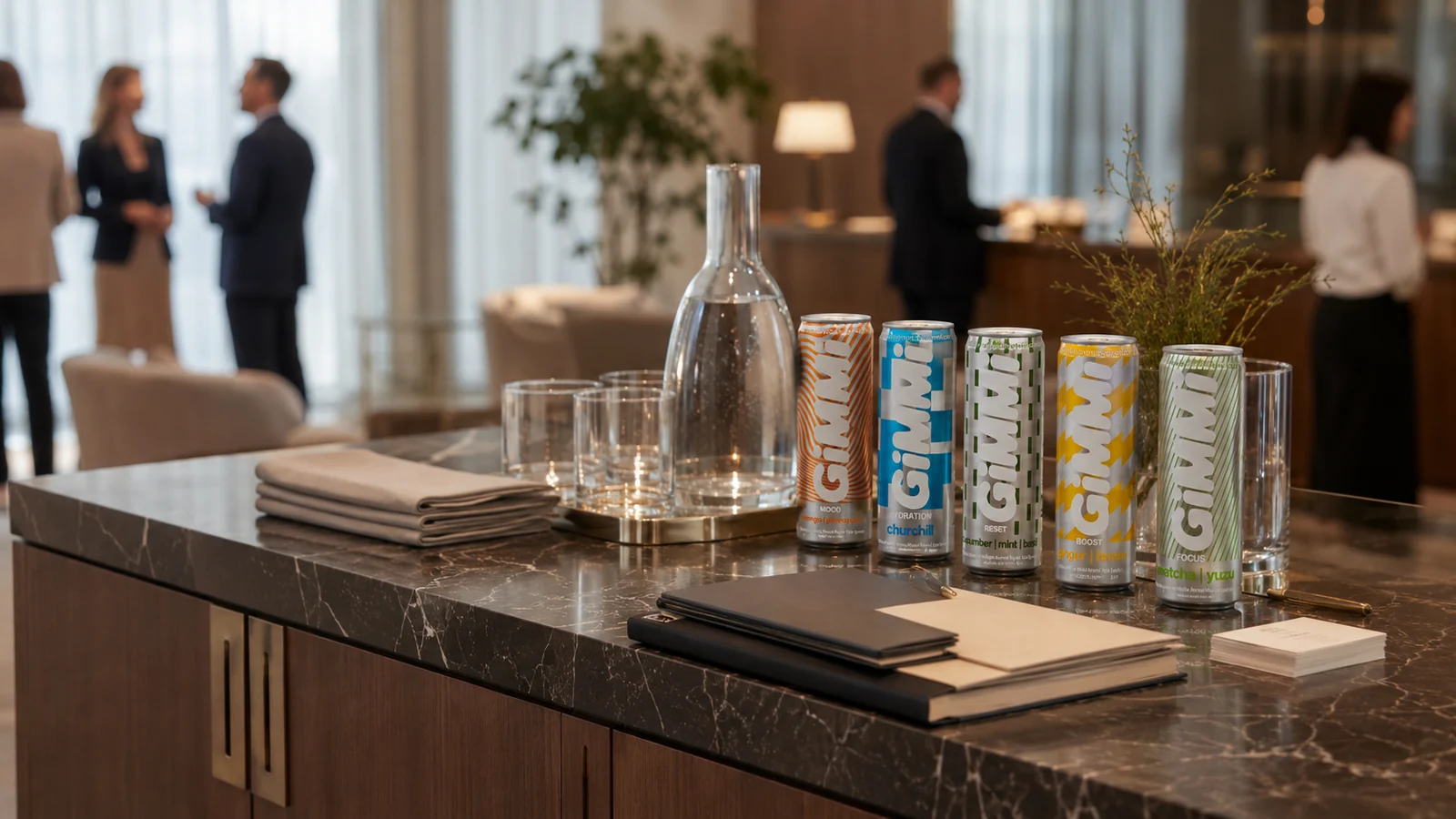
A B2B area for hospitality and custom orders — branded cans, venue programmes and an enquiry flow — so the brand site doubles as a sales channel, not just a shopfront.


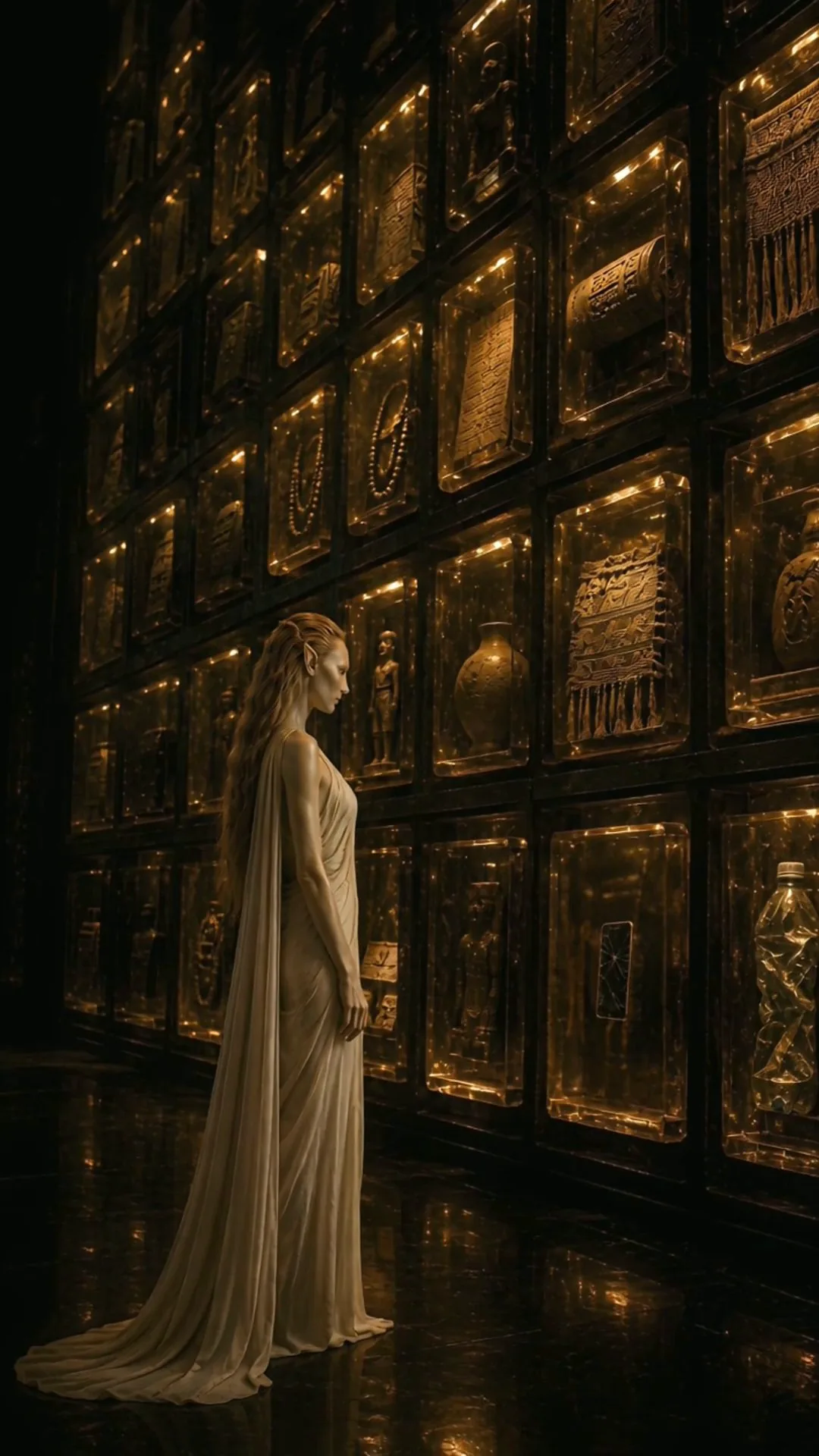
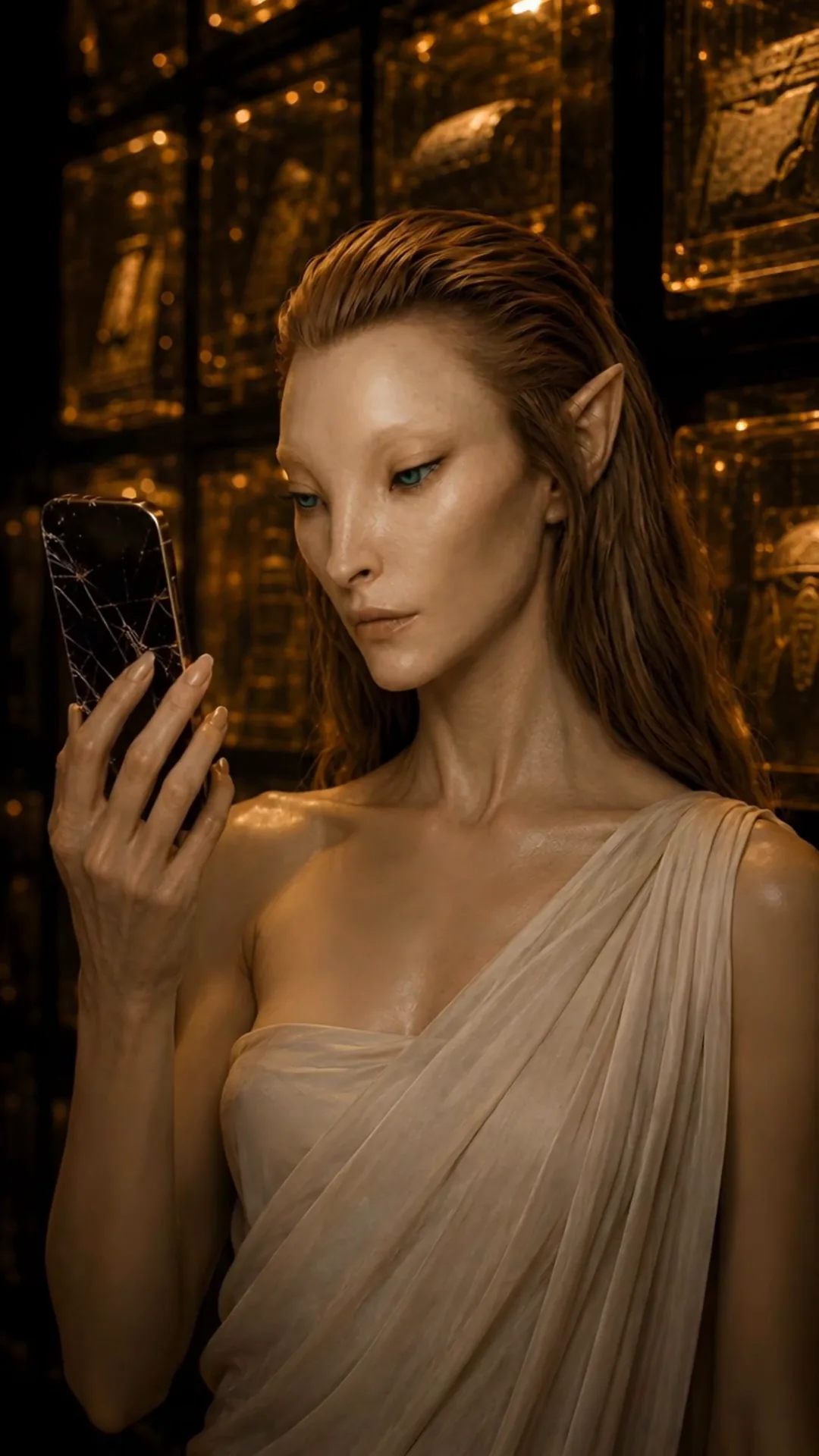
A 60-second vertical brand film, end-to-end AI-crafted. An ancient synthetic archivist walks an amber wall of every object humanity ever made — and passes a verdict on each: keep, or discard. One thing survives. The whole piece is a question aimed at the viewer: would the thing you own survive her verdict?
This is a concept spec piece — an imaginary luxury campaign produced to show what an OMNI Labs synthetic film looks like end to end. No shoot, no crew, no location. One original synthetic character held identical across eight shots, one product held identical alongside her, and a designed motion layer that turns raw clips into an actual ad film instead of an AI montage.
The point isn't the model — it's the direction. The image-to-video was generated on an inexpensive, near-zero-cost video model: deliberately cheap, because the craft is in everything wrapped around it. Identity locking across frames, a verdict mechanic built for the feed, kinetic typography cut to the beat, and a full original soundtrack — a first-person narration in the archivist's own voice, scored under a custom audio mix. Cheap generation, expensive taste.
Vaelara is an original synthetic persona — a Lyrian humanoid, built and owned in-house. The hard part of AI film isn't generating one beautiful frame; it's the same face across eight of them. She holds across every shot: the bone structure, the eyes, the ears, the skin — no drift, no morphing between cuts.
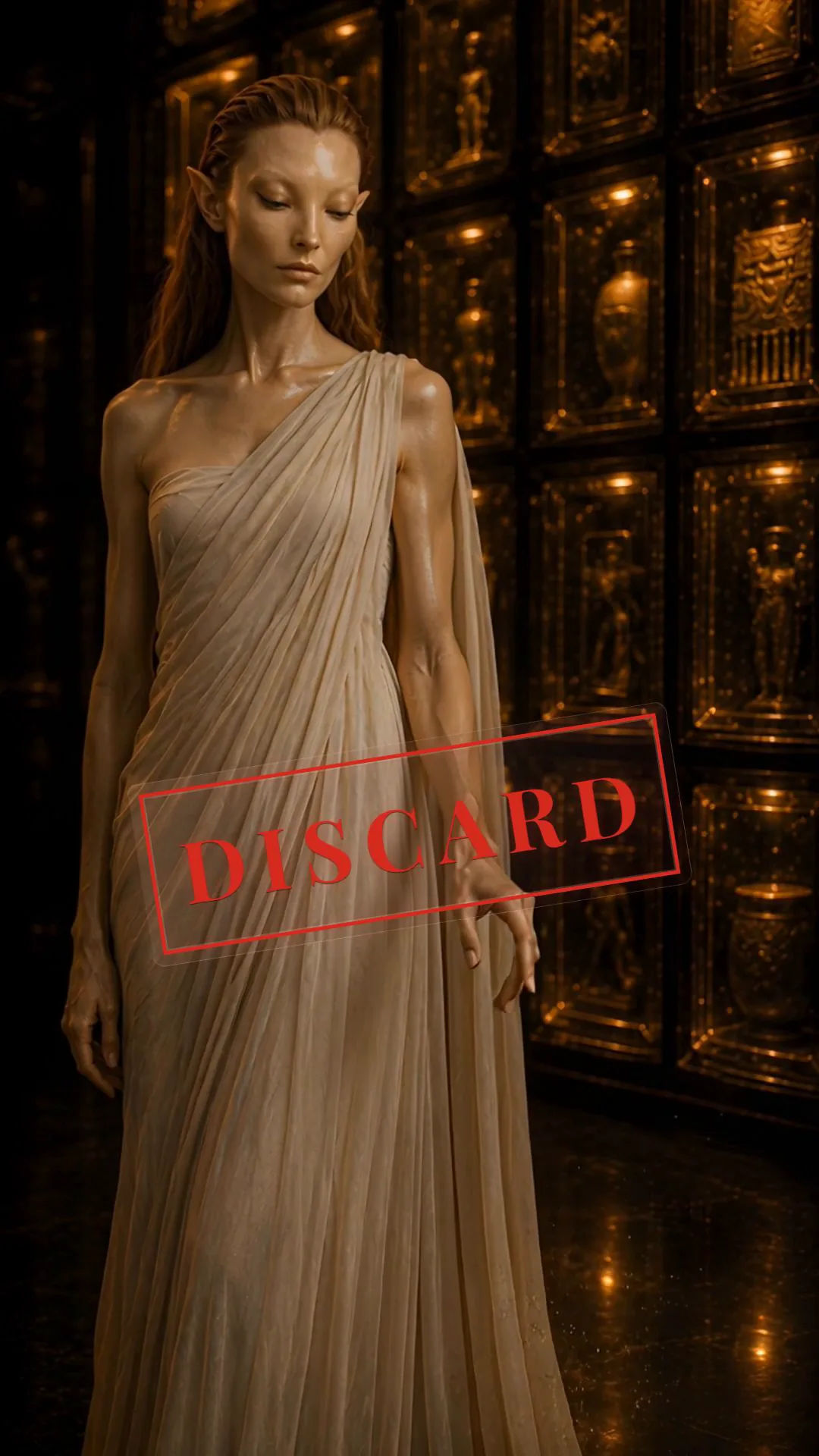
The film is built around a single feed-native device: she judges each object and a stamp lands — KEEP or DISCARD. It's a hook engineered for replay and comment, the editorial idea doing the work — not the render.
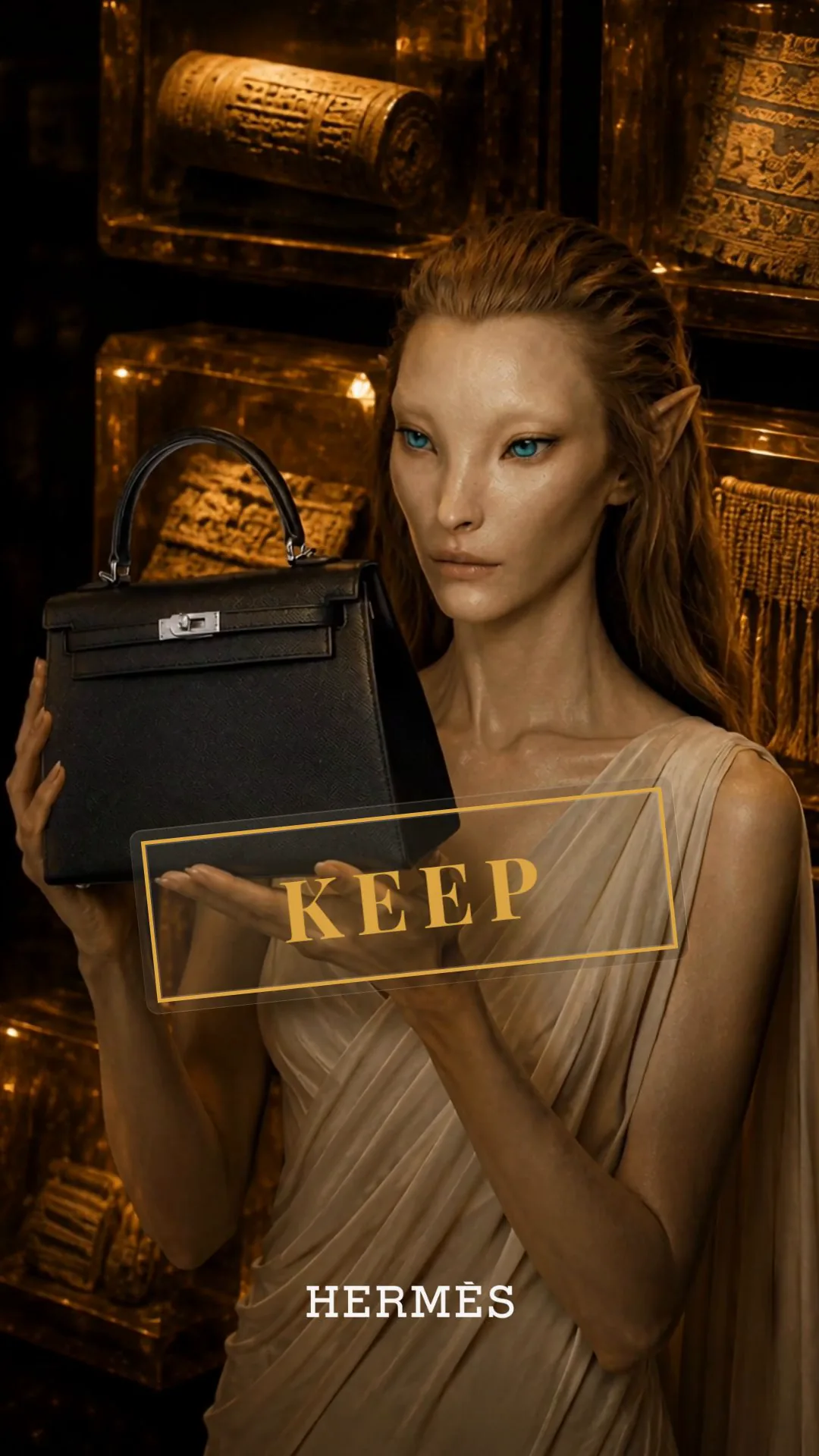
Everything modern is discarded. The single object she keeps is a timeless one — the positioning of the entire piece in one frame: the thing an archivist older than civilisation would still choose to keep.
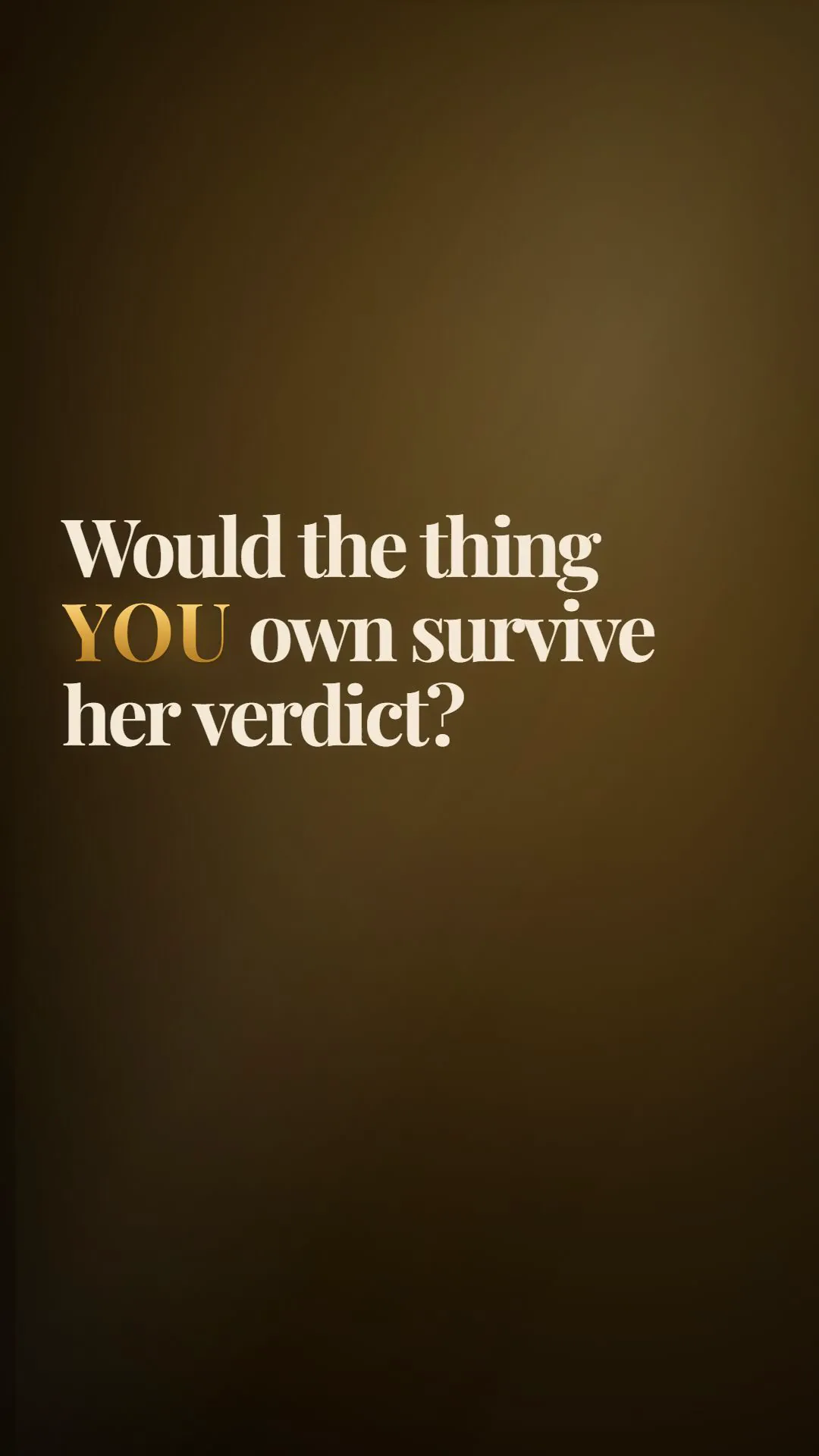
Raw image-to-video clips don't make a film. Each clip was colour-graded and re-timed, then composited with a designed motion layer — kinetic serif typography, metallic verdict stamps, glass lower-thirds, cross-dissolves — and closed on a question. The generation is cheap; the cut is the craft.
The archivist narrates the film in the first person — an original eight-segment script, beat-aligned to the cut and scored under a custom atmospheric mix. The sound is built last, against a locked picture, so voice and image land together.
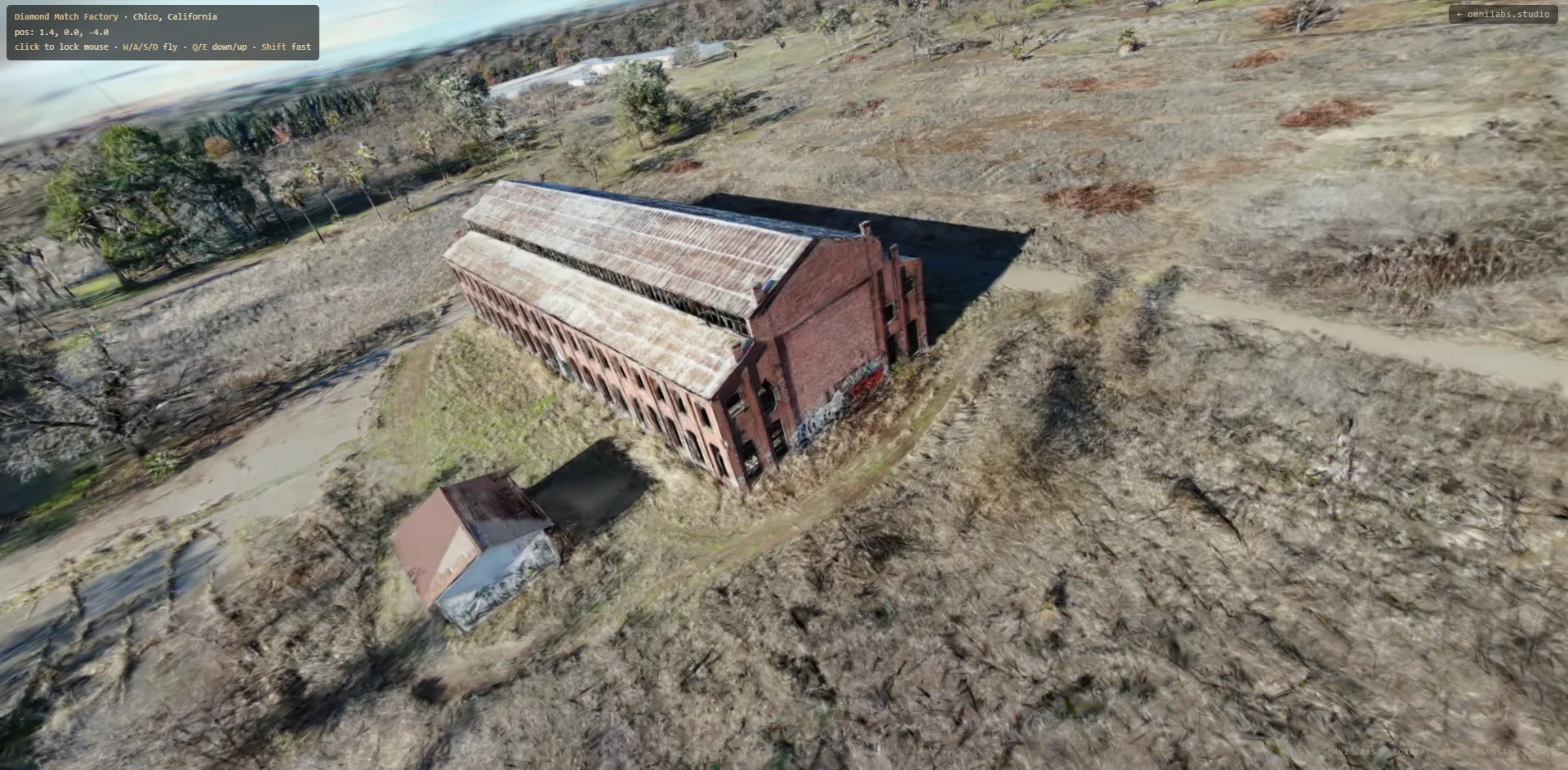
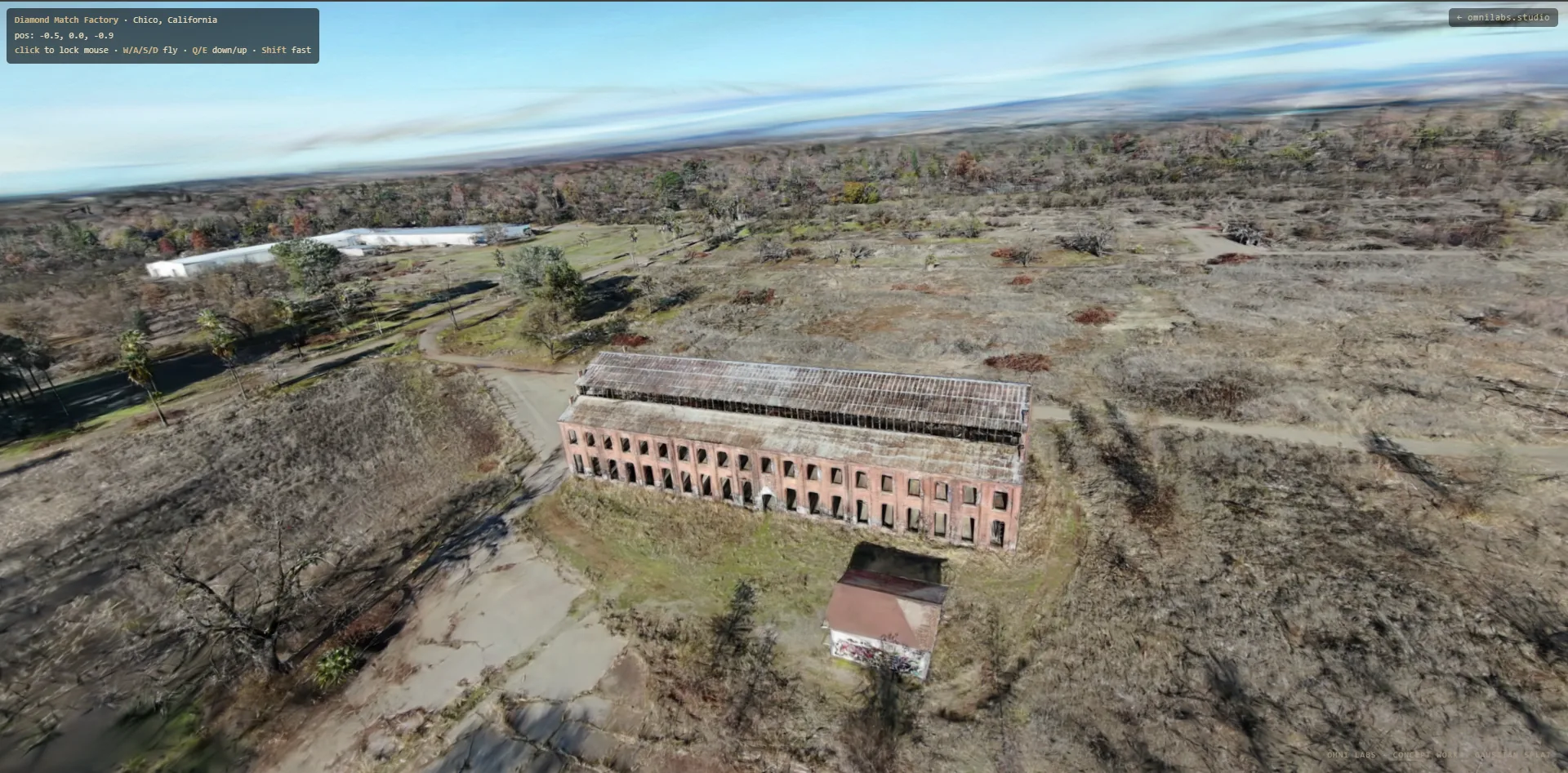
A single DJI drone, one continuous helix orbit of the Diamond Match Factory in Chico, California — and from that one video, a fully walkable 3D Gaussian-splat reconstruction of the real building. No LiDAR, no rig, no studio capture: just photogrammetry and a real flight.
The source is the orbit footage above — a helix flight that rises while it circles, so the camera sees every façade from multiple elevations. That coverage is the whole trick: a flat circle leaves the vertical surfaces ambiguous, but a helix gives the solver the parallax it needs to resolve window lancets, cornices and brickwork. We pull sharp frames from the flight, then run them through a classical Structure-from-Motion pass.
COLMAP solved all 407 of 407 cameras — a clean 100% registration, every frame placed in 3D space with the sparse point cloud to match. That posed dataset feeds Brush, a WGPU Gaussian-splat trainer, which optimises millions of splats into a continuous radiance field you can fly through. The result is a walkable world reconstructed from a real place, rendered in a Three.js viewer — the third local splat rail in the OMNI Labs creative-tech stack.
Frames captured live inside the walkable Gaussian-splat viewer — the same scene you can fly through, posed at varied angles from hero three-quarter to near top-down.
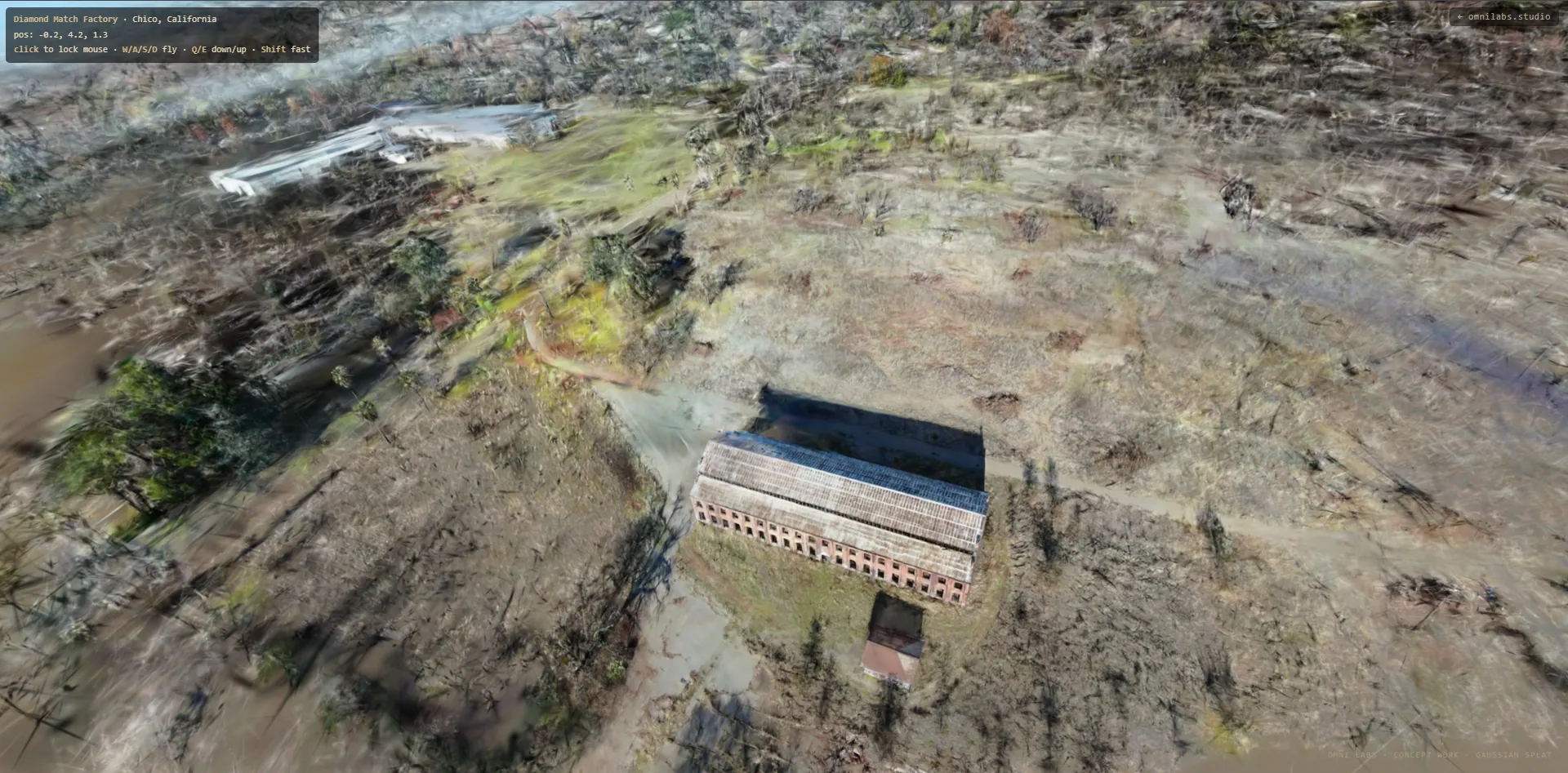
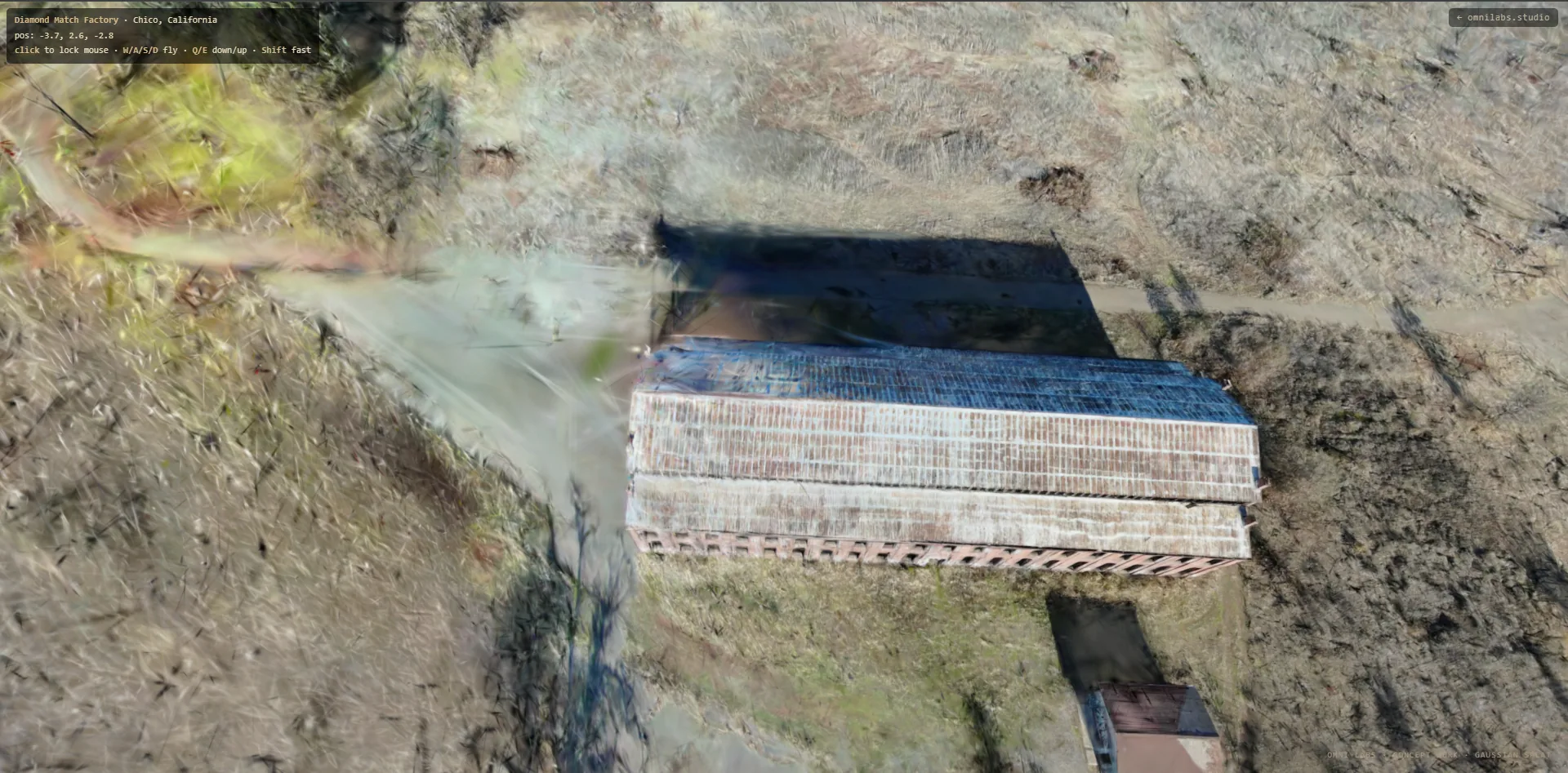
One continuous DJI flight, rising as it circles the building — a helix, not a flat ring. The ascent gives the camera multiple elevations on every façade, which is exactly the parallax a single-orbit capture lacks. Architectural detail — window heads, cornices, buttresses — only resolves cleanly when the surfaces are seen from varied angles.
Sharp frames are extracted from the orbit and run through COLMAP Structure-from-Motion. Every frame is matched, the cameras are triangulated, and a sparse point cloud is reconstructed. The solve landed at a full 407 of 407 cameras registered — a 100% clean alignment with no stray two-image fragments, the sign of well-conditioned footage.
The posed dataset feeds Brush, a WGPU Gaussian-splat trainer that runs entirely on local GPU — no CUDA-toolkit compile, no cloud. It optimises millions of 3D Gaussians into a continuous radiance field that captures the brick, glass and street context of the real building.
The trained splat loads into a Three.js viewer where you can fly the camera through the reconstruction — a real place, navigable in the browser. It's the video-to-world counterpart to our generative single-image splat rail: that one dreams a world, this one faithfully rebuilds one that exists.
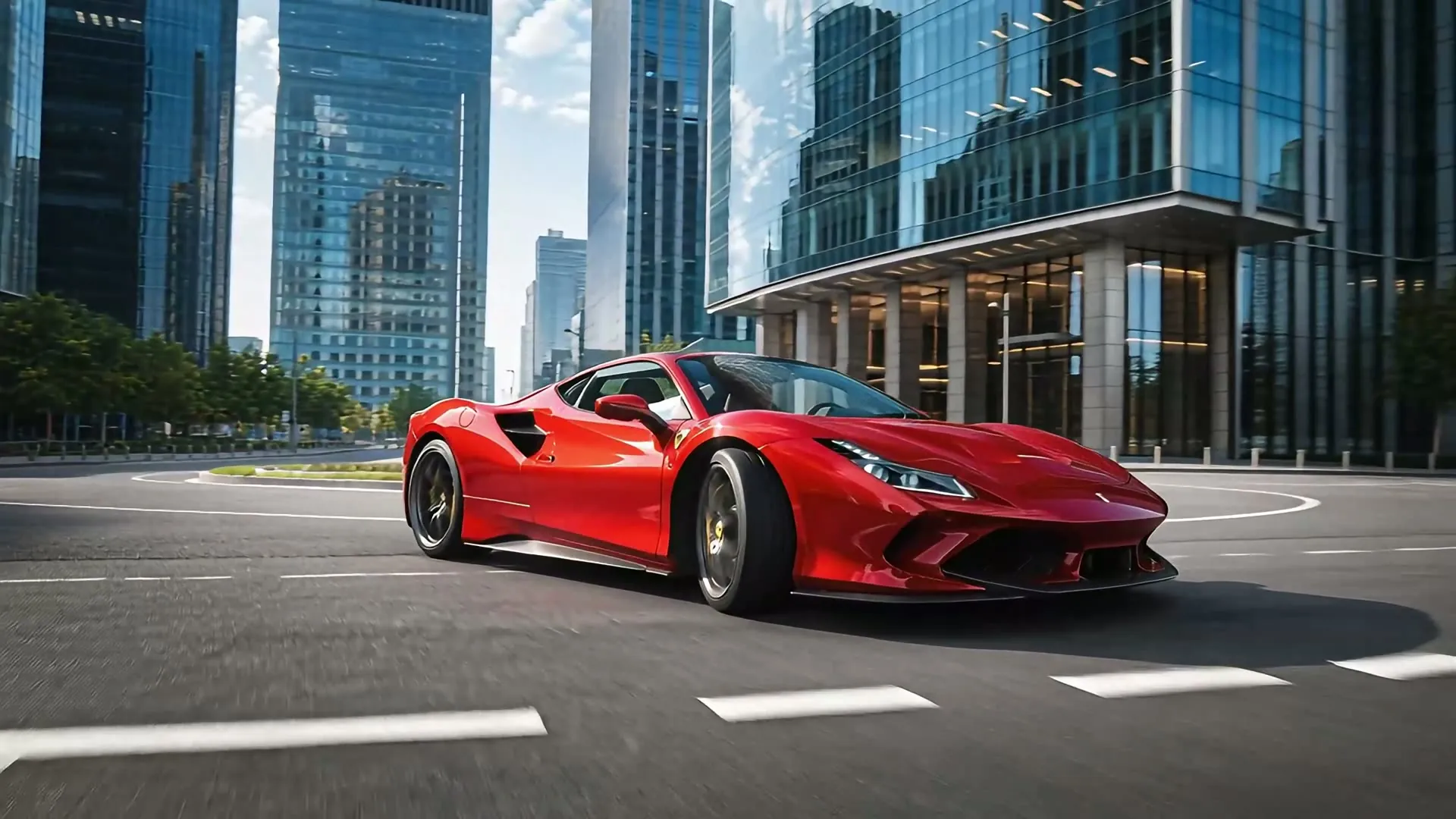

A fictional performance concept, built as a single-page showcase you drive with the scroll. As you move down the page a scarlet GT sweeps through a glass-tower junction, its V8 unbolts itself into a full teardown, and — at the finale — you take real-time control of a 3D cruise through an endless night corridor. One in-house automotive spec piece, no real manufacturer, no game engine: just frame sequences, an AI-authored engine disassemble, and a browser 3D renderer.
The spine is a scroll-scrub frame sequence — hundreds of pre-rendered stills mapped one-to-one to scroll position, so the page scrubs a film frame by frame as you move. Three separate sequences carry the story: the hero junction turn, the engine teardown, and the night-run finale. Every frame is a fixed still, but the scroll makes it motion — the same technique behind the highest-end product launch pages, rebuilt from scratch as a standalone site with no build step.
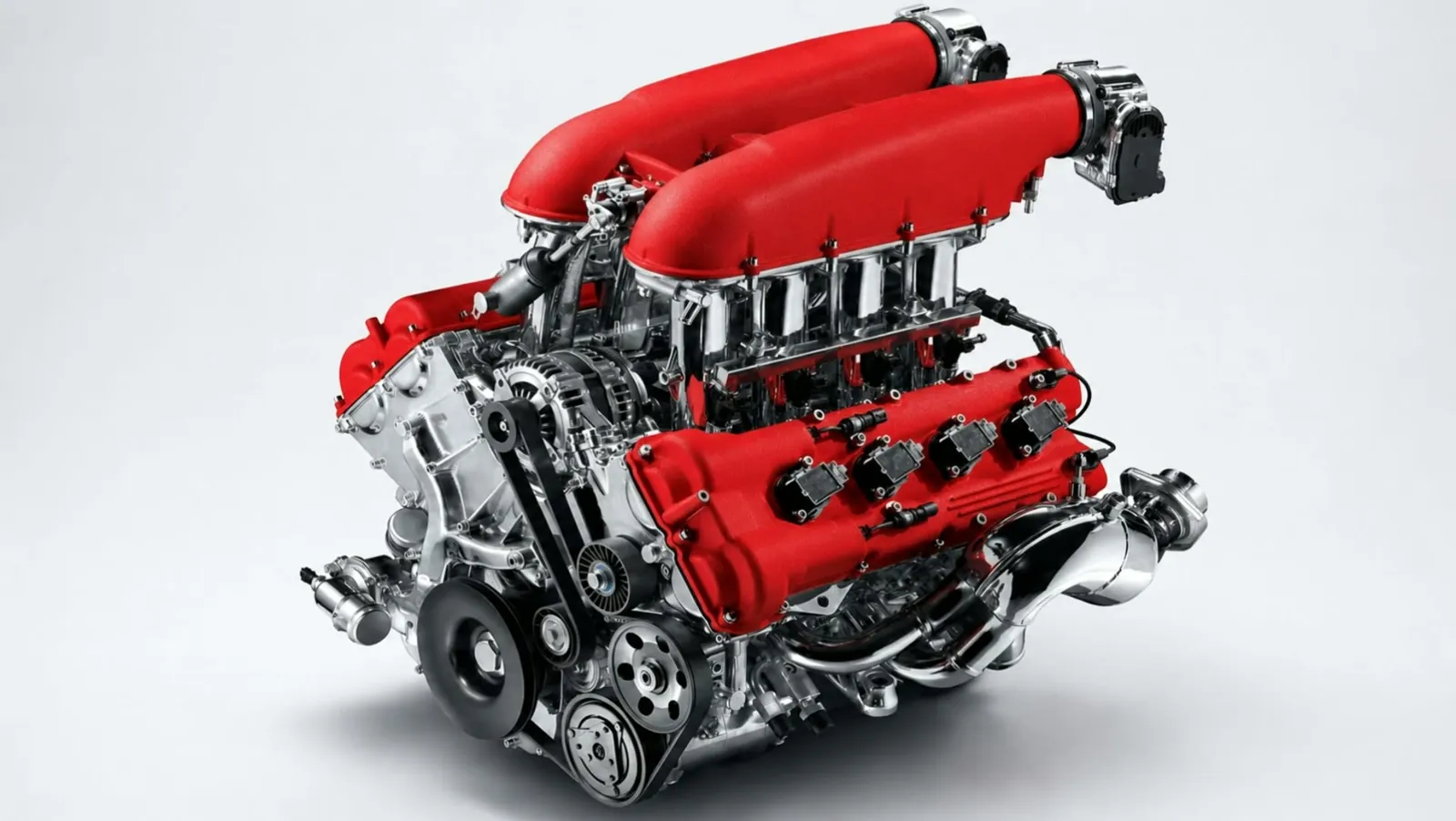
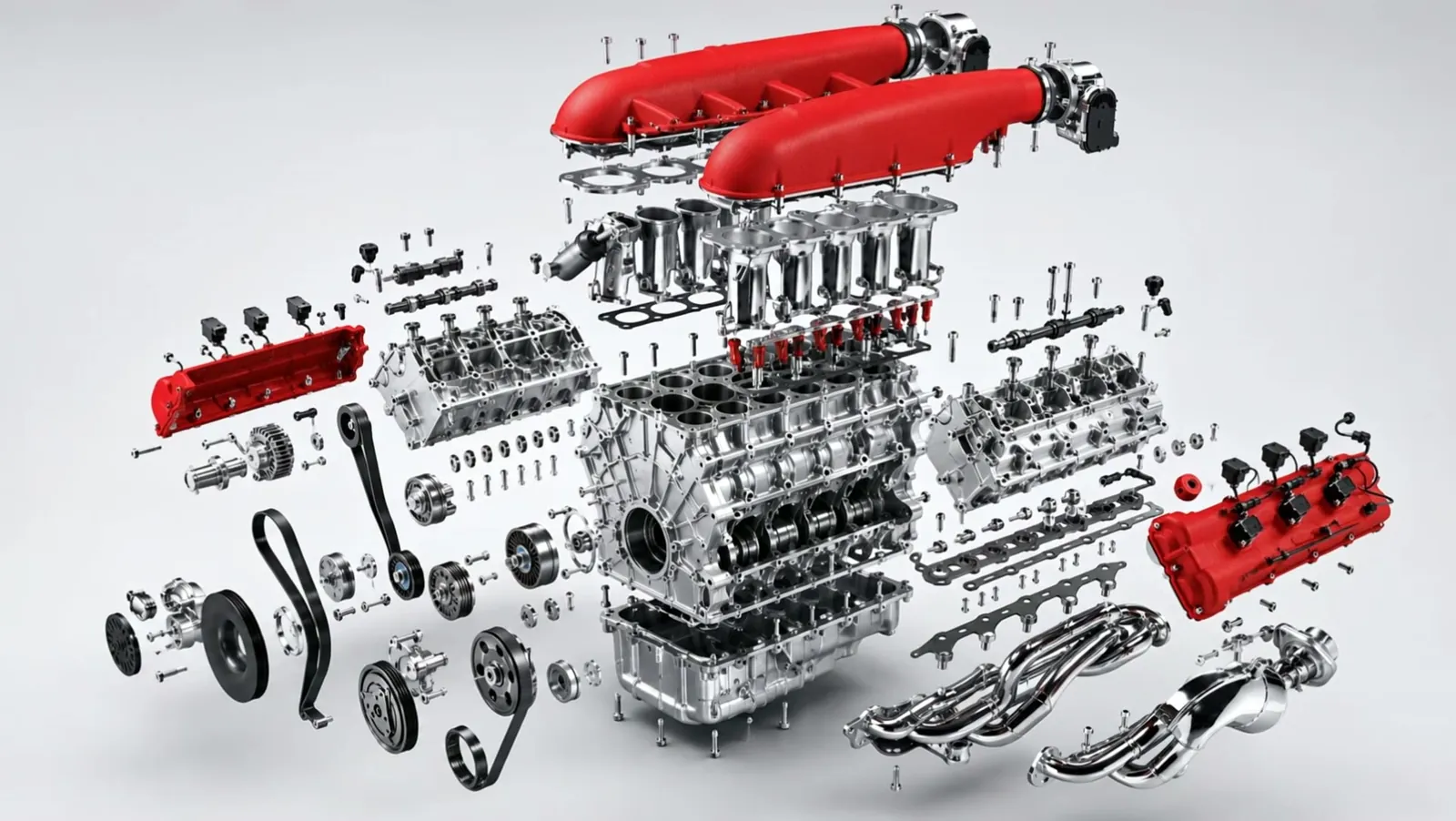
The centrepiece is the engine disassemble: the car's V8 lifts apart into a fully exploded teardown, every intake, header and pulley separating in mid-air. That sequence was authored with an AI image-to-video model driven by start-and-end keyframe interpolation — one frame shows the assembled engine, another the fully exploded state, and the model resolves the disassembly in between. The result is scrubbed on scroll like the rest, so the viewer teardown-and-rebuilds the engine with their own hand on the wheel.
Frames from the live showcase — the engine teardown scrubs from a fully assembled V8 to a mid-air exploded view, and the night-run finale keeps the camera low while the machine rotates.
Screen capture of the live WebGL scene — the concept cruising the night corridor in real time, rendered in the browser with Three.js from a GLB model, with reflections, a moving HUD and scroll-driven speed.
Hundreds of pre-rendered stills are mapped one-to-one to scroll position and painted to a canvas, so the page scrubs a film frame by frame as the viewer moves. It reads as continuous motion but never plays — the scroll is the transport. Three independent sequences hand off cleanly down the page: the junction turn, the engine teardown, and the finale run.
The V8 teardown was authored with an AI image-to-video model driven by start-and-end keyframe interpolation — one keyframe is the assembled engine, the other is the fully exploded state, and the model resolves every intermediate frame of the disassembly. Those frames become their own scroll-scrub sequence, so the viewer pulls the engine apart and back together by scrolling.
Between the frame sequences, the page hands the viewer live control of a 3D scene rendered in the browser with Three.js — a real-time night corridor the machine cruises through, with reflections on wet asphalt, a moving HUD and scroll-driven speed. Not a video, not a game engine: a WebGL scene running live in the page, alongside the pre-rendered frames.
The whole showcase is vanilla HTML, CSS and JavaScript with a vendored 3D library — no framework, no build step, no external dependencies. It ships as a single static site deployed straight to Netlify, with a strict content-security policy and long-cache-immutable frame delivery. An in-house automotive spec piece, engineered like a product launch page.
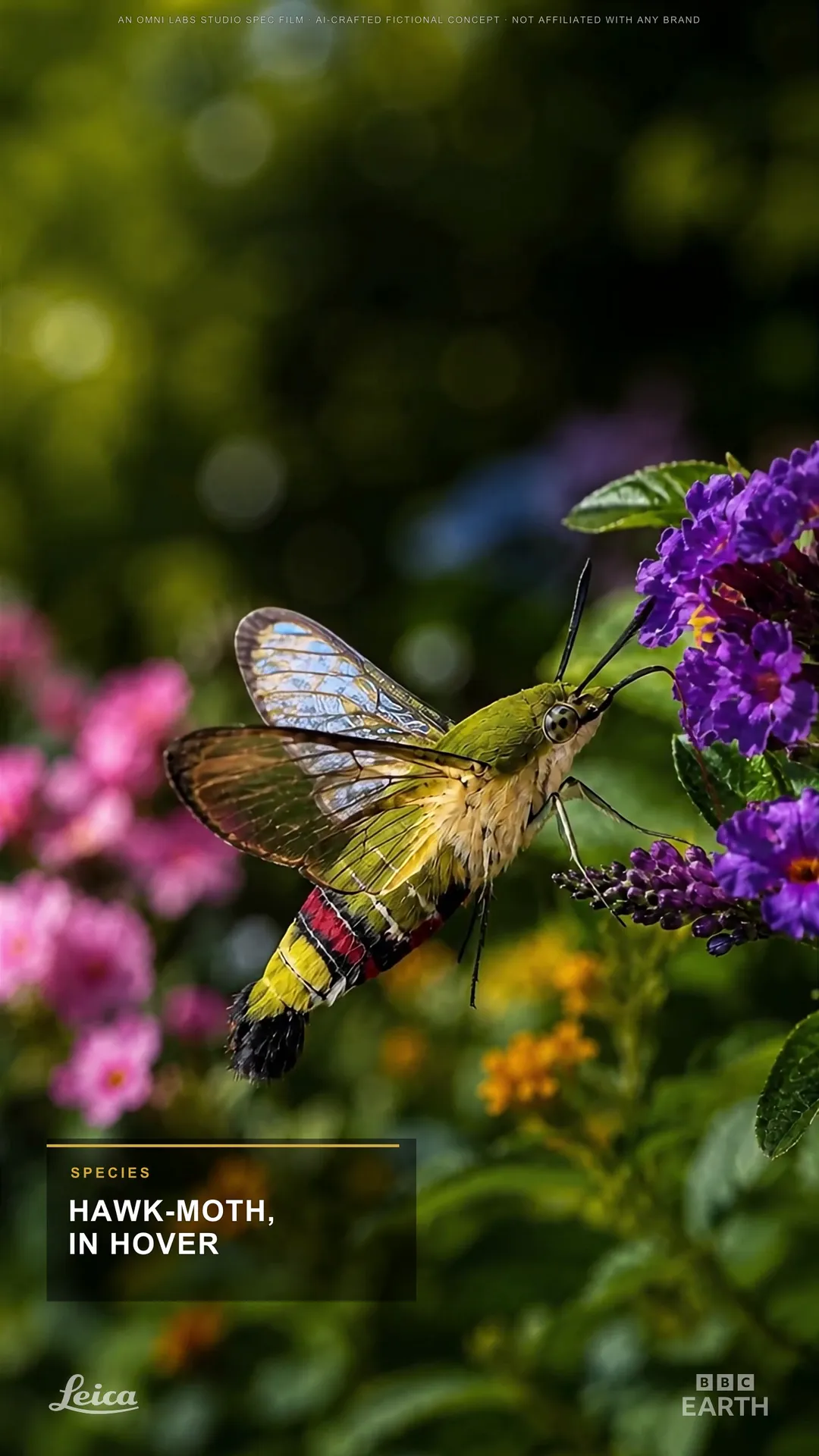
A 70-second vertical wildlife film, end-to-end AI-crafted. A hummingbird hawk-moth hovers at a bank of garden flowers — wings a blur no eye can resolve, held still only by the lens. Broadcast-grade lower-thirds name what the camera is seeing, frame by frame, while a permanent Leica and BBC Earth bug anchor the corner. See what speed hides — the world between frames.
This is a concept spec piece — an imaginary broadcast collaboration produced to show what an OMNI Labs macro nature film looks like end to end. No lens, no garden, no crew. Every wingbeat, every pollen grain, every iridescent vein in that translucent wing was generated, not filmed — then directed like a real natural-history segment: species cards, a consistent on-screen information system, and a closing brand card that plays it straight, the way a real broadcast credit would.
The craft is in the restraint. The image-to-video was produced on an inexpensive AI video pipeline and finished with a 2× local upscale — deliberately cheap, because the direction is where the budget actually goes. A kinetic broadcast-UI layer holds identity and framing steady across the cut; a cinematic narrator reads the moth's Latin cue and a fictional "Leica 35mm APO-Summicron" credit line in the same breath a real wildlife documentary would; and underneath it all, a layered mix — a scored bed, a garden's worth of ambience, and the voiceover ducked cleanly above both — does the quiet work of making a generated reel feel like it was actually recorded somewhere.
A hummingbird hawk-moth in hover is one of the hardest things a camera can hold: wingbeats too fast for the eye, a body that never stops correcting for wind. The film opens on exactly that — a species card names the shot while the moth's whole body, wings included, holds identity across the frame instead of dissolving into motion blur.
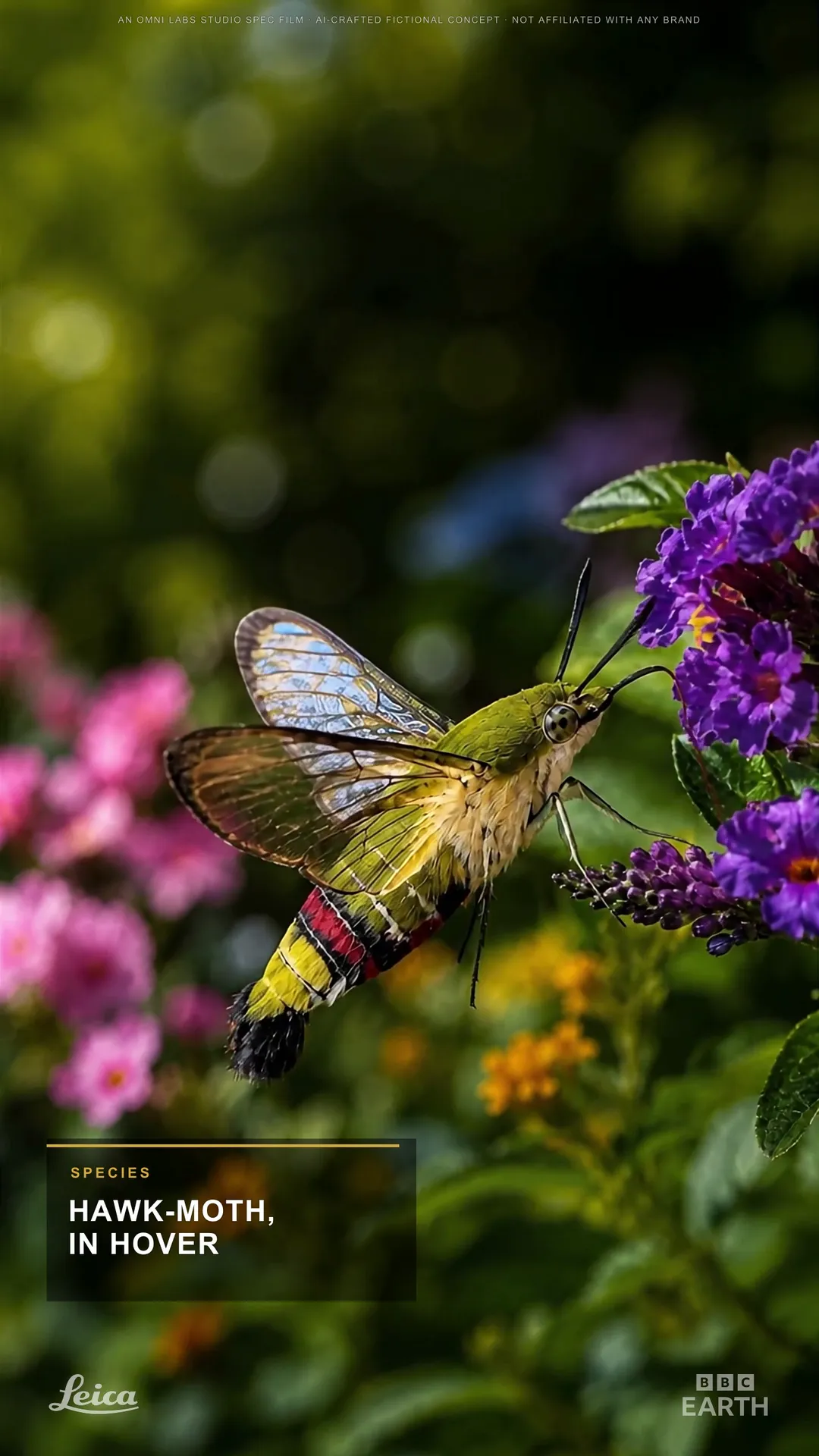
The film's thesis, stated in its own lower-third: every translucent wing pane, every vein, every dusting of pollen was already there in the generation — the macro lens doesn't invent detail, it uncovers what speed normally hides. That's the positioning this whole piece is built to prove.

Unlike a social reel, this film never drops its on-screen information system: a quiet Leica mark bottom-left, a BBC Earth bug bottom-right, and a disclaimer running the full length of the top edge. The lower-third cards land and clear like a real natural-history segment — never louder than the subject.

A cinematic narrator carries the film in a single unbroken read, naming the fictional "Leica 35mm APO-Summicron" the way a real product-partnership documentary would credit its glass. Underneath her, a scored bed and a full garden's ambience are mixed and ducked against the voice — built last, against a locked picture, so sound and image land together.

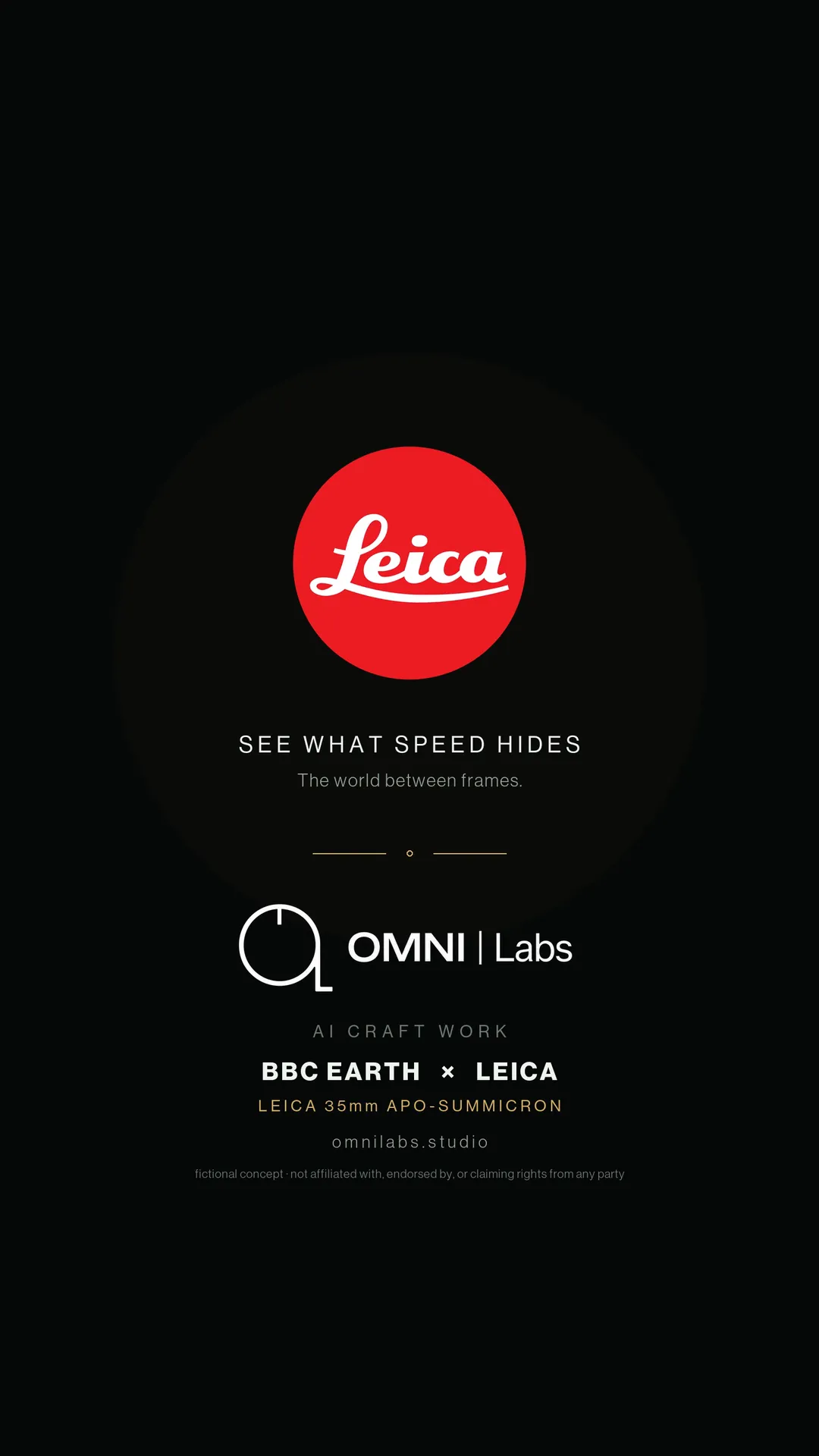
The film closes the way a real broadcast partnership would: the Leica mark, the line "See what speed hides," and a clean Leica × BBC Earth co-sign under the OMNI Labs credit. No wink, no reveal — the spec piece is played entirely straight, because that restraint is the pitch.


We define the visual world, references, boundaries, audience, tone, and output format.
We build the prompt logic, model choices, workflow structure, asset rules, and consistency framework.
We generate, select, refine, upscale, retouch, sequence, and prepare assets for use.
We manage approval loops, claim boundaries, visual corrections, and final delivery.
We package final assets with naming, usage notes, prompt documentation where relevant, and reusable workflow logic.
Who need authority content without becoming full-time creators.
That need visual systems faster than traditional production allows.
That need AI production capacity behind the scenes.
Exploring synthetic media without losing control.
Lifestyle, product, and technology companies building visual worlds.
We do not sell random AI image packs. We do not chase trends without a visual strategy. We do not treat AI output as finished work. Every asset passes through direction, selection, refinement, and brand review.
A dedicated local workstation holds each face, persona, and visual world fixed across every frame — PuLID-class identity control, run on our own hardware, not rented per call.
A local vision model screens every render before a human sees it — sorting each frame into ship, reject, or review against a per-brand rubric. Nothing weak reaches the selection table.
Retouching and finishing run inside the software itself — live Photoshop driven from code, not clicked by hand. Repeatable, auditable, fast.
Every shot goes to the engine proven best for it — image, video, upscale — by tested routing rules, not by whatever is trending this week.
AI production becomes valuable only when it is controlled. OMNI Labs defines boundaries, references, selection logic, review steps, and delivery rules before scaling output.
A generated face is easy to copy. A certified identity is not. OMNI Labs issues a verifiable authenticity certificate for each model — binding its full creation lineage into a tamper-evident, signed, time-anchored record. Not a watermark. A chain of custody.
The model's core identity frames are fingerprinted with SHA-256. Change one pixel and the seal breaks.
The authorship workflow that produced the identity is hashed and bound to the model — its origin, not just its output.
Every published asset is hashed and locked to the same identity, so a certified image can be matched back to its source.
The combined root is signed with the OMNI Labs key (ed25519). The signature is ours; the proof is public.
The root is anchored to the Bitcoin blockchain via OpenTimestamps — independent, unfalsifiable proof of when it existed.
Signed certificate, model passport, and an internal provenance registry entry.
Adds the full SHA-256 hash bundle, a public verification page, and embedded C2PA Content Credentials.
Adds a signed usage license with exclusivity, a Bitcoin time-anchor, and an impersonation / copy audit baseline.
This certificate verifies provenance, authorship workflow, uniqueness claim, and asset integrity. It does not by itself constitute statutory copyright registration. No real person is depicted.
If you are licensing a synthetic model for campaign or editorial use, certification is how you prove what you own — and how you defend it. Talk to us about certified models for your brand.
The same team behind our visual work also ships software end to end — immersive 3D experiences, full-stack products, AI infrastructure, and brand sites that go from design to deploy.
Three.js and WebGL scenes, interactive product configurators, scroll-driven motion, and high-end immersive experiences that run in the browser.
End-to-end products on Next.js and NestJS — dashboards, auth, payments, real-time, and Postgres data models. From first commit to production.
LLM pipelines, autonomous agents, custom generation and review workflows, and automation wired into real systems — not demos.
Premium marketing sites, e-commerce, and design systems — taste-led design carried all the way through to clean, fast, deployed code.
We scope the problem, model the data, and design the system and interface before a line of production code is written.
We build in focused, well-bounded pieces — typed, tested where it matters, and reviewed — so the codebase stays clean as it grows.
We deploy, monitor, and hand over something maintainable — infrastructure, documentation, and a system you can keep building on.
Beyond our creative production, we design and hand over private AI production systems — the same kind of setup our own studio runs. Your team operates it directly, inside their own tools. No middle-man dashboard, no monthly lock-in. You own it outright.
A one-time build you own — no subscription, no recurring licence. The system lives in your environment and answers to your team.
Automation runs directly inside the tools your team already uses. Nothing to log into, no extra layer between the request and the result.
We build the exact capabilities you need — nothing you don't. Each system is scoped to your workflow, not a fixed template.
You receive a maintainable, documented system your team can run and extend on day one — with our support behind it.
We map the repeating work your team does by hand and design the system around it — the exact capabilities, nothing more.
We build the system to your brief and wire it into the tools your team already works in, tested against real work.
We hand over an owned, documented system — clean, maintainable, and ready for your team to run and extend.
The complete automation setup for your production — every capability, built and wired together as one owned system. A single one-time purchase.
Buy only the capabilities you need, one by one. Start with a single workflow and add more when you're ready — each a one-time purchase.
Send a short brief. Tell us what you are building, what you need to produce, and where the assets will be used.
Thanks — we've got your brief and will get back to you, usually within a day. For anything urgent, reach us at hello@omnilabs.studio.
For one campaign, launch, visual system, or asset set.
For ongoing image, video, editorial, or social content production.
For teams that need a custom AI production system.