
The Snap Reveal: Why MiniMax H3 Ignored the Gesture and Unreal Didn't
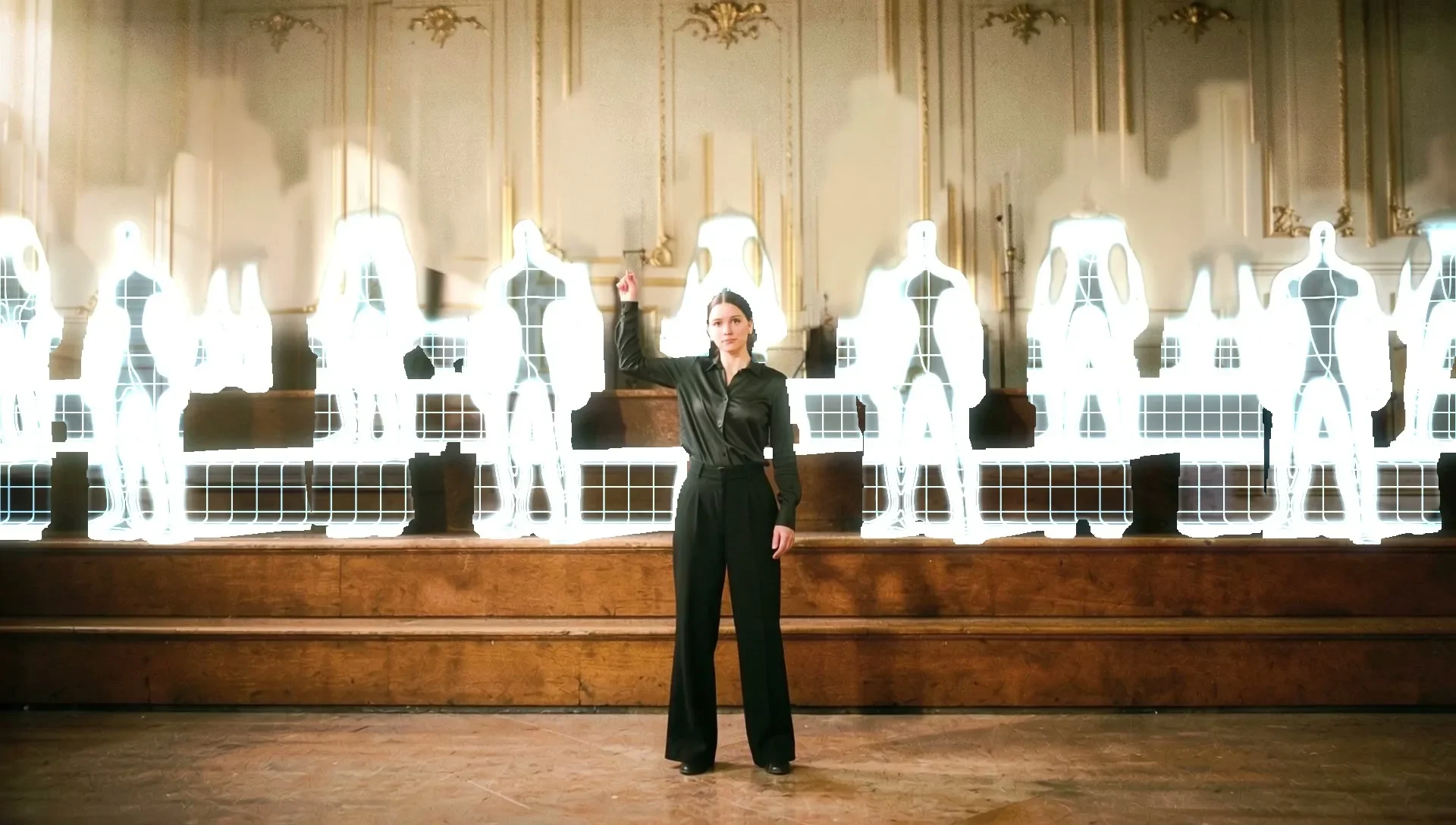
A woman snaps her fingers and a choir appears behind her. A frame-to-frame video model kept her playing and faded the choir in like ghosts. Blocking the gesture in Unreal put it exactly where we wanted it.
Key takeaways
- On MiniMax H3 the take comes from the seed and the keyframes, not the prompt: given start and end frames, it filled the gap by the shortest path and skipped the snap.
- In Unreal the gesture is animation, not a request: a layered Control Rig raised the hand on the frame we chose.
- An appearing object is two renders from one camera, with and without it; the grey difference is a perfect matte.
- The reveal wipe has to cover a region, not the object's outline: two AI renders never match in wall brightness.
- Version 2 works but is not finished: the hologram is too white, the hand reads as a fist, and the empty stage has smudges.
The brief
A woman on a stage snaps her fingers, and the rest of the ensemble appears behind her. It is a simple idea and a hard shot: the gesture has to land on a specific moment, the new people have to appear in the same space under the same camera, and the appearance has to look intended rather than like a glitch.
We tried it twice, first with MiniMax H3 running locally, then with Unreal Engine and LTX 2.5 Layout-To-Render (the pipeline in Unreal Is the Director).
Attempt one: MiniMax H3, start and end frames
The plan used keyframes. Frame A was an empty concert hall with a cellist playing. Frame B was the same hall with an orchestra seated behind her, painted into A so the cellist stayed pixel-identical. Clip one animated A on its own: she played, the chairs stayed empty, and that take was good. Clip two ran from the last frame of clip one to B, with a prompt that said she lifts her hand from the bow and snaps.
She never snapped. Frame B shows her playing, and with guidance off the model fills the gap between two frames by the shortest path, so she kept playing. The musicians faded in like ghosts at around 2 seconds. On this model the take is decided by the seed and the frames, not by the words; a gesture that is not in a keyframe does not happen.
The fix was to draw the snap as a keyframe of its own. Before we could, the GPU began dropping off the bus during the roughly 15-minute H3 jobs, on two different drivers. That is still unresolved, and it is part of why the second attempt kept every stage short.
Attempt two: block it in Unreal
In Unreal the gesture is not a request; it is animation. We built a stage, tagged the choir figures, and gave the woman an idle animation with a layered Control Rig on top to raise her arm on the frame we chose. (One trap: setting the rig's controls through the helper functions silently wrote nothing; keying the channels directly worked.)
The appearing choir is two renders from one camera: one with the choir, one without. The difference between the two grey renders is a perfect matte, for free. Each version then went through LTX Layout-To-Render with its own look still, so we had a finished empty stage and a finished full stage that share every camera move.
The reveal itself is the hologram wipe from our hologram effect, run in reverse: empty stage, then the choir as a hologram, then solid. It has to wipe a region (everything above the risers, minus the woman), not the outline of the choir. The two AI renders never match exactly in wall brightness, and an outline-shaped wipe left white silhouettes where the people would be.
The empty stage was its own small problem. Painting the choir out of the full look still made the image model repaint the people as ghosts; filling the area first with classical inpainting, then painting in narrow vertical strips, gave clean risers.
Version 2
| Time | What happens |
|---|---|
| 0–1.8 s | she stands alone on the stage, hand rising |
| 1.875 s | light burst at the snap |
| 1.9–2.6 s | the choir appears bottom to top as a hologram |
| 2.75–3.3 s | the hologram turns solid; the choir stays |
What works: the camera and her arm follow the grey layout frame by frame. The choir of 13 holds its faces and robes across all 81 frames. And the GPU held: four stages of about 5 minutes each ran back to back without the crash that stopped the long H3 jobs.
What does not, yet:
- The hologram is too white. The figures read as white cut-outs and the grid is weak.
- The hand reads as a fist above her head, not a snap beside her face. The shoulder angle needs to come down.
- The empty stage still has flaws: blurred smudges on the wall and a seam where two strips of the steps meet.
All three fixes are in progress. We are publishing version 2 because the method is the point: the gesture landed where we put it, which the first attempt could not do.
The lesson
Frame-to-frame video models are good at getting from one picture to another and bad at doing something in between that neither picture shows. If an action must happen at a moment, it has to exist somewhere the model cannot ignore: a keyframe, or an animated layout it follows frame by frame.
More on the layout route: Unreal Is the Director. The effects series begins at Hy-Nomas on a 16 GB Card.
Related

Building a Room Out of Holograms: Empty Set, Wireframe, Solid
An empty place fills up as wireframe holograms that turn solid on a spoken word. We did it on a locked Unreal shot and on handheld AI footage, then spent three rounds killing the flicker.
A Wireframe Hologram Effect Built from Depth, Not Generated
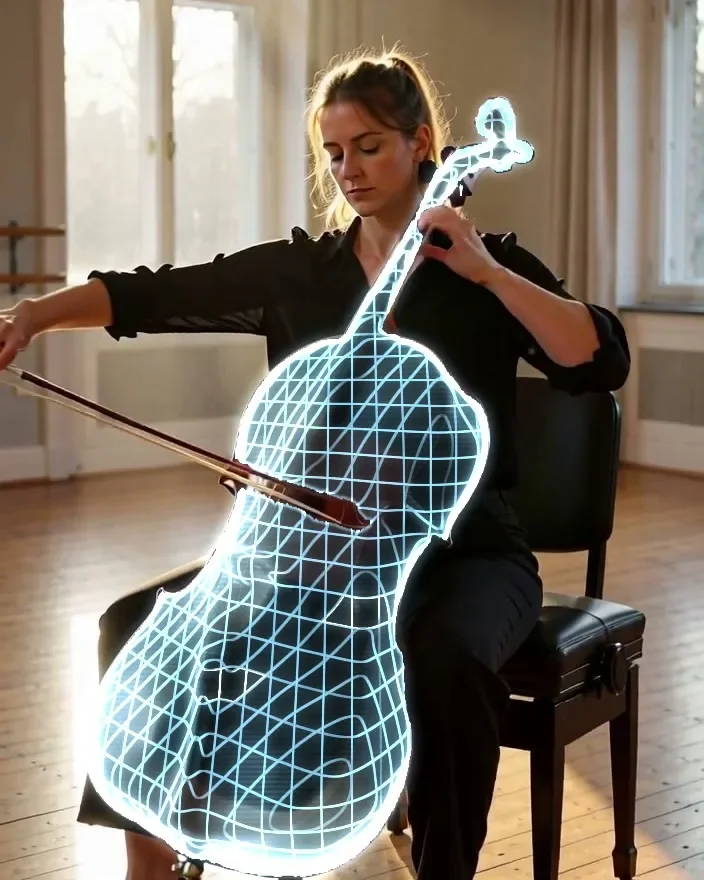
One object turns into a glowing digital twin while everything else stays real. A text prompt picks the object, depth wraps the grid around its curves, and it rendered on the first try for $0.
Built, Not Generated: A LiDAR Scan Effect on AI Video
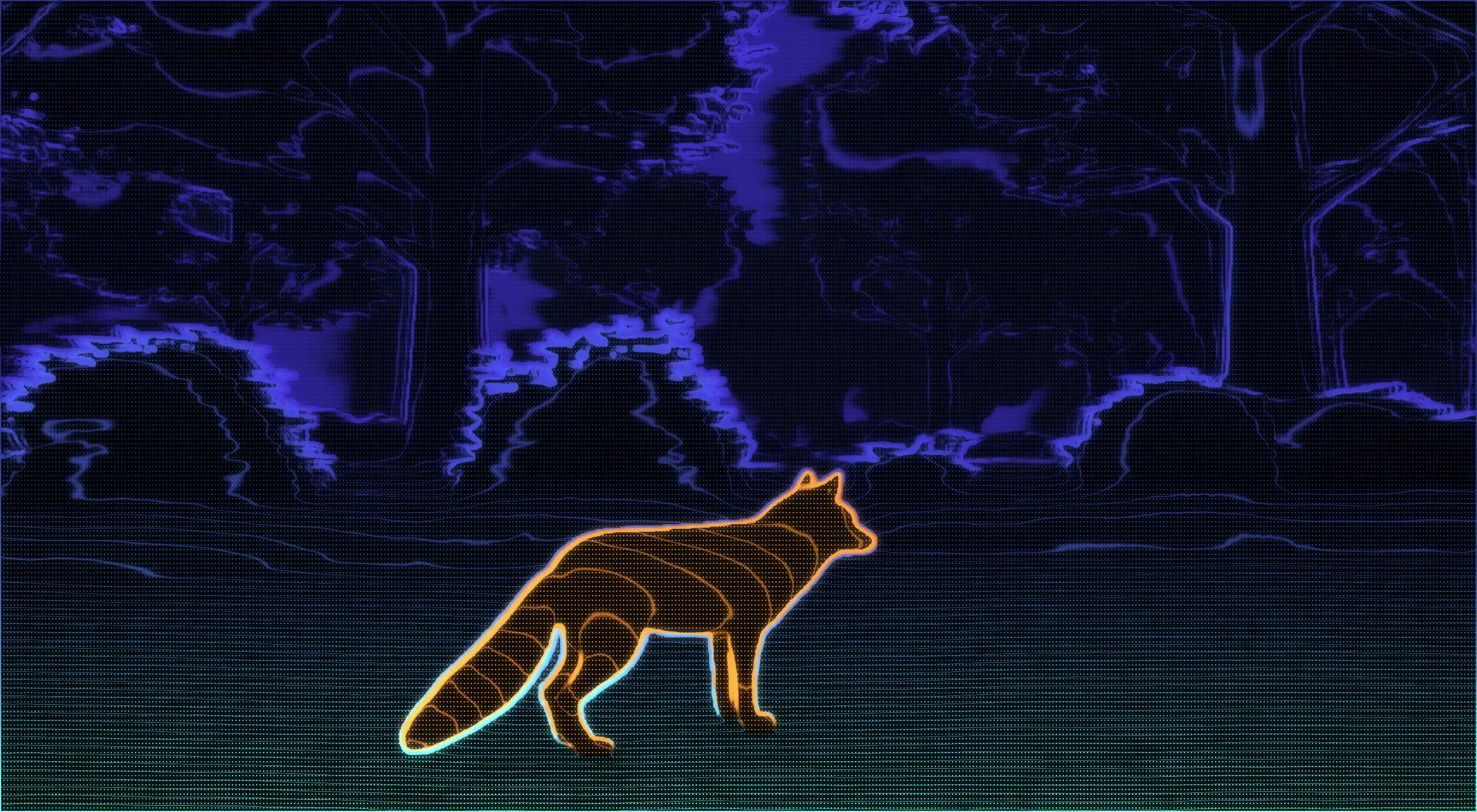
We built the viral LiDAR look from depth instead of asking a model to regenerate the clip. The 2.5D version renders 598 frames in 25 seconds; the 3D version gets real parallax from a single frame.