
World Memory Holds, New Objects Don't: Testing Hy-Nomas Segments and Camera Moves
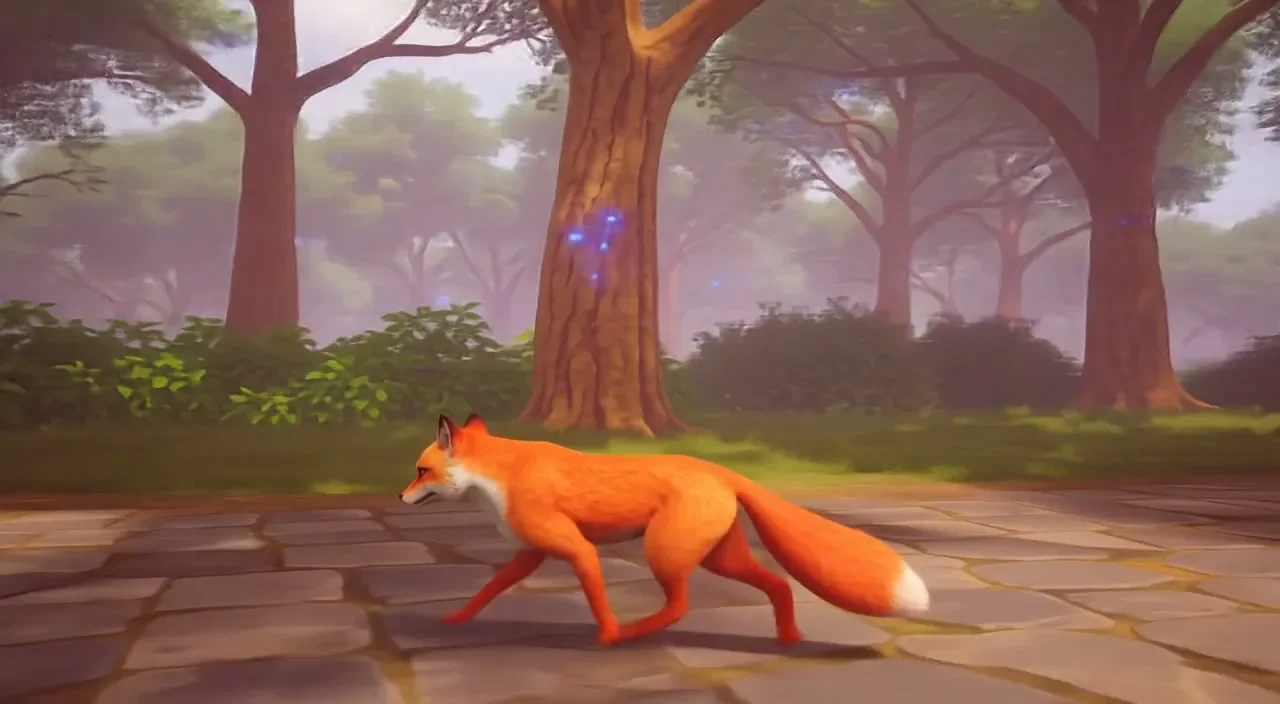
Across a segment seam the world stayed the same world. A camera arc changed the shot and even fixed the walk. But asking the scene to grow something new did nothing.
Key takeaways
- Across a two-segment, 10-second clip the seam at 5 s was clean: same fox, same path, same trees. The world memory works.
- An action change in segment two ("looks around") was obeyed. A new object ("glowing blue flowers open") never appeared, and the mood drifted to plain daylight.
- Named camera trajectories work. arc turned a follow shot into a side-profile tracking shot with parallax, and the fox's glide became a real stride.
- Use the pipeline's own list of camera names; a different list in the code cost us a run.
- Run it with nothing else on the GPU: with a segmentation model resident, one segment took 498 s to denoise instead of about 100.
What we were testing
A world model is only worth its setup if two things hold: the world stays the same across segments, and the camera does what you ask. Getting Hy-Nomas onto a 16 GB card is covered in Hy-Nomas on a 16 GB Card. Here we tested what it does once it runs.
Two tests, on the official example scene of a fox in a firefly-lit forest: a two-segment clip where the second segment changes the scene, and a single segment with a named camera trajectory.
Two segments: the memory holds
The two-segment clip is 10 seconds, 240 frames. The seam at 5 seconds is clean: the same fox, on the same path, between the same trees, with no jump. The model carries the scene forward instead of starting again, which is the whole promise of a world model.
The action change worked too. Segment two asked the fox to stop and look around, and it did.
| Instruction in segment two | Result |
|---|---|
| Same world continues | held: same fox, path and trees across the seam |
| Fox looks around | obeyed |
| Glowing blue flowers open | never appeared |
| Firefly-lit mood | drifted to plain daylight |
Two segments: new objects do not arrive
The scene change failed. The second segment asked for glowing blue flowers to open along the path; no flower appeared anywhere in the clip. And the atmosphere slipped: the luminous, firefly-lit forest of segment one became an ordinary daylight park in segment two.
Our reading, from one example: the memory is strong enough to keep the world as it was, and that strength works against adding something that was not there. Changes that act on what already exists (a subject's action) went through; a change that adds a new object did not.
That shapes how we would use it. Segment changes should probably stay at the level of atmosphere, light or weather ("evening falls", "rain starts") rather than new objects. We have not tested that yet.
Camera moves: arc changes the shot
Hy-Nomas takes a camera trajectory by name. The names the pipeline accepts are:
- forward, circular, spiral
- pan_left, pan_right, tilt_up, tilt_down
- dolly, crane_up, crane_down, truck_left, truck_right
- arc, zigzag, random_walk
A custom trajectory from a file also works. Another file in the code carries a different list, with orbit names; using one of those cost us a failed run.
With no trajectory, the camera follows the fox from behind. With `arc`, the camera swings around it: the fox is seen in side profile, the trees slide past with real parallax, and the framing is a different shot from the same prompt.
The surprise was the walk. Without a camera move, the fox's legs glide. Under `arc`, the gait became a real stride cycle. We have one example, so we do not claim a rule, but a moving camera gave the model a better reason to animate the legs.
One rule for the GPU
The `arc` run took 498 seconds to denoise, against roughly 100 for the same job earlier. Nothing about the job had changed. A segmentation model was still loaded on the card from another task, and Hy-Nomas spent the run working around it.
Where this fits in agency work
- Same world, different camera. One prompt rendered with `arc`, `dolly`, `crane_up` and `truck_left` gives four or five coverage angles of the same place, useful for B-roll and A/B variants.
- Same world, changed atmosphere. Keep segment one fixed and change light or weather in segment two. Untested; new objects did not work.
- World plates. The place comes from the world model; product or talent is composited on top.
Limits stay as measured: landscape only (vertical untested), no audio, game-render texture. It is B-roll and stylised material, not a hero shot.
A camera that moves through a world that holds still also turned out to matter for effects, in a LiDAR scan built from depth. Back to the start of the series: Hy-Nomas on a 16 GB Card.
Related

Building a Room Out of Holograms: Empty Set, Wireframe, Solid
An empty place fills up as wireframe holograms that turn solid on a spoken word. We did it on a locked Unreal shot and on handheld AI footage, then spent three rounds killing the flicker.
The Snap Reveal: Why MiniMax H3 Ignored the Gesture and Unreal Didn't
A woman snaps her fingers and a choir appears behind her. A frame-to-frame video model kept her playing and faded the choir in like ghosts. Blocking the gesture in Unreal put it exactly where we wanted it.
A Wireframe Hologram Effect Built from Depth, Not Generated
One object turns into a glowing digital twin while everything else stays real. A text prompt picks the object, depth wraps the grid around its curves, and it rendered on the first try for $0.