
Verifying Headless Robot Motion: Why Exit Code 0 Lies on 3D Exports
Headless Blender exits with code 0 even when internal animation imports fail entirely. How our pipeline verifies BVH channels, bone hierarchies, and foot slide.
Key takeaways
- Headless Blender CLI processes consistently return exit code 0 even when internal Python import routines fail to parse 3D motion files.
- Automated pipelines must verify FBX exports by programmatically re-importing assets and asserting 30 bones, root 'pelvis', and frame ranges.
- BVH motion exports require verifying dynamic variance across 93 channels; single-axis knees swing 73 degrees on Y while holding 0.00 on X.
- Foot-sliding quality checks require a calibrated 30 mm contact band; naive 120 mm thresholds produce 126 mm of false slide errors on clean walks.
- Native Linux Blender 5.1.2 builds produce byte-identical FBX files (224,332 B) matching Windows environments without cross-OS translation drift.
The false reassurance of return code zero in headless CLI tools
In automated 3D synthesis and robotics pipelines, developers rely extensively on command-line utilities operating in headless environments. When converting raw joint trajectory data into industry-standard animation formats like FBX or BVH, scripts dispatch background processes to engines like Blender. Standard software development discipline dictates checking the process exit status: if the command returns code zero, the operational step is registered as successful, and downstream compositing begins.
In 3D animation automation, this assumption is dangerously flawed. During testing of our headless motion generation pipeline on 2026-08-18, automation scripts repeatedly logged successful conversions while downstream game engines loaded empty scenes. Investigating headless Blender 5.1.2 execution logs revealed that the process routinely emits return code 0 even when internal Python operators crash or when source motion files fail to parse.
Never trust a zero exit code from a headless 3D engine; inspect the written artifact directly. Blender considers its CLI execution successful if the application binary boots, executes its script runner, and shuts down without an internal segmentation fault. An unhandled Python exception occurring inside an import operator does not propagate to the operating system shell, masking broken animation exports behind a false exit code 0.
Rigorous re-import verification across FBX bone hierarchies
To prevent corrupt or empty animation files from entering production timelines, our export pipeline enforces a mandatory re-import verification pass. Once the background conversion script completes, an independent verification worker re-opens the resulting FBX file within a clean scene context and programmatically inspects the internal object graph.
The verification script executes a strict structural checklist against the imported armature. It asserts that the file contains exactly 1 armature object, exactly 30 bones matching the Unitree G1 kinematic chain, that the root bone is explicitly named 'pelvis', and that the associated animation action contains a non-zero frame range spanning the requested duration. If any bone is missing or if the root transform is unlinked, the asset is rejected.
| Motion Format | Structural Metric Verified | Required Kinematic Specification | Quality Assurance Verdict |
|---|---|---|---|
| Headless CLI Process | Process return status | Standard `exit code 0` check | Deceptive: returns 0 on failed imports |
| Re-Imported FBX | Armature bone hierarchy | Exactly 30 bones; root bone `pelvis` | Reliable structural validation |
| Clean BVH Stream | Channel variance analysis | 93 channels total; ~37 active channels | Confirms authentic skeletal movement |
| Knee Joint Kinematics | Channel axis isolation | 73 degrees on Yrotation; 0.00 on Xrotation | Verifies single-axis hinge mechanics |
| Foot-Sliding Band | Contact height threshold | Calibrated `CONTACT_HEIGHT_M = 0.03` (30 mm) | Discriminated: 4.2mm idle vs 31.1mm zombie |
Cross-platform testing confirmed that native Linux Blender 5.1.2 generates byte-identical FBX exports matching Windows installations, producing an exact file size of 224,332 B for standardized motion inputs. Operating native Linux binaries inside WSL eliminates path translation overhead while maintaining flawless binary parity.
Channel variance analysis across BVH motion streams
Validating BVH animation files presents distinct challenges. A corrupt export can produce a valid text header and generate a non-zero byte count while containing static, frozen joint values across all frames. Simply checking that a BVH file exists on disk provides no proof that the skeleton actually animates.
Our pipeline parses BVH files using an independent parsing package, evaluating the mathematical variance across all 93 channels. The G1 skeleton comprises 30 joints, producing 6 root translation and rotation channels accompanied by 29 rotational joints carrying 3 Euler channels each (6 + 29×3 = 93 channels total), formatted under ZYX Euler conventions with translation coordinates scaled by 100 from metres to centimetres.
Crucially, verification algorithms must account for single-axis anatomical mechanics. The G1 humanoid knee operates as a mechanical hinge: during locomotion, the knee joint swings dynamically across 73 degrees on its Yrotation channel while remaining completely static at 0.00 on Xrotation. An algorithm evaluating only X-axis motion would falsely flag the knee as broken. In a healthy locomotion cycle, approximately 37 of the 93 channels exhibit dynamic movement, providing a reliable numerical fingerprint of valid skeletal animation.
Calibrating the contact height band for foot-sliding detection
Beyond file integrity, automated motion synthesis requires rigorous kinematic validation to catch physical defects like foot sliding and ground penetration. However, kinematic QA metrics can be actively misleading if geometric thresholds are not calibrated to physical hardware dimensions.
On the Unitree G1 robot, the physical `ankle_roll` body sits approximately 25 mm above the ground plane when the rubber sole is planted, elevating to approximately 190 mm during swing phase. In early test iterations, the validation engine utilized an uncalibrated 120 mm contact height threshold. Because the robot's foot swings through that vertical band during forward stride, the algorithm treated mid-air flight travel as ground contact, reporting 126 mm of severe false foot sliding on perfectly executed walks.
To establish accurate physical discrimination, we calibrated the contact threshold to physical reality: `CONTACT_HEIGHT_M = 0.03` (30 mm), issuing warnings at 20 mm. With this calibrated band, the validator discriminated cleanly between motion styles: `idle` registered 4.2 mm of micro-drift, `stealth_walk` logged 15.8 mm, and standard `walk` recorded 16.9 mm—all cleanly passing QA. Conversely, `walk_zombie` logged 31.1 mm, correctly failing QA due to authentic foot dragging.
Visual ground-truth verification across headless renders
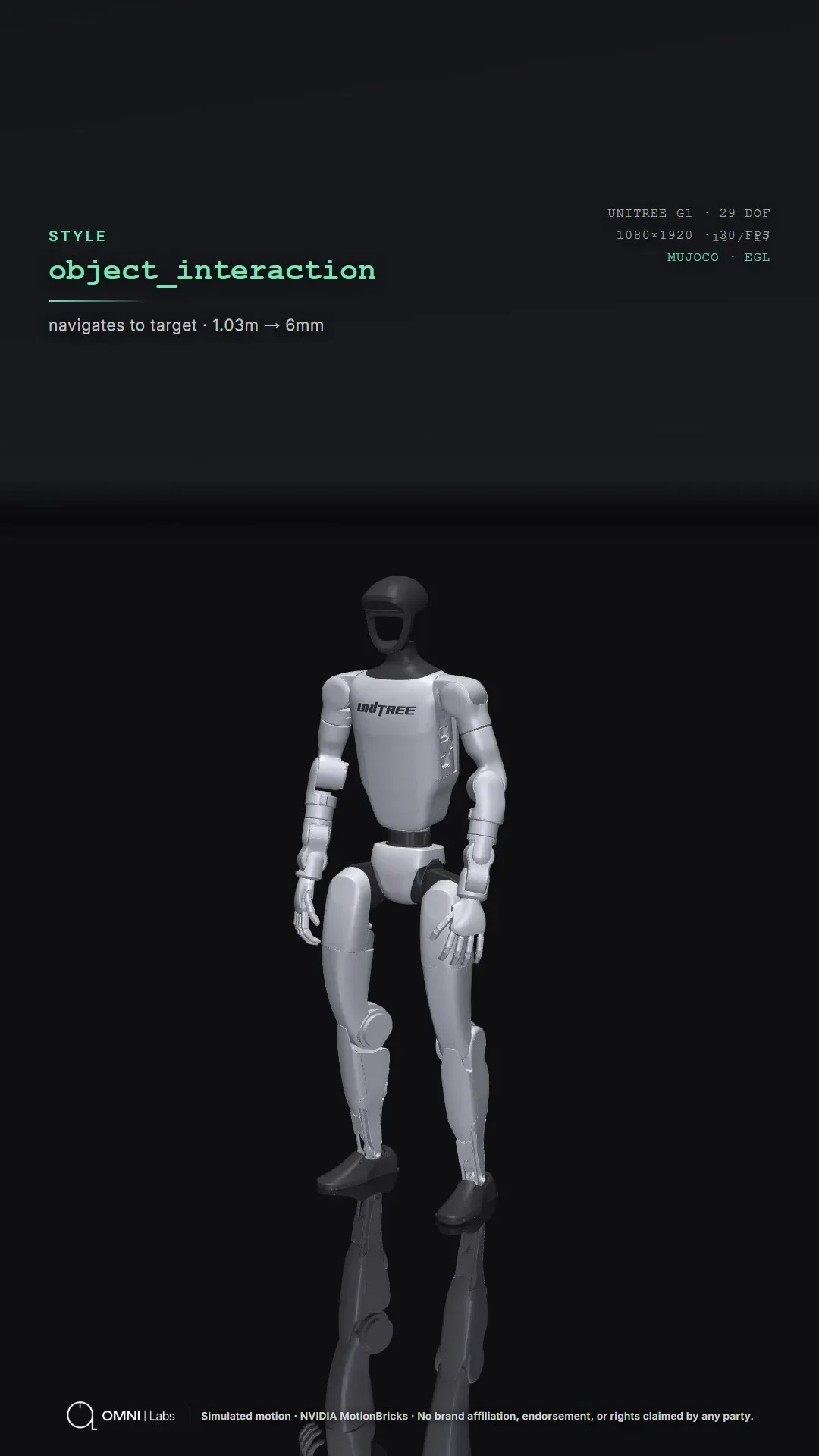
The final stage of the export runbook addresses video rendering. When generating preview MP4 clips via offscreen EGL pipelines piped into ffmpeg, software wrappers frequently confirm valid video headers, standard resolutions, and non-zero byte counts on files where the camera is pointed into empty space or where the character is collapsed.
Our studio mandates pulling a physical frame from the generated MP4 and inspecting its visual contents. An automated test script extracts a frame at midpoint, verifies that the subject bounding box occupies expected frame percentages, and checks that offscreen lighting shaders compiled cleanly. Automated pipelines must never confuse successful file creation with successful creative generation.
By layering structural re-import checks, channel variance analysis, calibrated kinematic thresholds, and visual ground-truth audits, our studio guarantees that headless 3D motion pipelines deliver production-ready assets without human babysitting.
Related

FastH3 Omni: Identity-Locked Persona Video on a Local GPU
FastH3 replaced WanGP Ref2VA on our local 16 GB workstation: render times dropped from 32 minutes to 5 minutes, dialogue followed the script, and 1088×1920 rendered direct.

Transitions in an AI-Edited Film: What Works, What Throws
Match cuts, hard cuts, why built-in shaders throw, and when to cut on the beat: technical rules for compositing AI commercial films in Remotion.

How an AI Ad Film Gets Made: The Studio Workflow
From story sign-off to decoupage lint and Remotion composites, no money enters before the story passes. How our studio pipeline structures eight gates.