Curved Label Warping Math: Visible Chords and 2D Planar Shear
Wrapping labels with 3D modifiers introduces asymmetric twisting and excessive curvature. Closed-form 2D shear and visible chord math preserve optical realism.
Key takeaways
- Applying 2D arc-text to cylindrical packaging fails in 3D modeling modifiers due to asymmetric spline collapse.
- Over 8 Blender attempts using Simple Deform Bend and Curve modifiers produced diagonal twisting and over-wrapping.
- Closed-form per-column parabolic shear guarantees mathematically perfect left-right curvature symmetry.
- Camera optics capture the front-face visible chord rather than wrap arc-length, requiring arcsine trigonometry.
- Multi-weight typography must be rendered on a shared baseline and composited into a single bitmap before warping.
The failure of 3D modifiers on planar typography
When graphic artists and packaging engineers need to apply curved typography or sticker branding across cylindrical products—such as aluminum beverage cans, cosmetic spray bottles, or perfume tubes—their default instinct is to load the typography vector into a full 3D software suite like Blender. The standard assumption is that a 3D modeling engine is naturally equipped to bend flat text around curved geometry. In production reality, applying 3D procedural deformation modifiers to 2D typographic strings frequently produces severe geometric corruption.
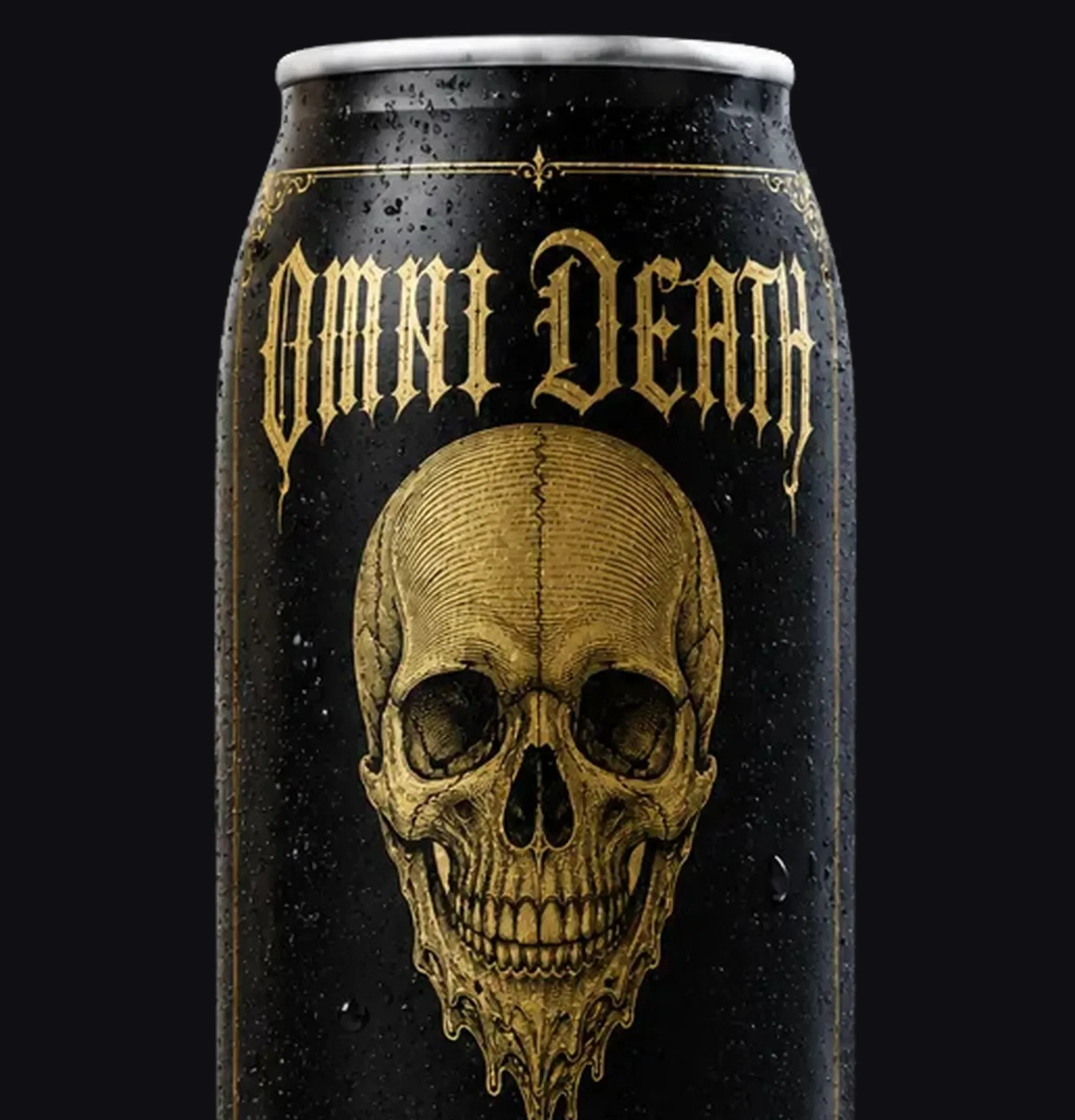
During our internal packaging pipeline development on 2026-06-15, our engineering team spent over 8 separate Blender attempts attempting to achieve a clean, symmetric smile arc across a long brand slogan for our studio beverage can assets. Every attempt utilizing Blender's Simple Deform Bend modifier or Curve modifier failed. The Simple Deform Bend modifier operates by wrapping geometry around a local axis, but when applied to elongated horizontal text, the algorithm wraps text past 180 degrees, causing the letters at the extremities to compress and curl inward. When the team switched to a Curve modifier attached to a poly spline curve, the modifier collapsed the deformation along a diagonal axis, twisting the typographic baseline asymmetrically. Chasing symmetric curves through 3D modifiers wasted hours of technical artist time.
Closed-form parabolic shear in 2D space
Following repeated 3D modifier failures, our executive producer halted the 3D experiments and instituted a fundamental engineering principle: when a visual effect is fundamentally planar, engineering teams must not reach for a 3D engine without first verifying the true dimensionality of the target. A label sticker applied to a product packshot is viewed from a fixed camera perspective; the distortion is an optical projection problem in 2D image coordinates, not a complex volumetric deformation. Treating 2D typography as 3D geometry requires dense mesh subdivision to prevent facet creasing along curved edges, inflating polygon counts for what is essentially a flat decal.
To solve the curvature cleanly, our technical team authored a standalone 2D script utilizing Python Imaging Library (PIL). Instead of bending polygons in 3D space, the script executes a closed-form per-column parabolic vertical shear directly on the rasterized pixel grid. For each vertical column of pixels across the label width, the vertical displacement (sag) is calculated analytically using the formula sag equals R times the difference between cosine of theta and cosine of half the total arc angle. Because this displacement is derived from an analytical trigonometric function evaluated relative to the label centerline, the resulting curve is symmetric by mathematical construction. Left-right baseline drift is completely eliminated, yielding an immaculate curved smile line in milliseconds without adding a single polygon to the scene.
Visible chord trigonometry versus wrap arc-length
Even after establishing a reliable 2D shearing function, engineers frequently stumble into a secondary mathematical trap: selecting the wrong metric for curvature angle. When designers calculate how much a label should curve across a cylinder, their intuitive approach is to use the wrap arc-length formula, dividing the graphic width by the cylinder diameter. However, when our pipeline initially applied wrap arc-length mathematics, the resulting curvature was vastly exaggerated, wrapping the graphic to an angle of 320 degrees so that it resembled a circular fishbowl rather than a commercial product can.
A camera looking at a physical cylinder in perspective or orthographic view does not see the surface arc-length wrapped along the cylinder's circumference; it sees the front-face visible chord. When observers view a cylinder from standard camera distances, the lateral edges undergo natural foreshortening governed by perspective projection. To match optical reality, the subtended viewing angle must be calculated using visible chord trigonometry: 2 * asin(visible_width / diameter). This formula produces a gentle, natural curvature that accurately reflects what human eyes and studio camera lenses observe when viewing a physical aluminum container. Calculating curvature from visible chord geometry restores realistic perspective compression without distorting legibility.
Verifying curvature symmetry through vertex profiles
A major operational hazard in packaging visualization is trusting visual symmetry on downscaled viewport previews. During our initial 3D modifier trials, thumbnail previews displayed in Blender's user interface gave the deceptive illusion that the bent text was roughly level. Because downscaled previews compress subtle pixel offsets, human operators cannot reliably distinguish between a genuine symmetric arc and a skewed diagonal baseline with the naked eye.
To establish absolute quality assurance, our pipeline instituted an automated numerical profile check. Rather than inspecting low-resolution preview renders, an automated diagnostic script extracts the geometry's coordinates, binning vertices along the horizontal X-axis and computing the mean vertical Z-position for each bin. Plotting this bin-by-X mean-Z profile instantly exposes the true nature of the deformation. An asymmetric, diagonally collapsed curve reveals a monotonic upward or downward trend across the profile, whereas a valid cylindrical bend produces a perfectly symmetric, U-shaped parabolic curve. Automating vertex profile validation eliminates human visual guesswork and prevents flawed geometric assets from reaching client review.
Shared baselines for mixed typography weights
Real-world commercial packaging labels rarely consist of a single uniform typeface. A typical luxury or consumer label combines multiple typographic weights on a single continuous line, such as a lightweight Roman brand slogan followed immediately by a bold callout or legal URL. In naive automation setups, scripts attempt to render each typographic segment independently and apply the cylindrical warp to each text block separately. This piecemeal approach invariably causes severe alignment failure, because differences in segment widths produce mismatched curvature radii.
Our production guidelines mandate that mixed-weight typography must be composited before executing the warp. In our studio tooling, individual text segments are rendered using their respective font weights on a shared, locked typographical baseline and concatenated horizontally into a unified bitmap. The closed-form parabolic shear is then applied in a single pass across the entire pre-composited strip. Furthermore, our protocols require that white emissive text with alpha transparency must always be previewed against a dark or photographic background, preventing invisible alpha dropouts during final composite assembly. This comprehensive 2D mathematical framework guarantees consistent, production-hardened results across every commercial packshot. By unifying 2D mathematical shear with rigorous preflight discipline, OMNI Studio delivers flawless cylindrical packaging visuals across all commercial campaigns.
Related

FastH3 Omni: Identity-Locked Persona Video on a Local GPU
FastH3 replaced WanGP Ref2VA on our local 16 GB workstation: render times dropped from 32 minutes to 5 minutes, dialogue followed the script, and 1088×1920 rendered direct.

Transitions in an AI-Edited Film: What Works, What Throws
Match cuts, hard cuts, why built-in shaders throw, and when to cut on the beat: technical rules for compositing AI commercial films in Remotion.

How an AI Ad Film Gets Made: The Studio Workflow
From story sign-off to decoupage lint and Remotion composites, no money enters before the story passes. How our studio pipeline structures eight gates.