AI Mesh Intake in Blender: Repairing Raw 3D Generator Geometry
Raw generative 3D models output non-manifold edges, flipped normals, and chaotic topologies. Establishing an intake gate in Blender standardizes assets before runtime export.
Key takeaways
- Raw outputs from generative 3D models like TripoSR are geometry candidates, never production-ready game assets.
- TripoSplat point clouds serve strictly as appearance references, not as importable polygon meshes.
- Blender functions as the sole authoritative production gate for transform normalization, topology repair, and GLB export.
- Automated repair passes eliminate non-manifold edges, degenerate zero-area faces, and inverted normals.
- Subprocess exit code 0 does not guarantee success; exported GLBs must be verified in an isolated secondary process.
The geometry candidate doctrine
The proliferation of generative 3D foundation models has created widespread confusion among game developers and visual effects studios regarding the production readiness of AI outputs. Marketing demonstrations frequently showcase single-image-to-3D tools generating textured meshes in seconds, prompting teams to assume these assets can be piped directly into runtime game engines like Godot or Unreal Engine. In production reality, importing raw generative meshes directly into an interactive game environment is a recipe for engine crashes, shadow corruption, and unplayable frame rates.
In the OMNI Studio 3D asset architecture, our foundation rule establishes that TripoSR output is strictly a geometry candidate, not a final game asset. Foundation models reconstruct 3D volumes by predicting implicit neural representations and extracting isosurfaces through algorithms like Marching Cubes. While this pipeline produces an impressive approximate volumetric silhouette, the resulting polygonal mesh is completely unstructured: edge loops do not follow anatomical stress lines, polygon densities are erratic, and hidden rear surfaces suffer from profound hallucination. Furthermore, Marching Cubes algorithms operate on voxelized scalar fields that inherently generate dense clusters of microscopic, zero-volume geometric artifacts along thin boundaries. Treating generative output as an unvetted draft candidate rather than a finished delivery is the necessary first step toward professional pipeline hygiene.
Separating geometric candidates from splat appearances
A critical architectural discipline in modern 3D asset pipelines involves maintaining a strict separation between volumetric geometry and photoreal surface appearance. When processing reference photography through multi-modal AI pipelines, our studio deploys two distinct generative models in parallel: TripoSR for polygon reconstruction and TripoSplat for Gaussian splat point-cloud generation.
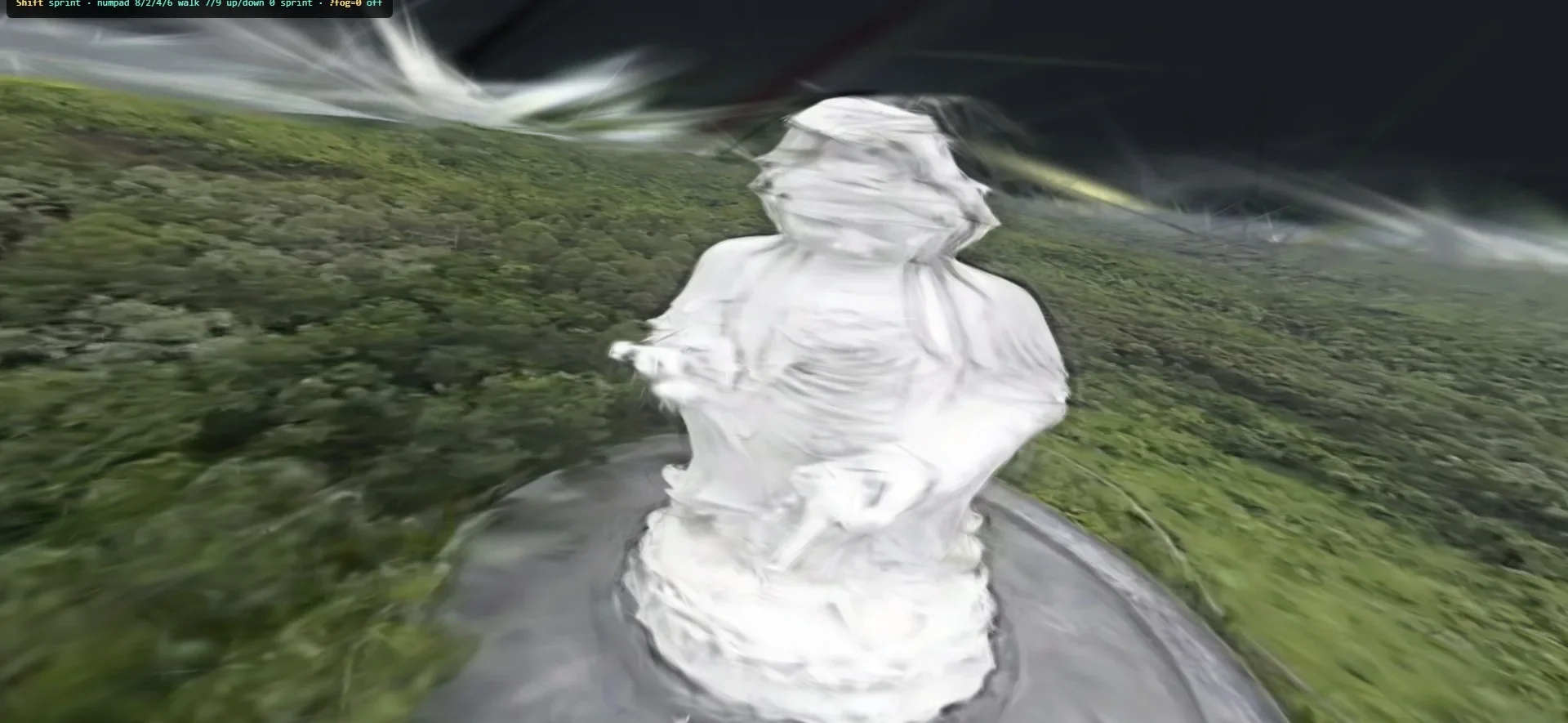
Under our pipeline contract, TripoSplat output is classified exclusively as an appearance reference, not as a polygon mesh. Gaussian splats excel at capturing micro-reflections, complex anisotropic lighting, and sub-millimeter surface textures, but they lack discrete polygonal topology and cannot be deformed by standard skeletal animation rigs. TripoSR provides the raw geometric hull, while TripoSplat provides the photoreal ground truth for surface shader calibration. In our production file system, the pipeline automatically routes outputs into segregated directories: assets/_generated/triposr/ and assets/_generated/triposplat/, ensuring that raw point-cloud files are never mistakenly piped into polygon mesh importers. Merging or confusing these modalities results in bloated file sizes and broken shading. Blender acts as the dedicated integration environment where the polygonal geometry candidate is cleaned, unwrapped, and aligned with the visual appearance references before any runtime handoff.
Automated geometry repair and manifold verification
Before an AI-generated geometry candidate can undergo retopology or material assignment, it must pass through an intensive automated geometry repair protocol inside Blender. Meshes extracted by Marching Cubes algorithms invariably harbor severe topological anomalies that crash downstream Boolean operations and corrupt subdivision surfaces.
Our automated Python intake script inspects every imported mesh object across an exhaustive failure checklist:
- Non-manifold geometry: detecting and splitting T-junctions, open boundary edges, and shared non-manifold vertices.
- Degenerate faces: identifying and removing zero-area triangles, collapsed slivers, and colinear vertex clusters.
- Inverted face normals: recalculating surface normals outward and eliminating internal intersecting face partitions.
- Duplicate vertices: welding coincident vertices within an epsilon threshold without altering surface contours.
- Disconnected islands: pruning floating geometric debris and internal structural noise generated during extraction.
Executing this automated repair pass stabilizes the mesh topology, ensuring that subsequent operations—such as UV unwrapping, baking ambient occlusion maps, or generating level-of-detail (LOD) collision hulls—execute without numerical exceptions.
Transform normalization and budgetary gating
Once geometric defects are eliminated, the intake pipeline enforces strict dimensional normalization. Generative AI tools operate in arbitrary, unscaled normalized coordinate spaces, outputting assets that may appear microscopic or gargantuan when imported into a standard scene. Our Blender intake automation enforces the metric system across all scenes, automatically measuring the mesh's axis-aligned bounding box and scaling the object to match specified real-world dimensions in meters. Furthermore, the script resets the object's origin and pivot point according to functional requirements, ensuring props rest cleanly on ground planes and vehicles sit accurately on axle centers.
The intake script then evaluates the asset against hard project budgets defined in the job manifest. In our automated build_asset.py runner, every candidate must clear explicit verification gates: confirming that valid mesh objects are present, verifying that total triangle counts do not exceed the lod0 budget, asserting that material slots do not exceed threshold limits, and checking that all three bounding dimensions are strictly non-zero. For instance, in our vehicle and prop pipeline, if a raw mesh exceeds the allocated lod0 triangle budget or exceeds allowed material slots, the asset build script rejects the candidate immediately and logs an actionable failure report. Our executive producer mandated that failing assets must never silently propagate through the pipeline.
The false-positive export trap and isolated validation
The final and most dangerous trap in automated 3D pipelines is relying on operating system exit codes to verify asset delivery. In headless automation scripts executed via Blender background processes, the command line interface frequently returns a successful exit code of 0 even when file serialization is incomplete, textures fail to embed, or mesh data blocks are corrupted during glTF export. Assuming that exit code 0 proves asset viability is a common fallacy that results in empty files landing in runtime directories.
To ensure absolute delivery integrity, OMNI Studio enforces an immutable post-export verification gate. Every exported canonical GLB file must be verified by snippets/06_verify_glb.py executed in a completely separate, clean Blender process. The verification script initializes with an empty factory scene, re-imports the exported GLB, and programmatically queries the scene database: counting loop triangles, checking material assignments, and validating bounding box dimensions. If the file contains zero meshes or fails triangle count assertions, the script exits with code 1, preventing corrupted assets from reaching Godot runtime directories. Running this verification pass in a decoupled subprocess guarantees that memory leaks, lingering global variables, or residual scene state from earlier processing steps cannot mask export failures. If an exported mesh exhibits corrupt UV mapping coordinates or missing vertex color channels, the isolated validator intercepts the defect before runtime packaging begins. By combining rigorous intake repair with isolated delivery verification, OMNI Studio transforms volatile generative meshes into rock-solid production assets.
Related

FastH3 Omni: Identity-Locked Persona Video on a Local GPU
FastH3 replaced WanGP Ref2VA on our local 16 GB workstation: render times dropped from 32 minutes to 5 minutes, dialogue followed the script, and 1088×1920 rendered direct.

Transitions in an AI-Edited Film: What Works, What Throws
Match cuts, hard cuts, why built-in shaders throw, and when to cut on the beat: technical rules for compositing AI commercial films in Remotion.

How an AI Ad Film Gets Made: The Studio Workflow
From story sign-off to decoupage lint and Remotion composites, no money enters before the story passes. How our studio pipeline structures eight gates.