
When Identity Isn't the Face: Locking Skin Patterns Across Shots
A vitiligo pattern that moves is the same failure as a different face: identity anchors, mark-side rules, masked editing, and expression set audits.
Key takeaways
- Distinct anatomical features like vitiligo patch layouts must be tracked with the same rigor as facial geometry.
- Wardrobe styling must never cover designated physical identity anchors, regardless of contemporary fashion trends.
- Reference banks require diverse expression plates; unreferenced emotions force diffusion models to hallucinate faces.
- The mark-side law dictates that opposite facial profiles must explicitly declare cheek surfaces clean to prevent mirroring.
- Maskless background edits redraw human subjects; preserving pixel-identical identity requires hard person masking.
Anatomical skin patterns as non-facial identity anchors
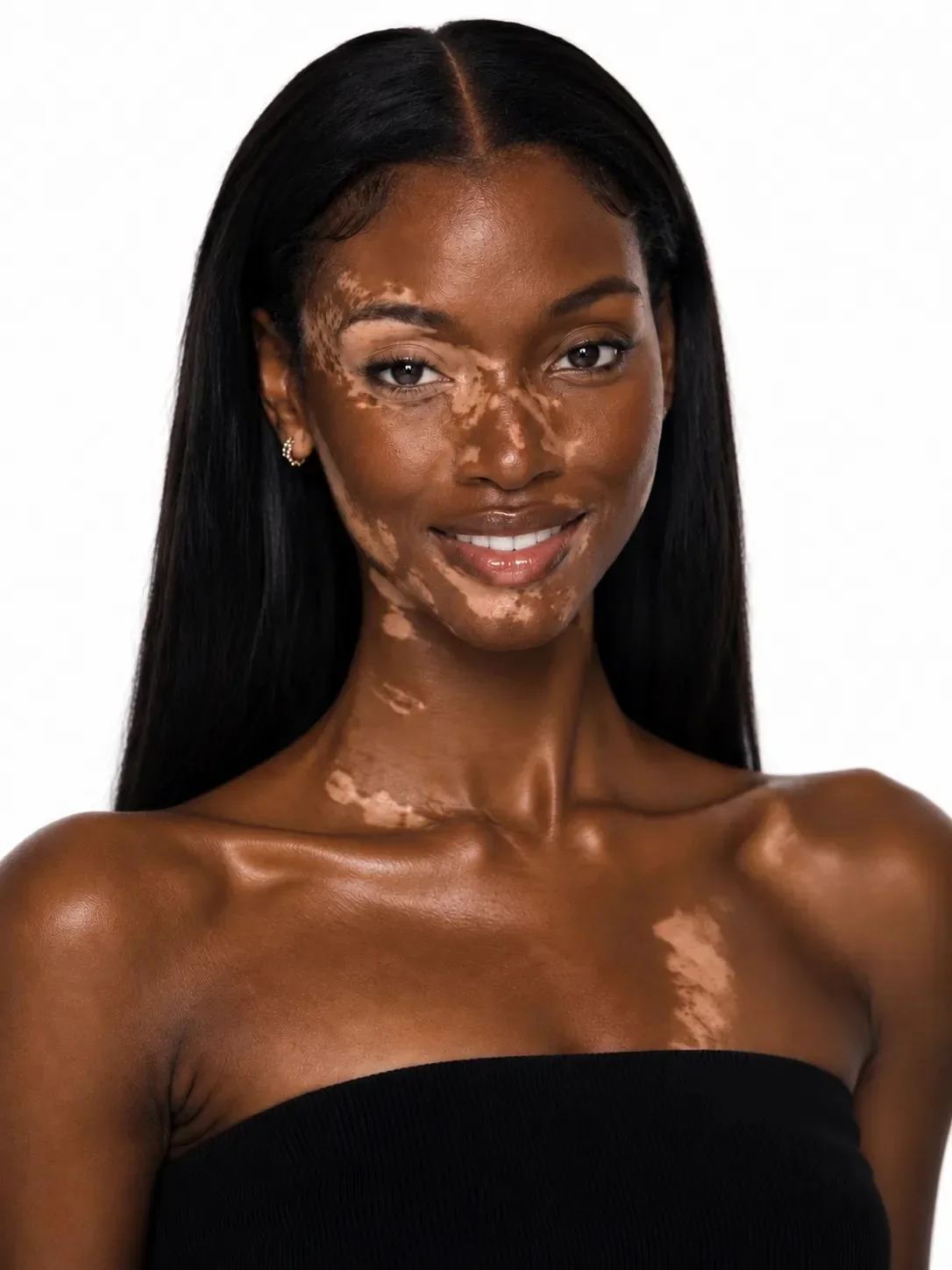
For one roster persona, the identity lock is her vitiligo patch pattern, not her face. A patch that moves, changes shape or disappears is the same failure as a different face, and we check the patch the way we check a face.
In synthetic talent management, identity verification often focuses exclusively on facial recognition metrics—such as inter-pupillary distance, jaw curvature, and nose bridge angles. However, when representing models with distinctive dermatological features, identity continuity depends entirely on body-wide consistency. For our talent Donna Vaelith, unique vitiligo pigmentation patches represent her primary visual signature. If a generative model shifts a pigmentation boundary across her shoulder, alters the contour of a patch, or erases it entirely, the take is rejected as an unrecoverable identity collapse.
Our styling rule never covers the anchor. A sleeve over a vitiligo patch that must stay visible is a rule break, and the trend research cannot override it.
Editorial styling must yield to biological authenticity. In our wardrobe planning pipelines, external fashion research frequently suggests long-sleeve knitwear, layered shawls, or high-collar tailoring. However, if a proposed garment occludes Donna's signature pigmentation anchors, the look is flagged as an invalid rule violation. Brand alignment and character recognition require identity features to remain clearly legible across all commercial assets.
Expression reference banks and emotional hallucination risks
Her reference set had nine frames and none showed an expression. Asking the model for a smile meant it invented one, because there was no reference to copy. On 2026-09-23 we added smile frames to the set by hand, and they are on the roster as portrait-11 to portrait-14.
Generative diffusion models cannot synthesize emotional expressions without grounding reference data. During early production trials, Donna's core reference library contained only nine frames, all captured in rigid neutral expressions. When narrative storyboards called for an open smile, the image generator was forced to invent facial muscle deformation out of statistical latent averages. Without reference data to guide the smile, the model substituted generic stock features, breaking Donna's facial identity completely. On 2026-09-23, our photography pipeline manually appended dedicated smiling portraits—indexed as portrait-11 through portrait-14—resolving the emotional gap.