
Editorial Shot Distance in AI Lookbooks: The 210-Pixel Limit
When full-body location staging reduces facial raster widths below 210 pixels, ocular anatomy collapses. How we curated Lookbook Vol. 02.
Key takeaways
- In wide environmental location frames, synthetic model faces occupy merely 130 to 210 pixels, causing iris and ocular geometry to collapse.
- Production guidelines for Lookbook Vol. 02 banned full-length location frames, restricting publication strictly to close and medium distances.
- Across 12 featured talents in The Native Eccentrics, 4 talents yielded zero location frames capable of passing publication QA.
- For talents lacking viable location frames, all five feature slots were successfully backfilled using controlled studio portrait captures.
- High-end print lookbooks require master rendering directly from raw PNG assets rather than downstream web-compressed WebP files.
The 210-pixel resolution threshold and anatomical collapse
High-fashion lookbooks demand an uncompromising standard of physical fidelity. In luxury print publications, readers scrutinize the subtle interplay of light across skin pores, delicate fabric weaving, and the crisp clarity of ocular anatomy. In synthetic editorial photography, achieving this fidelity depends entirely on the physical pixel allocation granted to the character's face. While close-up beauty headshots allocate millions of pixels to facial features, pulling the camera back into an expansive environmental wide shot creates an immediate quality cliff.
During quality audits for Lookbook Vol. 02 (The Native Eccentrics) on 2026-10-16, our production team identified severe structural degradation across wide environmental captures. In full-length location shots where the talent appears head-to-toe within complex architectural scenery, the character's face occupied only 130 to 210 pixels in width. Within this constrained spatial footprint, diffusion attention blocks lack sufficient latent resolution to resolve intricate anatomical geometry.
When face width drops below 210 pixels, eye geometry collapses into waxy artifacts. The pupils lose circular definition, eyelids fuse into undifferentiated bands of skin tone, and fine eyelashes blur into muddy smudges. While the wide frame may appear striking when viewed as a tiny mobile preview, inspecting the raw master file at print scale immediately betrays its synthetic origin.
Curatorial intervention across Lookbook Vol. 02
Recognizing that upscaling algorithms cannot invent authentic anatomical detail from a 130-pixel patch, the studio established a strict publication rule: full-length location frames were formally barred from the publication layout. The issue plan was restructured to permit location editorials exclusively at close and medium shot distances, where the character's face remains large enough to maintain sharp ocular definition.
Enforcing this quality gate severely impacted the yield of outdoor location photography. Across the 12 featured talents comprising The Native Eccentrics, exactly four talents—Augustin Ferreira, Priya Nair, Bruno Kessler, and Seo-Yeon Kang—produced zero location editorials capable of meeting the 210-pixel resolution threshold. Every outdoor frame captured for these four personas placed the camera too far away, causing their facial features to degrade into mush.
| Talent Name | Roster Category | Surviving Location Editorials | Studio Fallback Slots Used | Editorial Layout Composition |
|---|---|---|---|---|
| Noa Ben David | Native Eccentrics | 3 frames (ed03, ed04, ed05) | 2 studio portraits | Balanced location and studio mix |
| Ife Adebayo | Native Eccentrics | 2 frames (ed05, ed04) | 3 studio portraits | Medium location with studio backup |
| Margit Holm | Native Eccentrics | 1 frame (ed05) | 4 studio portraits | Cover talent; heavily studio-anchored |
| Samir Haddad | Native Eccentrics | 1 frame (ed05) | 4 studio portraits | Single barbershop interior with studio |
| Augustin Ferreira | Native Eccentrics | 0 frames | 5 studio portraits | Complete studio fallback; zero location |
| Priya Nair | Native Eccentrics | 0 frames | 5 studio portraits | Complete studio fallback; zero location |
| Bruno Kessler | Native Eccentrics | 0 frames | 5 studio portraits | Complete studio fallback; zero location |
| Seo-Yeon Kang | Native Eccentrics | 0 frames | 5 studio portraits | Complete studio fallback; zero location |
Rather than compromising print standards by publishing soft location captures, the build pipeline executed an automated fallback protocol. For any talent lacking viable environmental imagery, the layout engine backfilled all five feature photo slots using controlled studio portraits.
Studio portrait fallbacks and controlled lighting arrays
The studio fallback protocol relied on a standardized suite of high-resolution portraits captured under clean key-and-fill lighting. Because these frames frame the subject from the chest upward, the face occupies thousands of pixels, providing pristine skin textures, distinct iris rings, and sharp dental anatomy.
When a talent's location yield collapsed to zero, the layout system populated the five editorial slots from an established sequence of studio assets: - `portrait_3q_right`: A three-quarter perspective highlighting facial structure against neutral studio cycloramas. - `portrait_3q_left`: The opposing three-quarter angle, establishing structural consistency across bilateral profiles. - `portrait_side_right`: A pure profile view demonstrating clean jawline definition and hair geometry. - `expr_sad`: A subdued, contemplative expression showcasing subtle muscular relaxation across the brow. - `expr_angry`: A commanding, stern gaze demonstrating high-tension facial articulation without anatomical distortion.
By leveraging this controlled studio repertoire, talents who failed the location distance threshold retained immaculate visual presence within the book, transforming a generative limitation into a deliberate, high-end studio aesthetic.
Variable location yields across the eccentric roster
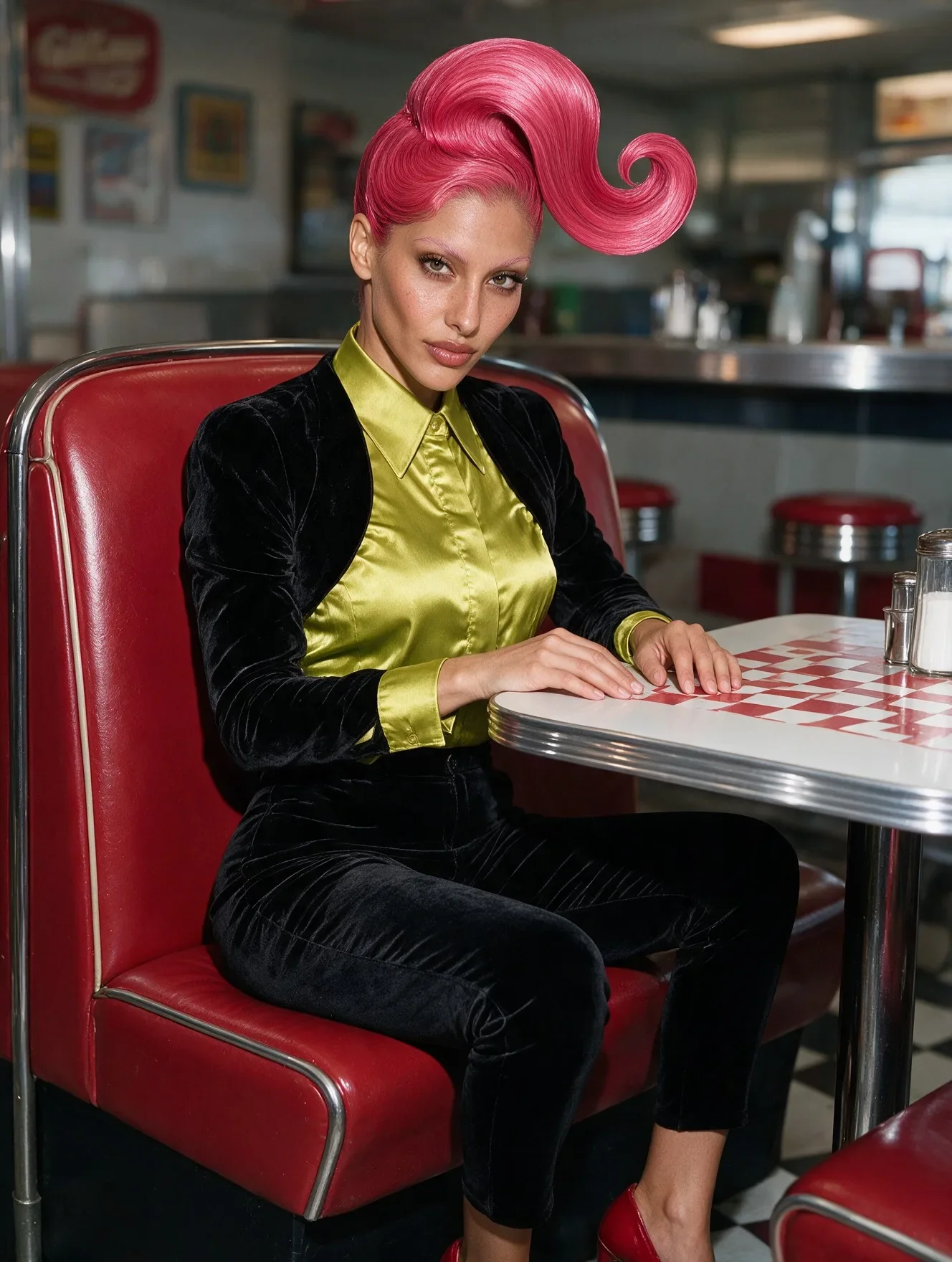
For the remaining talents on the roster, location yields varied depending on camera staging. Talents staged in tighter urban environments, such as retro diners or compact barbershops, yielded frames that cleared the resolution gate. Noa Ben David achieved the highest location yield among the group, retaining three approved location frames (ed03, ed04, and ed05). Her closer camera placements preserved crisp facial definition against textured market and diner backdrops.
Ife Adebayo followed with two approved location frames (ed05 and ed04), while six talents—including Margit Holm, Samir Haddad, Lucia Ortega, Liang Wei, Caio Silva, and Desmond Reid—retained exactly one viable location editorial each. For Margit Holm, her single surviving frame was ed05, an architectural capture set in a desert pavilion. Her ed04 frame in an art gallery served as the issue cover, but required aggressive contrast handling and text shielding to preserve print integrity.
This distribution demonstrated that environmental complexity is not inherently fatal to AI photography; rather, the fatal flaw is camera distance. When creative directors stage environmental scenes, the subject must remain in the mid-ground or foreground, allowing the location to function as a surrounding frame rather than swallowing the character in an extreme wide shot.
Eight-page pagination architecture and raw PNG delivery
Lookbook Vol. 02 is engineered as a physical luxury monograph. The publication allocates an extensive 8-page feature spread per talent across the 12 featured personas, totaling 96 core editorial pages. Each 8-page chapter balances expansive photographic layouts with technical character documentation.
The final page of each talent chapter features a rigorous 6-frame emotional range grid. This grid exhibits the model across standardized emotional states, verifying facial consistency across portrait_front_neutral, expr_confident, expr_happy, expr_surprised, expr_determined, and expr_worried. Inspecting this grid confirms that the model's underlying bone structure remains immutable across emotional shifts.
Crucially, the entire print compilation pipeline ingests uncompressed raw PNG files directly from generation directories (`tools/chatgpt-pipeline/outputs/<id>_v1/` and `tools/concept-campaigns/magnific/outputs/absurd_talents_editorial_v1/`). Web-optimized WebP files published to the public marketing site introduce 8-bit chroma sub-sampling and compression artifacts that ruin high-DPI press output. By assembling layouts exclusively from native PNG masters, Lookbook Vol. 02 preserves every micro-detail captured during initial synthesis.