Building a Reference Set for a Synthetic Model: Expressions Matter
A 9-frame reference set without expression frames invented a smile when prompted. How we audit reference grids, manage variants, and lock neutral faces.
OMNI LabsUpdated
Key takeaways
A 9-frame reference set lacking expression frames hallucinated an inconsistent smile when an emotional prompt was requested.
Across our ten roster characters audited on 22 September 2026, reference sets ranged from 12 to 21 frames.
To prevent full-range sets from drifting toward smiles in neutral scenes, prompts must specify resting face, mouth closed, no smile.
Restyling hair or wardrobe should be managed through named variants with 6 to 7 angles rather than registering duplicate characters.
Reference pickers resolve variants strictly by their assigned name, requiring immediate renaming of the default variant-1 label.
The live roster reference audit
We built contact sheets of the actual grid thumbnails for every live set on 22 September 2026, with zero generation. Ten characters ranged from 12 to 21 frames: 21, 19, 18, 17, 16, 15, 15, 14, 13 and 12.
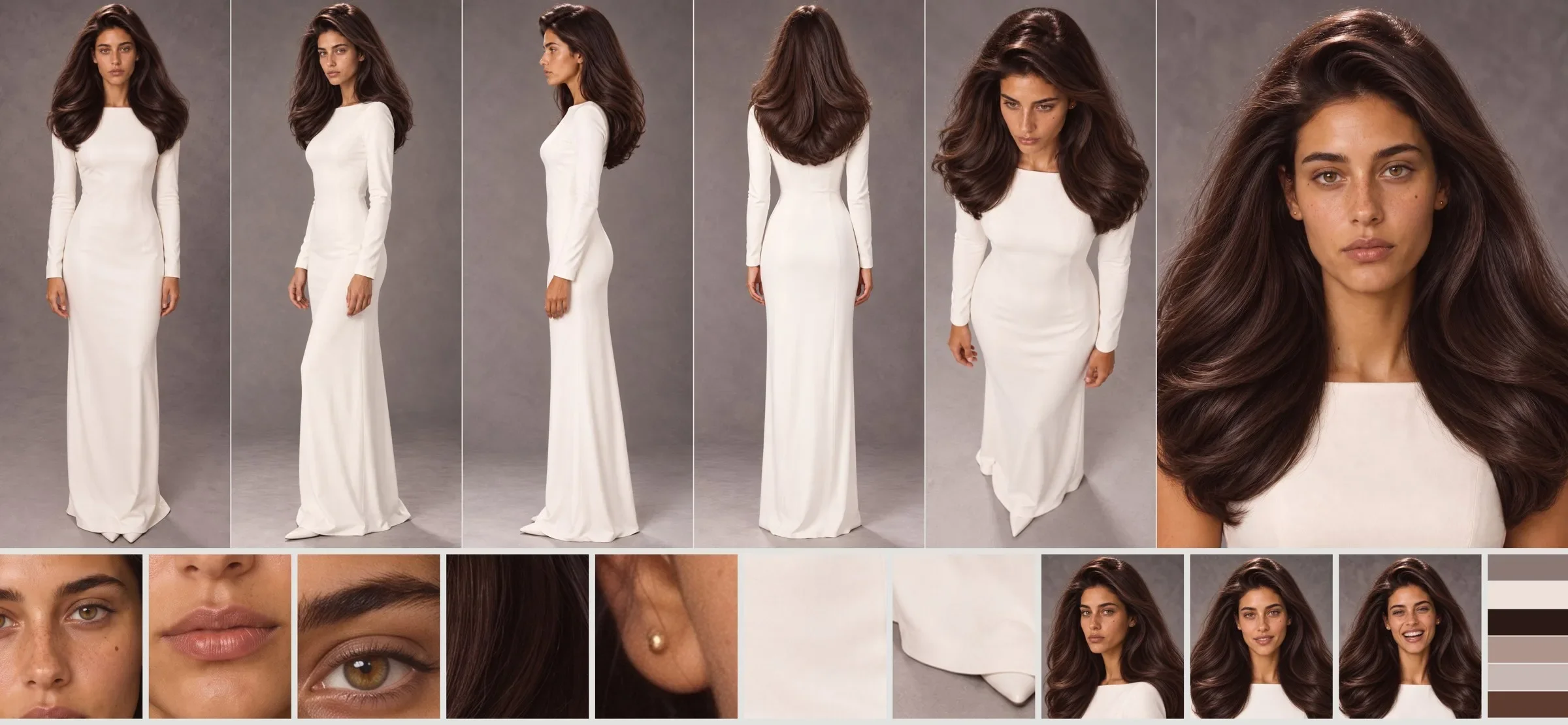
Building reference datasets for synthetic talent is often treated as a volume game, where artists dump twenty loosely related images into a character bucket and assume the model extracts facial identity. In practice, image generation models learn both identity and expression from the reference grid.
Full: multiple emotional extremes and candid micro-expressions
Set #C
18
Several smiles plus open mouth with teeth
Set #D
16
One smile and one shock frame
Set #E
13
Smiles present
Set #F
12
One smile frame only
Ten characters audited on 22 September 2026. Set sizes: 21, 19, 18, 17, 16, 15, 15, 14, 13 and 12 frames.
The MCP cannot read set sizes or variants. The count comes from the web UI through a recon script that scrolls the lazy grid to the bottom. Auditing the visual ground truth on disk reveals the exact boundaries of what each character set can deliver.
Automating the discovery of grid frames prevents creative directors from deploying models into scenes they cannot physically render. When a pipeline relies on blind assumptions about reference depth, expensive generation cycles fail silently.
Why sets without smiles invent them
Some sets are thinner. A 12-frame set holds one smile, a 13-frame set holds smiles, and a 16-frame set holds a smile and a shock frame. Check the sheet before you ask a set for an expression it may not hold.
A 9-frame set with no expression frames invented a smile when asked for one. Smile frames were added by hand on 23 September 2026.
When a reference set contains only severe, neutral, or passport-style portraits, the diffusion network possesses zero conditioning data for the talent's teeth, mouth corners, or cheek muscle movement. When the prompt subsequently demands a smile, the model is forced to hallucinate mouth geometry from its general training weights. The face distorts, dental features belong to a different person, and character identity shatters.
An attribute the Original's frames never show, such as an open mouth, hands or a profile, needs teaching somewhere in the set. It is not a reason to make a second character.
Instead of abandoning an established character when a missing attribute is discovered, retrofitting the reference set stabilizes the persona. Adding carefully supervised expression frames directly into the master grid repairs the deficiency permanently.
The neutral drift trap and explicit prompting
Three sets hold a full expression range: smile, laugh, shock, wink, eyes-closed or tongue-out. The 19-frame and 21-frame sets are among them. The 18-frame set holds several smiles plus an open mouth with teeth.
While rich expression diversity protects dramatic performance, it introduces a subtle counter-problem: neutral expression drift. On full-range sets a neutral shot can drift toward a smile, because the set teaches both. We state 'resting face, mouth closed, no smile' in the prompt rather than leaving it implicit.
When half the reference grid features animated grins or open mouths, the model assigns positive probability to smiling even when the prompt describes an ordinary conversation. Explicitly writing resting face locks the mouth geometry in serious or dramatic takes.
An 18-frame set with two to three smiles was judged low enough not to dominate neutral shots. That is a judgement, not a measured rate. If a neutral render starts grinning, the smile ratio is the first thing to check, and splitting the smiles into a variant is the fix.
Balancing smile ratios within the master set allows talent to transition seamlessly between emotional scenes without unwanted bleeding into dramatic moments.
When to build an expression variant
Do not build an expression variant for a character whose set already holds the frames. Check the contact sheet first.
Production teams frequently create unnecessary character duplicates. When a creative brief asks for a scene where a talent laughs or looks shocked, artists often rush to spin up a new reference model. This fractures identity management and clutters the asset library.
If the master set already contains frames depicting the required emotion, the base character model can execute the scene directly under proper prompt conditioning. Variants should be reserved for structural changes that conflict with the base set's global appearance.
Inspecting the contact sheet before launching variant workflows ensures that existing training data is fully utilized before introducing architectural complexity.
Structuring restyle variants with 6 to 7 angles
A haircut or wardrobe restyle belongs in a variant, not a second character. A portrait variant uses 6 to 7 angles: front, three-quarter left and right, profile left and right, back and a smile. Do not add standing or full-body frames to the variant, because they pull toward the old look.
When a narrative project requires a character to change hair color, cut their hair short, or wear an unvarying period uniform across twenty scenes, baking those modifications into a clean variant preserves facial bone structure. Using 6 to 7 tightly framed portrait angles gives the model comprehensive rotational understanding of the new hairstyle without diluting facial features.
Full-body or wide standing shots must never be uploaded into a restyle variant. Wide frames carry strong conditioning for old shoe styles, hem lengths, and bodily proportions, which will continually bleed into new generations.
Keeping restyle variants focused strictly on tight head and shoulder framing isolates the alteration cleanly from downstream wardrobe changes.
Variant selection mechanics and naming discipline
A variant is selected by its name in the reference picker, not by its library id. A new variant is named 'variant-1' by default, so we rename it straight away, because the name is what the next job uses.
In programmatic studio pipelines, tool integrations resolve character assets by text match in the user interface rather than database keys. If multiple talent entries maintain unrenamed default labels, automation scripts pick the wrong asset, generating scenes with mismatched wardrobes or outdated hair.
Renaming every variant immediately upon creation—using clear descriptors like 'bob-cut' or 'tuxedo-evening'—eliminates ambiguous asset calls. Systematic cataloging guarantees that downstream rendering queues pull the precise character version required by the decoupage plan.
Disciplined taxonomy transforms an unwieldy collection of experimental outputs into an industrial, production-ready virtual talent studio.